
Mind map
LAW AND JUSTICE
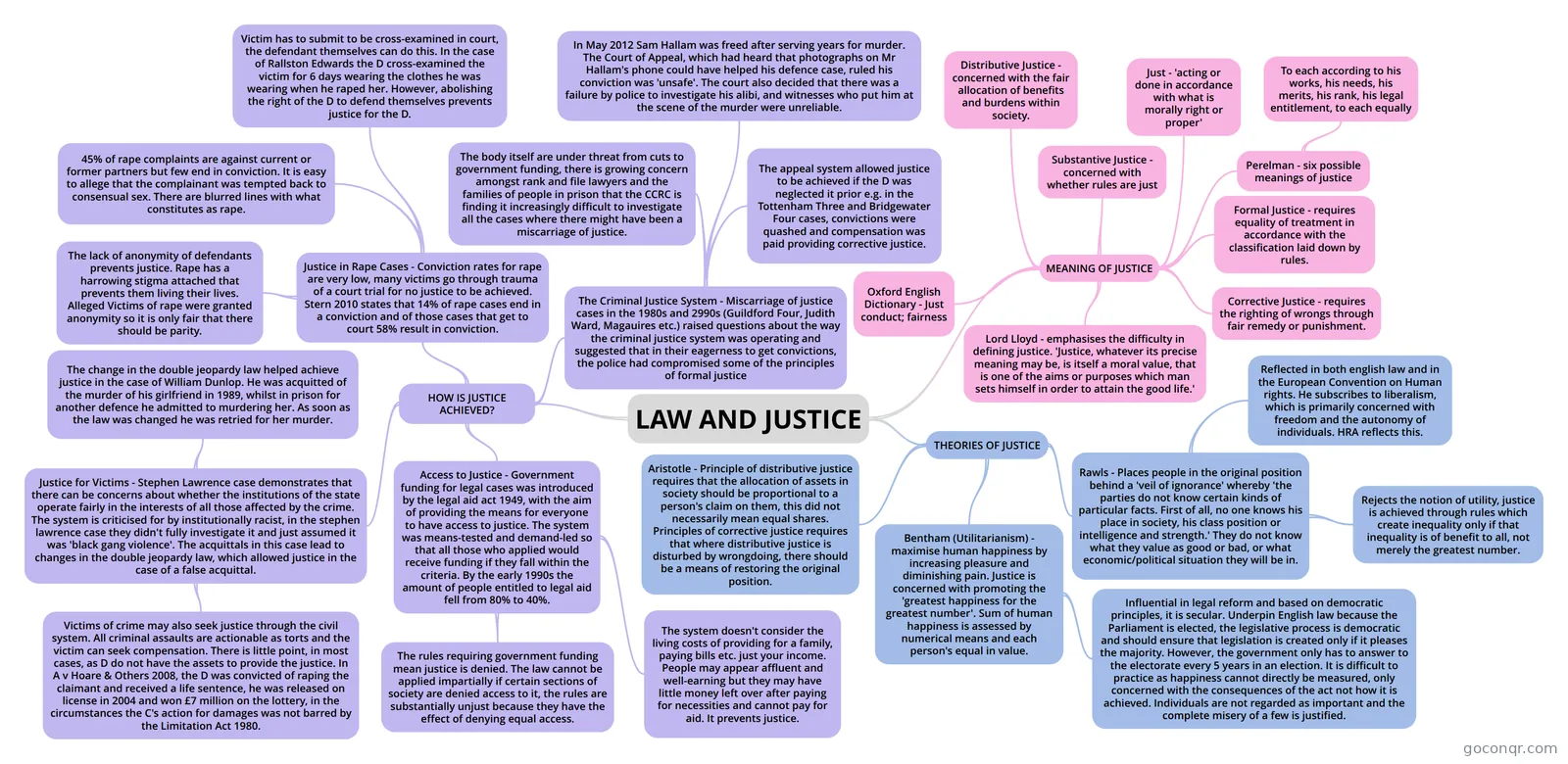
Mind map: Law and justice
Map content
LAW AND JUSTICE
MEANING OF JUSTICE
- Oxford English Dictionary - Just conduct; fairness
- Just - 'acting or done in accordance with what is morally right or proper'
- Lord Lloyd - emphasises the difficulty in defining justice. 'Justice, whatever its precise meaning may be, is itself a moral value, that is one of the aims or purposes which man sets himself in order to attain the good life.'
- Perelman - six possible meanings of justice
- To each according to his works, his needs, his merits, his rank, his legal entitlement, to each equally
- Formal Justice - requires equality of treatment in accordance with the classification laid down by rules.
- Substantive Justice - concerned with whether rules are just
- Distributive Justice - concerned with the fair allocation of benefits and burdens within society.
- Corrective Justice - requires the righting of wrongs through fair remedy or punishment.
THEORIES OF JUSTICE
- Aristotle - Principle of distributive justice requires that the allocation of assets in society should be proportional to a person's claim on them, this did not necessarily mean equal shares. Principles of corrective justice requires that where distributive justice is disturbed by wrongdoing, there should be a means of restoring the original position.
- Rawls - Places people in the original position behind a 'veil of ignorance' whereby 'the parties do not know certain kinds of particular facts. First of all, no one knows his place in society, his class position or intelligence and strength.' They do not know what they value as good or bad, or what economic/political situation they will be in.
- Reflected in both english law and in the European Convention on Human rights. He subscribes to liberalism, which is primarily concerned with freedom and the autonomy of individuals. HRA reflects this.
- Rejects the notion of utility, justice is achieved through rules which create inequality only if that inequality is of benefit to all, not merely the greatest number.
- Bentham (Utilitarianism) - maximise human happiness by increasing pleasure and diminishing pain. Justice is concerned with promoting the 'greatest happiness for the greatest number'. Sum of human happiness is assessed by numerical means and each person's equal in value.
- Influential in legal reform and based on democratic principles, it is secular. Underpin English law because the Parliament is elected, the legislative process is democratic and should ensure that legislation is created only if it pleases the majority. However, the government only has to answer to the electorate every 5 years in an election. It is difficult to practice as happiness cannot directly be measured, only concerned with the consequences of the act not how it is achieved. Individuals are not regarded as important and the complete misery of a few is justified.
HOW IS JUSTICE ACHIEVED?
- The Criminal Justice System - Miscarriage of justice cases in the 1980s and 2990s (Guildford Four, Judith Ward, Magauires etc.) raised questions about the way the criminal justice system was operating and suggested that in their eagerness to get convictions, the police had compromised some of the principles of formal justice
- The appeal system allowed justice to be achieved if the D was neglected it prior e.g. in the Tottenham Three and Bridgewater Four cases, convictions were quashed and compensation was paid providing corrective justice.
- In May 2012 Sam Hallam was freed after serving years for murder. The Court of Appeal, which had heard that photographs on Mr Hallam's phone could have helped his defence case, ruled his conviction was 'unsafe'. The court also decided that there was a failure by police to investigate his alibi, and witnesses who put him at the scene of the murder were unreliable.
- The body itself are under threat from cuts to government funding, there is growing concern amongst rank and file lawyers and the families of people in prison that the CCRC is finding it increasingly difficult to investigate all the cases where there might have been a miscarriage of justice.
- Justice in Rape Cases - Conviction rates for rape are very low, many victims go through trauma of a court trial for no justice to be achieved. Stern 2010 states that 14% of rape cases end in a conviction and of those cases that get to court 58% result in conviction.
- Victim has to submit to be cross-examined in court, the defendant themselves can do this. In the case of Rallston Edwards the D cross-examined the victim for 6 days wearing the clothes he was wearing when he raped her. However, abolishing the right of the D to defend themselves prevents justice for the D.
- The lack of anonymity of defendants prevents justice. Rape has a harrowing stigma attached that prevents them living their lives. Alleged Victims of rape were granted anonymity so it is only fair that there should be parity.
- 45% of rape complaints are against current or former partners but few end in conviction. It is easy to allege that the complainant was tempted back to consensual sex. There are blurred lines with what constitutes as rape.
- Access to Justice - Government funding for legal cases was introduced by the legal aid act 1949, with the aim of providing the means for everyone to have access to justice. The system was means-tested and demand-led so that all those who applied would receive funding if they fall within the criteria. By the early 1990s the amount of people entitled to legal aid fell from 80% to 40%.
- The system doesn't consider the living costs of providing for a family, paying bills etc. just your income. People may appear affluent and well-earning but they may have little money left over after paying for necessities and cannot pay for aid. It prevents justice.
- The rules requiring government funding mean justice is denied. The law cannot be applied impartially if certain sections of society are denied access to it, the rules are substantially unjust because they have the effect of denying equal access.
- Justice for Victims - Stephen Lawrence case demonstrates that there can be concerns about whether the institutions of the state operate fairly in the interests of all those affected by the crime. The system is criticised for by institutionally racist, in the stephen lawrence case they didn't fully investigate it and just assumed it was 'black gang violence'. The acquittals in this case lead to changes in the double jeopardy law, which allowed justice in the case of a false acquittal.
- Victims of crime may also seek justice through the civil system. All criminal assaults are actionable as torts and the victim can seek compensation. There is little point, in most cases, as D do not have the assets to provide the justice. In A v Hoare & Others 2008, the D was convicted of raping the claimant and received a life sentence, he was released on license in 2004 and won £7 million on the lottery, in the circumstances the C's action for damages was not barred by the Limitation Act 1980.
- The change in the double jeopardy law helped achieve justice in the case of William Dunlop. He was acquitted of the murder of his girlfriend in 1989, whilst in prison for another defence he admitted to murdering her. As soon as the law was changed he was retried for her murder.
- The Criminal Justice System - Miscarriage of justice cases in the 1980s and 2990s (Guildford Four, Judith Ward, Magauires etc.) raised questions about the way the criminal justice system was operating and suggested that in their eagerness to get convictions, the police had compromised some of the principles of formal justice
Information
- Description
- Mind Map on LAW AND JUSTICE, created by Francesca Barrett on 06/05/2017.
- Created by
- Francesca Barrett
- Views
- 1
- Rating