
9233722
Description

Mind Map by Natalie Bond, updated more than 1 year ago

|
Created by Natalie Bond
over 8 years ago
|
|
Defining abnormality
- Deviation from social
norms
- This explanation implies that there is a
correct way of behaving in society.
People who follow society's rules are
said to be normal and those who
deviate from these norms are said to
be abnormal.
- It is also believed that
those who break the
unwritten rules of
society are abnormal.
- Limitations
- Social norms change
over time
- For example homosexuality was
not removed from the mental
health classifications (DSM) until
1990. A true definition would not
have such variations over time.
- For example homosexuality was
not removed from the mental
health classifications (DSM) until
1990. A true definition would not
have such variations over time.
- Cultural issues
- For example - it is normal in
some societies for people to
speak out loud to ghosts/spirits
, in our society that would be
seen as abnormal or a
symptom of a mental health
disorder. A true definition
would be appropriate across all
cultures.
- For example - it is normal in
some societies for people to
speak out loud to ghosts/spirits
, in our society that would be
seen as abnormal or a
symptom of a mental health
disorder. A true definition
would be appropriate across all
cultures.
- Developmental
norms
- For example - A 2 year old having a
tantrum becuase he/she didn't get any
sweets is normal. A 40 year old carrying
out the same behaviour would be
abnormal. These need to be considered
when looking at behaviour.
- For example - A 2 year old having a
tantrum becuase he/she didn't get any
sweets is normal. A 40 year old carrying
out the same behaviour would be
abnormal. These need to be considered
when looking at behaviour.
- Social norms change
over time
- This explanation implies that there is a
correct way of behaving in society.
People who follow society's rules are
said to be normal and those who
deviate from these norms are said to
be abnormal.
- Statistical
infrequency
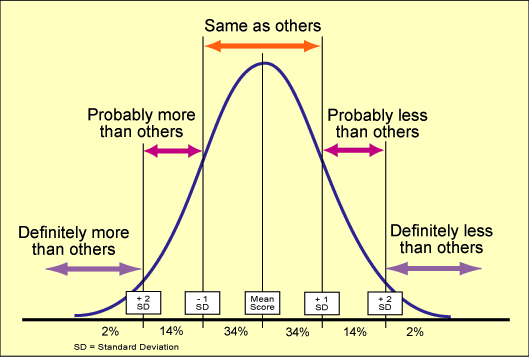
- Abnormality can been seen as a statistically rare
behaviour - this can be seen on a normal
distribution curve. Those who behave in the
average way made up the middle of the bell-shaped
curve. However, those who make up the tails of the
curve are seen as 'abnormal'.
- This explanation implies that the frequency of
the behaviour in the population determines
whether something is abnormal or not.
- Strengths
- Abnormality is on both sides of
the spectrum eg. weight (both
underweight and obese are
'abnormal')
- Provides a clear cut off point for
defining abnormality (these
people can then get the support
they need)
- Objective data
- Easy to analyse and there is
no personal subjective views
to interfere with diagnosis
due to it being statistical
data.
- Easy to analyse and there is
no personal subjective views
to interfere with diagnosis
due to it being statistical
data.
- Abnormality is on both sides of
the spectrum eg. weight (both
underweight and obese are
'abnormal')
- Weaknesses
- Undesirbale behanviour
may be common - It
would therefore be seen
as normal even when it
isn't ie. depression.
- It's subjective at where the
'cut-off' point for abnormality
should be.
- Undesirbale behanviour
may be common - It
would therefore be seen
as normal even when it
isn't ie. depression.
- Abnormality can been seen as a statistically rare
behaviour - this can be seen on a normal
distribution curve. Those who behave in the
average way made up the middle of the bell-shaped
curve. However, those who make up the tails of the
curve are seen as 'abnormal'.
- Deviation from ideal
mental health
- This explanation defines positive
concepts and looks for an absence of
well-being. If you do not meet
Johoda's criteria you are at risk of
being abnormal.
- Jahoda's criteria
- Self actualisation
(realising your potential,
being fulfilled)
- Positive self-attitude
(self-acceptance, high self
esteem)
- Positive relationships
(ability to form warm,
close relationships)
- Adaptation to the
environment (adapting
to life changing
circumstances,
resisting stress)
- Accurate perception
of reality
- Personal autonomy
(making your own
decisions, being
self-reliant/independent)
- Self actualisation
(realising your potential,
being fulfilled)
- Weaknesses
- Overdemanding
criteria
- Most people do not meet
all of these criteria, so
according to this definition
most people are abnormal.
- Most people do not meet
all of these criteria, so
according to this definition
most people are abnormal.
- Subjective
criteria
- Many of the criteria is
vague and is difficult to
measure, diagnosing
mental health is more
subjective.
- Many of the criteria is
vague and is difficult to
measure, diagnosing
mental health is more
subjective.
- Contextual
effects
- Mental health criteria are
effected by context eg. spitting
whilst running is seen as
normal whereas spitting whilst
in a cafe is not.
- Mental health criteria are
effected by context eg. spitting
whilst running is seen as
normal whereas spitting whilst
in a cafe is not.
- Overdemanding
criteria
- This explanation defines positive
concepts and looks for an absence of
well-being. If you do not meet
Johoda's criteria you are at risk of
being abnormal.
- Failure to function
adequately
- This definition states that if someone can't
cope with the demands of every day life
then they are abnormal. If you meet more
than one of the criteria you are considered
abnormal.
- The criteria
- Maladaptive
behaviour
(behaviour that is
stopping someone
attaining their life
goals socially and
occupationally)
- Personal distress
(affected by emotion to
an excessive degree)
- Observer discomfort
(behaviour that causes
others to become
uncomfortable)
- Unpredictable behaviour
(uncontrollable
impulsive behaviour)
- Irrational behaviour
(unreasonable or illogical
behaviour)
- Maladaptive
behaviour
(behaviour that is
stopping someone
attaining their life
goals socially and
occupationally)
- Weaknesses
- Abnormality doesn't
always come with
dysfunction.
- For example - people with
dangerous personality disorders
can appear normal.
- For example - people with
dangerous personality disorders
can appear normal.
- Normal abnormality
- There are times in your life where
it is normal to suffer distress
(abnormality) ie. griefing.
- There are times in your life where
it is normal to suffer distress
(abnormality) ie. griefing.
- Abnormality doesn't
always come with
dysfunction.
- This definition states that if someone can't
cope with the demands of every day life
then they are abnormal. If you meet more
than one of the criteria you are considered
abnormal.
Media attachments
Want to create your own Mind Maps for free with GoConqr? Learn more.