
Mind map
Science - Topic 1
Map content
Science - Topic 1
Atoms and their structure
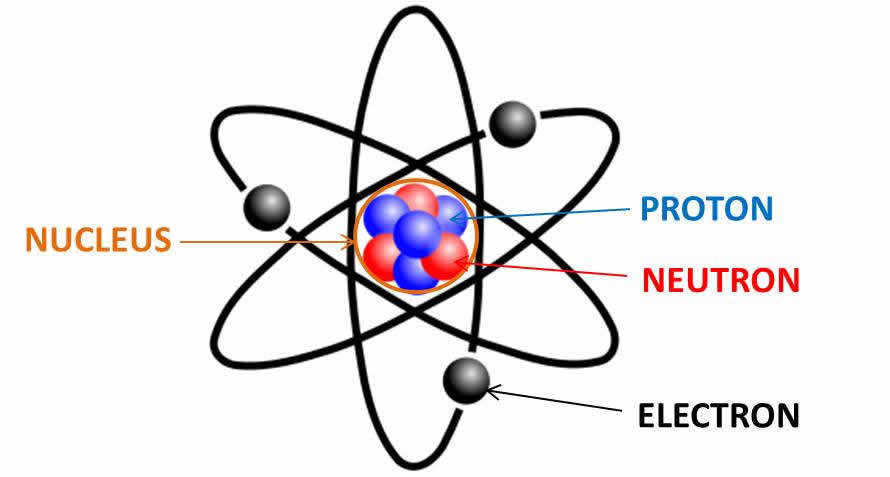
- At the centre of an atom is a nucleus containing protons and neutrons. Electrons are arranged around the nucleus in energy levels or shells.
Particles and their charges and masses
- Charges: Protons have a +1 charge Neutrons have 0 charge Electrons have a -1 charge
- Masses: Protons have a mass of 1 Neutrons have a mass of 1 Electrons have a very small mass (1/1836)
Subscripts and Superscripts and coefficients
- The subscripts in a chemical equation is the number on the lower right-hand side of a chemical element that tells a chemist how many atoms of that element are present in the equation.
- On the other hand, superscripts in a chemical equation are the notations for a positive or negative ionic charge.
- Coefficients are the numbers placed before the reactants in a chemical equation so that the number of atoms in the products on the right side of the equation are equal to the number of atoms in the reactants on the left side. If a written chemical reaction were not balanced in this manner, there would be no information available regarding the relationship between the reactants and products. Also known as stoichiometric coefficients, these numerical values demonstrate that the number of atoms on either side of the equation are equal to each other.
Isotopes
- Isotopes are the atoms of an element with different numbers of neutrons. They have the same proton number, but different mass numbers.
Mixtures and how to separate them
- Separating solids from liquids – filtration If a substance does not dissolve in a solvent, we say that it is insoluble. For example, sand does not dissolve in water – it is insoluble. Filtration is a method for separating an insoluble solid from a liquid. When a mixture of sand and water is filtered: the sand stays behind in the filter paper (it becomes the residue) the water passes through the filter paper (it becomes the filtrate).
- Separating solids from liquids – evaporation Evaporation is used to separate a soluble solid from a liquid. For example, copper sulfate is soluble in water – its crystals dissolve in water to form copper sulfate solution. During evaporation, the water evaporates away leaving solid copper sulfate crystals behind.
- Separating the solvent from a solution – simple distillation Simple distillation is a method for separating the solvent from a solution. For example, water can be separated from salt solution by simple distillation. This method works because water has a much lower boiling point than salt. When the solution is heated, the water evaporates. It is then cooled and condensed into a separate container. The salt does not evaporate and so it stays behind.
- Separating a liquid from a mixture – fractional distillation Fractional distillation is a method for separating a liquid from a mixture of two or more liquids. For example, liquid ethanol can be separated from a mixture of ethanol and water by fractional distillation. This method works because the liquids in the mixture have different boiling points. When the mixture is heated, one liquid evaporates before the other.
- Separating dissolved solids – chromatography Paper chromatography is a method for separating dissolved substances from one another. It is often used when the dissolved substances are coloured, such as inks, food colourings and plant dyes. It works because some of the coloured substances dissolve in the solvent used better than others, so they travel further up the paper.
- Mixtures are unlike chemical compounds, because: ● The substances in a mixture can be separated using physical methods such as filtration, freezing, and distillation. ● There is little or no energy change when a mixture forms. ● Mixtures have variable compositions, while compounds have a fixed, definite formula. ● When mixed, individual substances keep their properties in a mixture, while if they form a compound their properties can change.
- Examples of Common Mixtures: ● Sea water - a mixture of water and various salts. ● Crude oil - a mixture of organic compounds - mainly hydrocarbons. ● Gunpowder - a mixture of potassium nitrate, sulfur and carbon. ● Dry Air - a mixture of nitrogen, oxygen, argon, carbon dioxide, neon and tiny traces of other gases. (Air normally also contains water vapor as part of the mixture.) ● Ink - a mixture of colored dyes which can be separated using chromatography.
Models of the atom
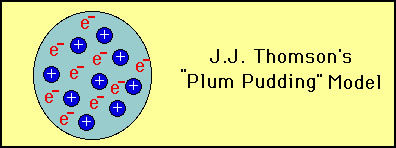
- The Plum Pudding Model is a model of atomic structure proposed by J.J. Thomson in the late 19th century. Thomson had discovered that atoms are composite objects, made of pieces with positive and negative charge, and that the negatively charged electrons within the atom were very small compared to the entire atom. He therefore proposed that atoms have structure similar to a plum pudding, with tiny, negatively charged electrons embedded in a positively charged substrate. This was later shown to be incorrect.
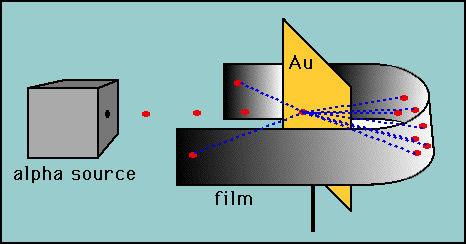
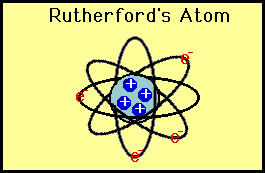
- Rutherford tested Thomson's hypothesis by devising his "gold foil" experiment. Rutherford reasoned that if Thomson's model was correct then the mass of the atom was spread out throughout the atom. Then, if he shot high velocity alpha particles (helium nuclei) at an atom then there would be very little to deflect the alpha particles. He decided to test this with a thin film of gold atoms. As expected, most alpha particles went right through the gold foil but to his amazement a few alpha particles rebounded almost directly backwards. These deflections were not consistent with Thomson's model. Rutherford was forced to discard the Plum Pudding model and reasoned that the only way the alpha particles could be deflected backwards was if most of the mass in an atom was concentrated in a nucleus. He thus developed the planetary model of the atom which put all the protons in the nucleus and the electrons orbited around the nucleus like planets around the sun.
Images and files in the map
Information
- Description
- Mind Map on Science - Topic 1, created by Bethany Wilcox on 18/07/2017.
- Created by
- Bethany Wilcox
- Views
- 2
- Rating