
Mind map
Recognise cultural perspectives on intelligence (LO1)
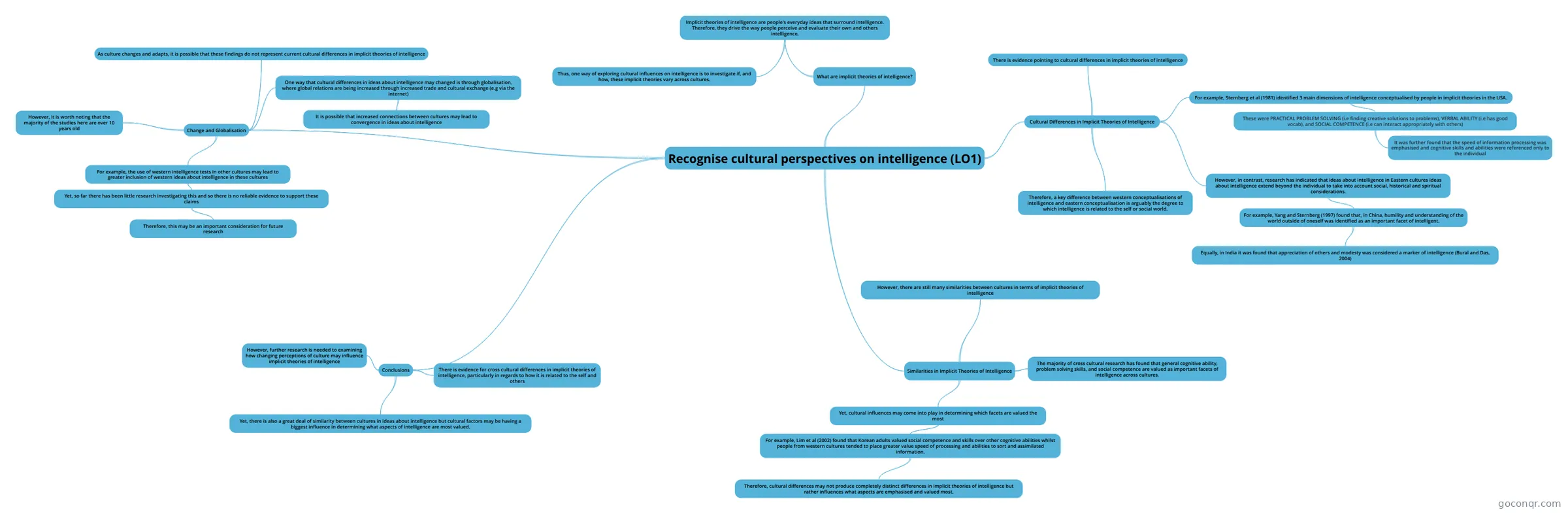
Mind map: cultural perspectives on intelligence
Map content
Recognise cultural perspectives on intelligence (LO1)
What are implicit theories of intelligence?
- Implicit theories of intelligence are people's everyday ideas that surround intelligence. Therefore, they drive the way people perceive and evaluate their own and others intelligence.
- Thus, one way of exploring cultural influences on intelligence is to investigate if, and how, these implicit theories vary across cultures.
- Implicit theories of intelligence are people's everyday ideas that surround intelligence. Therefore, they drive the way people perceive and evaluate their own and others intelligence.
Cultural Differences in Implicit Theories of Intelligence
- There is evidence pointing to cultural differences in implicit theories of intelligence
- For example, Sternberg et al (1981) identified 3 main dimensions of intelligence conceptualised by people in implicit theories in the USA.
- These were PRACTICAL PROBLEM SOLVING (i.e finding creative solutions to problems), VERBAL ABILITY (i.e has good vocab), and SOCIAL COMPETENCE (i.e can interact appropriately with others)
- It was further found that the speed of information processing was emphasised and cognitive skills and abilities were referenced only to the individual
- These were PRACTICAL PROBLEM SOLVING (i.e finding creative solutions to problems), VERBAL ABILITY (i.e has good vocab), and SOCIAL COMPETENCE (i.e can interact appropriately with others)
- However, in contrast, research has indicated that ideas about intelligence in Eastern cultures ideas about intelligence extend beyond the individual to take into account social, historical and spiritual considerations.
- For example, Yang and Sternberg (1997) found that, in China, humility and understanding of the world outside of oneself was identified as an important facet of intelligent.
- Equally, in India it was found that appreciation of others and modesty was considered a marker of intelligence (Bural and Das, 2004)
- For example, Yang and Sternberg (1997) found that, in China, humility and understanding of the world outside of oneself was identified as an important facet of intelligent.
- Therefore, a key difference between western conceptualisations of intelligence and eastern conceptualisation is arguably the degree to which intelligence is related to the self or social world.
Similarities in Implicit Theories of Intelligence
- However, there are still many similarities between cultures in terms of implicit theories of intelligence
- The majority of cross cultural research has found that general cognitive ability, problem solving skills, and social competence are valued as important facets of intelligence across cultures.
- Yet, cultural influences may come into play in determining which facets are valued the most
- For example, Lim et al (2002) found that Korean adults valued social competence and skills over other cognitive abilities whilst people from western cultures tended to place greater value speed of processing and abilities to sort and assimilated information.
- Therefore, cultural differences may not produce completely distinct differences in implicit theories of intelligence but rather influences what aspects are emphasised and valued most.
- For example, Lim et al (2002) found that Korean adults valued social competence and skills over other cognitive abilities whilst people from western cultures tended to place greater value speed of processing and abilities to sort and assimilated information.
Change and Globalisation
- However, it is worth noting that the majority of the studies here are over 10 years old
- As culture changes and adapts, it is possible that these findings do not represent current cultural differences in implicit theories of intelligence
- One way that cultural differences in ideas about intelligence may changed is through globalisation, where global relations are being increased through increased trade and cultural exchange (e.g via the internet)
- It is possible that increased connections between cultures may lead to convergence in ideas about intelligence
- For example, the use of western intelligence tests in other cultures may lead to greater inclusion of western ideas about intelligence in these cultures
- Yet, so far there has been little research investigating this and so there is no reliable evidence to support these claims
- Therefore, this may be an important consideration for future research
- Yet, so far there has been little research investigating this and so there is no reliable evidence to support these claims
Conclusions
- There is evidence for cross cultural differences in implicit theories of intelligence, particularly in regards to how it is related to the self and others
- Yet, there is also a great deal of similarity between cultures in ideas about intelligence but cultural factors may be having a biggest influence in determining what aspects of intelligence are most valued.
- However, further research is needed to examining how changing perceptions of culture may influence implicit theories of intelligence
Information
- Description
- Orgins of Individual Differences Mind Map on Recognise cultural perspectives on intelligence (LO1), created by Nichola Livermore on 18/07/2017.
- Created by
- Nichola Livermore
- Views
- 0
- Rating
More on Theories of Intelligence