
Mind map
Coastal Processes
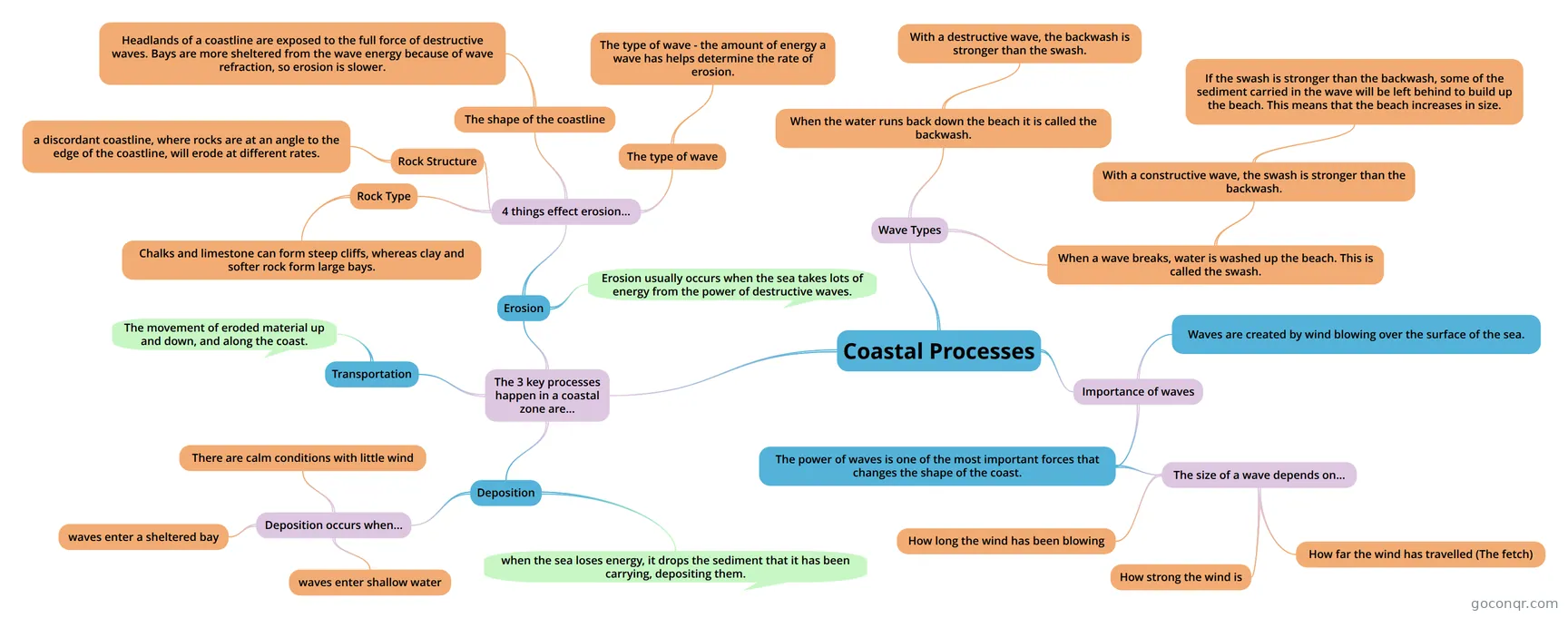
Mind map: Coastal processes
Map content
Coastal Processes
The 3 key processes happen in a coastal zone are...
- Deposition
- when the sea loses energy, it drops the sediment that it has been carrying, depositing them.
- Deposition occurs when...
- waves enter shallow water
- waves enter a sheltered bay
- There are calm conditions with little wind
- Transportation
- The movement of eroded material up and down, and along the coast.
- Erosion
- Erosion usually occurs when the sea takes lots of energy from the power of destructive waves.
- 4 things effect erosion...
- The shape of the coastline
- Headlands of a coastline are exposed to the full force of destructive waves. Bays are more sheltered from the wave energy because of wave refraction, so erosion is slower.
- Rock Type
- Chalks and limestone can form steep cliffs, whereas clay and softer rock form large bays.
- Rock Structure
- a discordant coastline, where rocks are at an angle to the edge of the coastline, will erode at different rates.
- The type of wave
- The type of wave - the amount of energy a wave has helps determine the rate of erosion.
- The shape of the coastline
- Deposition
Importance of waves
- The power of waves is one of the most important forces that changes the shape of the coast.
- The size of a wave depends on...
- How long the wind has been blowing
- How strong the wind is
- How far the wind has travelled (The fetch)
- The size of a wave depends on...
- Waves are created by wind blowing over the surface of the sea.
- The power of waves is one of the most important forces that changes the shape of the coast.
Wave Types
- When a wave breaks, water is washed up the beach. This is called the swash.
- With a constructive wave, the swash is stronger than the backwash.
- If the swash is stronger than the backwash, some of the sediment carried in the wave will be left behind to build up the beach. This means that the beach increases in size.
- With a constructive wave, the swash is stronger than the backwash.
- When the water runs back down the beach it is called the backwash.
- With a destructive wave, the backwash is stronger than the swash.
- When a wave breaks, water is washed up the beach. This is called the swash.
Information
- Description
- GCSE Geography (Coasts) Mind Map on Coastal Processes, created by Katie Peak on 02/08/2017.
- Created by
- Katie Peak
- Views
- 117
- Tags
- Rating