
Mind map
Irradiation-induced damage & DNA damage response (DRR)
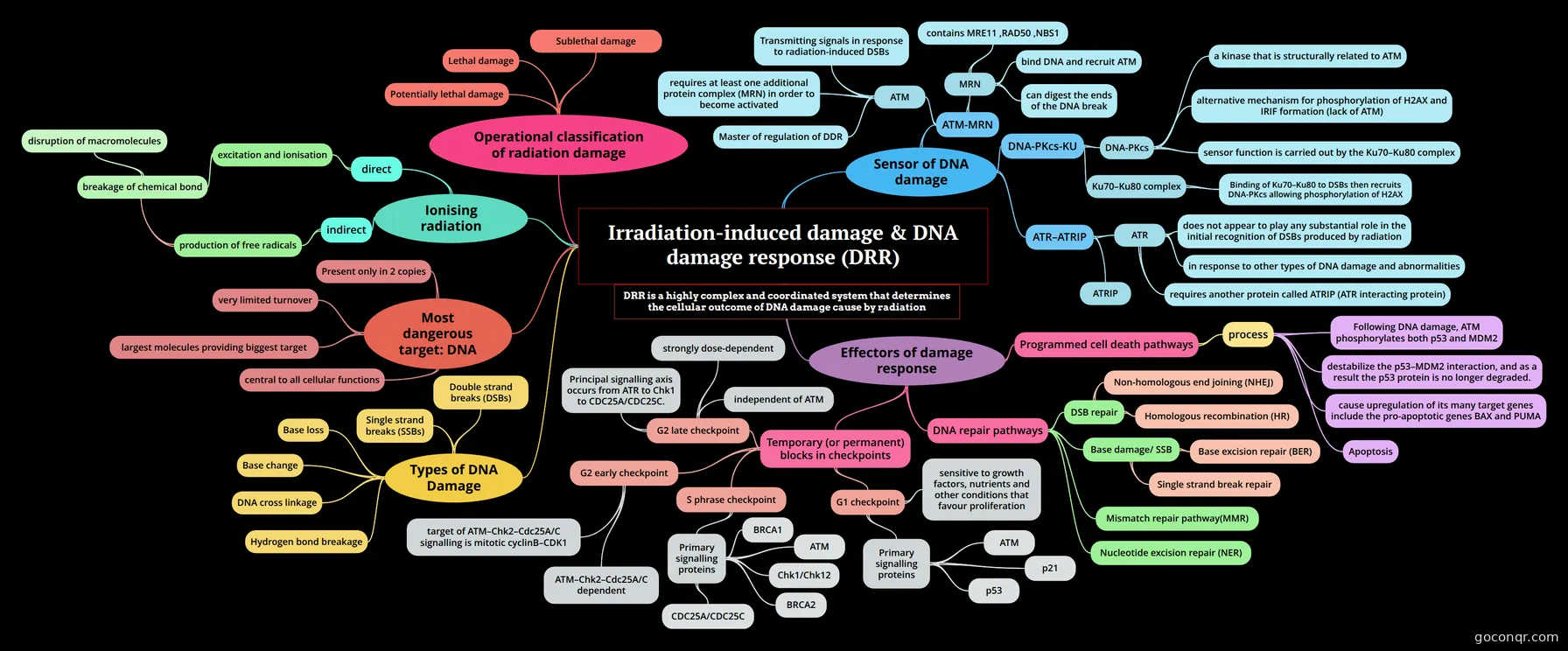
Mind map: Irradiation-induced damage & DNA damage response
Map content
Irradiation-induced damage & DNA damage response (DRR)
Ionising radiation
- direct
- excitation and ionisation
- breakage of chemical bond
- disruption of macromolecules
- breakage of chemical bond
- excitation and ionisation
- indirect
- production of free radicals
- breakage of chemical
- production of free radicals
- direct
Most dangerous target: DNA
- Present only in 2 copies
- very limited turnover
- largest molecules providing biggest target
- central to all cellular functions
Types of DNA Damage
- Hydrogen bond breakage
- Base loss
- Base change
- DNA cross linkage
- Single strand breaks (SSBs)
- Double strand breaks (DSBs)
Operational classification of radiation damage
- Lethal damage
- Potentially lethal damage
- Sublethal damage
Sensor of DNA damage
- ATM-MRN
- ATM
- requires at least one additional protein complex (MRN) in order to become activated
- Transmitting signals in response to radiation-induced DSBs
- Master of regulation of DDR
- MRN
- contains MRE11 ,RAD50 ,NBS1
- bind DNA and recruit ATM
- can digest the ends of the DNA break
- ATM
- DNA-PKcs-KU
- DNA-PKcs
- a kinase that is structurally related to ATM
- alternative mechanism for phosphorylation of H2AX and IRIF formation (lack of ATM)
- sensor function is carried out by the Ku70–Ku80 complex
- Ku70–Ku80 complex
- Binding of Ku70–Ku80 to DSBs then recruits DNA-PKcs allowing phosphorylation of H2AX
- DNA-PKcs
- ATR–ATRIP
- ATR
- does not appear to play any substantial role in the initial recognition of DSBs produced by radiation
- in response to other types of DNA damage and abnormalities
- requires another protein called ATRIP (ATR interacting protein)
- ATRIP
- ATR
- ATM-MRN
DRR is a highly complex and coordinated system that determines the cellular outcome of DNA damage cause by radiation
Effectors of damage response
- Programmed cell death pathways
- process
- Following DNA damage, ATM phosphorylates both p53 and MDM2
- destabilize the p53–MDM2 interaction, and as a result the p53 protein is no longer degraded.
- cause upregulation of its many target genes include the pro-apoptotic genes BAX and PUMA
- Apoptosis
- process
- DNA repair pathways
- DSB repair
- Non-homologous end joining (NHEJ)
- Homologous recombination (HR)
- Base damage/ SSB
- Base excision repair (BER)
- Single strand break repair
- Mismatch repair pathway(MMR)
- Nucleotide excision repair (NER)
- DSB repair
- Temporary (or permanent) blocks in checkpoints
- G2 late checkpoint
- strongly dose-dependent
- independent of ATM
- Principal signalling axis occurs from ATR to Chk1 to CDC25A/CDC25C.
- S phrase checkpoint
- Primary signalling proteins
- ATM
- Chk1/Chk12
- CDC25A/CDC25C
- BRCA2
- BRCA1
- Primary signalling proteins
- G1 checkpoint
- sensitive to growth factors, nutrients and other conditions that favour proliferation
- Primary signalling proteins
- ATM
- p53
- p21
- G2 early checkpoint
- ATM–Chk2–Cdc25A/C dependent
- target of ATM–Chk2–Cdc25A/C signalling is mitotic cyclinB–CDK1
- G2 late checkpoint
- Programmed cell death pathways
Information
- Description
- diagnostic imaging Mind Map on Irradiation-induced damage & DNA damage response (DRR), created by NG Hui Sin on 09/08/2017.
- Created by
- NG Hui Sin
- Views
- 1
- Rating