
Notes
Integument
Content of the notes (2)
Page 1
Function
Keratin
Keratin proteins
Un mineralised
Soft keratin
Hard keratin
Skin glands
Sebaceous glands
Empty into hair follicle
Oil glands
Secrete SEBUM
Oils hairs
Forms an oily film on skin
Lubricates skin
???
Odourless until broken down by bacteria
?
Comparative
None with feathers
Lanolin?
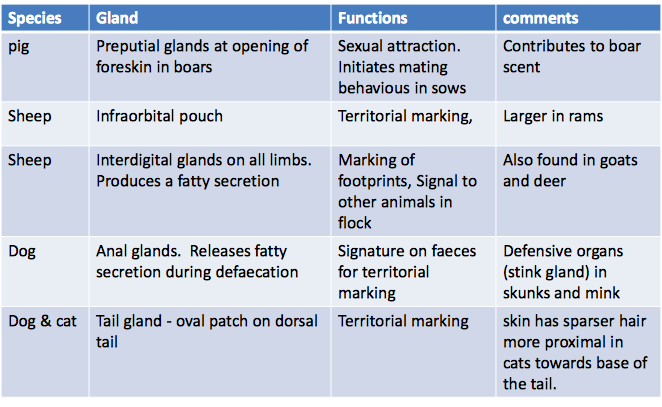
Horn glands of goats
?
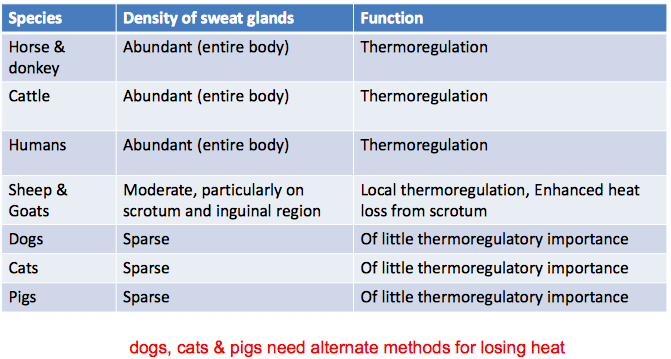
Sweat glands
Involved in thermoregulation
Apocrine
Common in domestic species, sparce in primates
Impt in evaporative heat loss
Sympathetic adrenergic
Oily opaque secretion initially dourness but becomes smelly with bacterial breakdown
Ecrine
Common in primates, space in domestic species
Impt in evaporative heat loss
Sympathetic cholinergic
Watery NaCl solution that can be modified by aldosterone
Odourless
Both contain ?
Skin isn't waterproof
Not very permeable but not waterproof + contributes to insensible water loss
Sebaceous gland secretion contributes to water resistance
Keratinocytes
Loosing heat without sweating
Production of melanin
Impt in
Camouflage
Mimicry
Social communication
Protection against harmful effects of solar radiation
Melanocytes
Cell bodies interspersed with other cells in basal layer epidermis
Cell extensions are squeeze between stratum spinous
Melanin is synthesised and packed in vesicles
Intact vesicles are transferred to adjacent keratinocytes = pigmentation of skin + hair
?
Two pigments
Eumelanins
Pheomelanins
Control of pigment ?
Pigment synthesis in melanocytes regulated by melanocyte stimulating hormones (MSH)
Produced by pars intermedia of pituitary gland
Directly by melanocytes
MSH receptors not activated by?
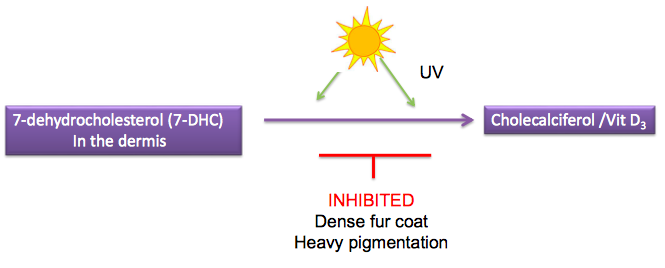
Synthesis of vitamin D
Dietry sources of vit AD
Fat, Liver , blood
Supplementation in commercial food
Synthesised in skin ?
Vit D deficiency
Rickets in camelids
Deformities
Lameness
Require supplementation
Sunburn
Rare in domestics as they are protected by hairs + feathers
They do get Photosensitivisation?
????
Liver damage
Ingestion of poisonous plants
Treatment
Suntan lotion
Out of the sun
Sensory information
Mechanoreceptors
Thermoreceptors
Nocicepters
?
Sensory cells
V superficial
Free nerve endings
Sensitive to
Pain
Temperature
Surrounding hair
Tonic receptors
Fire rapidly when first activated then slow and maintain firing whilst present
Phasic receptors cease firing if strength remains constant
Sensory nerve fibre is affected by stimulation within its receptive field
Action potentials are all or nothing
Brain localises + detects intensity by
frequency of action potentials ,
number of receptors
Different receptors have?
Thermoregulation
Mammals are endotherms - their core temp is stable
Hypothalamus
Increase core temp
Shivering
Vasoconstriction
Hair stands up
Decrease core temp
Sweating
Vasodilation
Hair lies flat
Thermal sensations
Free nerve ending
Epidermis - cold receptors
Dermis - warm receptors
?
Fever
Inc in body temp when the hypothalamic set point temp is shifted to higher value than normal
Thermoregulatory centre interprets a normal temp as being too low = actions shivering
?
Caused by pyrogens
Blood flow
Blood flow to skin can vary widely by a factor of 3-5 depending on the need to dissipate heat?
Sympathetic nervous system also contracts the erector pili muscle
?
Evaporation
Requires hat energy
Contributes to thermoregulation is that due to
Sweating
Panting
Rapid shallow breathing
Not for respiration
Dogs, Cat, Pigs, Ruminants , birds
Natural frequency of ?
Wetting the body
?
Behaviour
Wallowing
Huddling
Seeking shade/shelter
Eating
Thermogenesis
Shivering
Primary involuntary mean of increasing heat production
Antagonistic muscles contract simultaneously
Non shivering
?
Heat input
Animals often put on heat pads as they loose a lot of heat being unable to move
Brown fat
Recently found that it is in adult
?
Thermo-neutral zone
Range of ambient temp without regulatory changes in metabolic heat prod or evaporated heat loss
Animals don't have to expend energy to maintain its normal body temp
Depends on
?
Energy not required to maintain core temp
Cold stress
Temp lower than LCT
Decrease heat loss
Increase heat generation
Heat temp
Increasing heat loss
Decreasing heat generation
Production affected
Page 2
Histology
Integument
Largest + heaviest organ of the body
Includes
Skin
Epidermis
Dermis
Appendages
Hair
Skin associated glands
Nails, Claws, Hoofs, Horns, Beak, Feathers, Scales, Shells
Functions
Protraction
Thermoregulation
Secretion
Sensory
Pigmentation
Motion + shape
Storage
Vit D metabolism
Synthesis + glandular
Immune - surveilance
Capture of prey
ID characteristics
Organisation of skin
Epidermis
Stratified keratinised squamous
Dermis
Vascular connective tissue
Papillary region
Reticular region ?
Hypodermis
Loose connective tissue
Not true part of skin
Embryological development
Epidermis is from ectoderm
Dermis is from mesoderm
Becomes stratified
Accessory structures developed from epidermis
Fully developed at birth
Histology
Invagination of epidermis = epidermal ridge
?
Thick skin vs thin skin
Refers to epidermis not dermis
Presence or absence of hairs
Thick skin
5 layers
Hairless
Thin skin
?
Presence of hair
Epidermis
Stratum corneum
Outermost layer
Flattened cells
Dead
Keratinised epidermal cells
Continuously laughed off
Sratum lucidum
No nuclei
Don't produce keratin anymore
Dead cells
Greatly reduced in thin skin
Translucent keratinised epidermal cells
St granulosum
few layers
Darkly stained , drastic increase in keratinisation
Keratohyaline granules
Highly basophilic
Stratum spinous
Spinous or prickle cell later
Cytoplasm contains tonofilament
Several layers of keratinocytes bound tightly by desmosomes
Stratum basale
Single layer of cuboidal cells
in contact with BM
Stem cells
Divide to form new keratinocytes
In epidermis 90% cells produce keratin
Cells of epidermis
Keratinocytes
Main cell type of epidermis
Stem cells in st basale
Non keratinocytes
Melanocytes
Dispersed between basal cells
Hair follicle
Produce melanin - pigment
UV protection
Coloration
Melanin
Melanosomes
Tyrosinase
Required for production of melanin
Albinos lack this
Merkel cells
Mostly present in basal layer
Sensory
Langerhans cells
Monocytes- derived from dendritic cells
Immune-surveillance cells
Important in antigen presentation
Processes in epidermis
Continuous proliferation of keratinocytes in basal layer
Migration, differentiation + keratinisation
Squamous cells subsequently sloughed off at the surface
Result in formation of relatively impermeable protective layer
Dermis
Vascular dense irregular CT layer of skin
2 layers
Papillary layer
Sub epithelial LCT
Reticular layer
DCT
Contains epidermally derived hair, sweat and sebaceous glands
Blood supply
Epidermis
No vessels
Nourished by diffusion from blood vessels in the dermis
Dermis
Consists of blood, lymphatic vessels and nerves
Artieriovenous anastomosis (thermoregulation)
Shunts blood to bypass capillaries by providing direct routed between arteries + veins
Hypodermis
Subcut layer
Technically not part of skin
LCT , irregular
Connects body + skin
On health animals has large deposits of fat
Accessory structures of the skin
Hairs
Sweat glands
Sebaceous glands
These structures are derived from the epidermis but anchored in dermis
Hairs
Covers entire body in Dom. animals
Excepting
Food pad
Hoof
Glans penis
Mucocutaneous junctions
Teat
Produced by hair follicles embedded in dermis
Functions
Mechanical protection
Thermoregulation
Sensory perception
Type and arrangement of hair follicles varies between species
Hair shaft
Outer cuticle
Single layer
Flat keratinised cells
Cortex
Compact dead cell layer under cuticle
Medulla
Central region of the shaft
Cuboidal/ flat cells
Hair root
Part of hair below surface of skin
Similar structure to hair shaft
Hair bulb
Conical mass at base of hair root
Covered by squamous epithelium.
Epithelium is indented at the base of the bulb by dermal CT - the dermal papilla
Cyclic activity of hair
Anagen = growth
Catagen = regressive/ atrophy
Telogen = Quiescent
Anagen = renewed growth
Types of hair follicles
Sinus or tactile hair = vibrissae
Specialised for tactile sense
Blood filled sinus
Skeletal muscle
Innervation
Limited facial distribution
Extremely large
Single hair follicles grouped in clusters of 2-4 follicles (pigs)
Compound hair follicles (dogs + cats)
Glands
Sebaceous
Exocrine gland
Sebum
Waterproofing
Increasing agility
Spread sweat
Secretory portion
Pale staining
Flask shaped
Holocrine method
Whole cell disintegrates to release sebum
Excretory duct
Empties into hair follicle
Sweat
Exocrine gland
Sweat
Ultrafiltrate of blood plasma
Functions
Thermoregulation
Excretion
Scent signalling
Secretory portion
Simps cuboidal epithelium
Myoepithelial or basket cells
Apocrine or meocrine?
Excretory duct
2 layers of cuboidal epithelium
Hair follicle / sweat pore
Mammary glands = modified sweat glands
Ecrine
Apocrine
Clinical relevance
Indicator of systemic conditions
Economic significance
Skin incised in almost all surgical procedures
Pathological conditions
Allergies
Dermatitis
Parasitic infection
Hyperkeratosis - hard pad disease?
Melanoma
Squamous cell carcinoma
Burns
First degree
Sun burn
Epidermis affected
Second degree
Blisters
Epidermis + dermis affected
Third degree
Epidermis + dermis + subcutaneous layer affected
Cornified epidermal structures
Hooves, Claws and horns in mammals
Claws in
Beaks in
Shells + scales in
Scales in ??
Vestigial toe?
Feathers
Contour feathers
Downs
Filoplumes
??
Information
- Description
- Vet Med 1 (NSF) Note on Integument, created by Alice Butterworth on 01/03/2018.
- Created by
- Alice Butterworth
- Views
- 1
- Rating