
Notes
Behaviorism - created from Mind Map
Content of the notes (1)
Page 1
Assumptions
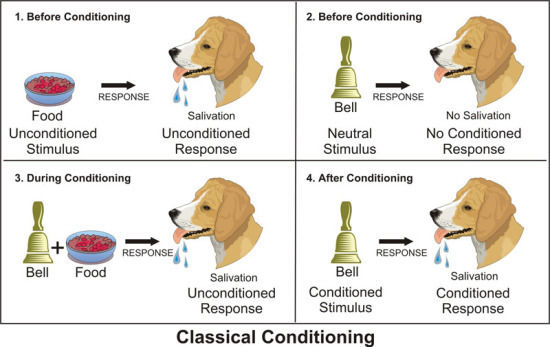
Classical conditioning
Operant conditioning
Application
Scientific (lab experiments) - Control of extraneous and independent variables. This allows a cause and effect relationship to be established.
Strong nurture side - Better decisions with regard to education and child-rearing.
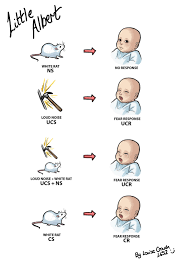
Deterministic - Ignores the role of free will e.g. Little Albert's fear response was created through conditioning.
Observable behavior
Animals and humans learn in the same ways so behaviorists carry out experiments on animals and generalise results to humans.
Lab experiment based
An existing involuntary reflex response is associated with a new stimulus (learning by association)
Pavlov's dogs
Watson and Rayner - Little Albert
new voluntary behaviour is associated with a consequence (learning by consequences)
Skinners box
Positive reinforcement
Negative reinforcement
Punishment
Positive reinforcement - Rat rewarded with food when it pressed the lever
Negative reinforcement - rat was able to turn off electric shock by pressing lever
Receiving a reward based on an action. Increases the likelihood of the behavior being repeated.
A behavior strengthened by avoiding a negative outcome. Increases the likelihood of the behavior being repeated.
A consequence that makes a behaviour less likely to occur
Behaviorism has increased our understanding of the causes of phobias and attachment.
Given rise to therapies such as systematic desensitisation and token economy e.g. in prisons.
Lacks ecological validity which means that results may not be a true reflection of real life behaviour.
Information
- Description
- Note on Behaviorism - created from Mind Map, created by neeka patt on 11/10/2018.
- Created by
- neeka patt
- Views
- 2
- History
-
- Created by neeka patt · Oct 11, 2018
- Copied to Note by neeka patt · Oct 11, 2018
- Rating