
Notes
Soil Mechanics MidTerm 2
Content of the notes (5)
Page 1
A Site investigation is typically (6) Steps:
Desk study - In this stage we are collecting and understanding information relating to the site such as:
- Location of area
- Details of the area including proposed/existing state
- Government regulations
Site Reconnaissance - A site visit is conducted to:
- Validate results of the desk study
- Take photographs
Planning a field program - What do we need to do and how?
- Determine the type of testing that needs to be done, the sampling method and frequency
- Determine the number of boreholes/pits
- Determine the type of equipment required
- Locate utilities
Executing the field program
Laboratory testing
reporting
SOILS EXPLORATION METHODS.
NON DESTRUCTIVE TECHNIQUES:
GROUND PENETRATING RADAR
SEISMIC SURVEYS
TEST PITS
SOIL IDENTIFICATION IN THE FIELD
Colour
Moisture
Structure
Shape
Smell
Feel
BOREHOLES REQUIRED:
<250m2 = 3min BH
250m2 < plan area < 1000m2 = 4 min for plat, 5 min for sloped
>1000 = every 300m2 --- if area is 4500m2 then 4500/300 = 15min
In-Situ (SITE) Testing
TYPES:
SPT Standard penetration test
CPT Cone penetrometer test
PMT Pressuremeter test
VST Vane Shear test
- Large variety of In-Situ testing, most commonly being the Standard penetration test (SPT) and Cone penetration test (CPT)
STANDARD PENETRATION TEST (SPT)
The number of blows required to penetrate 6" increments is recorded
N Value is # of blows to penetrate last 12"
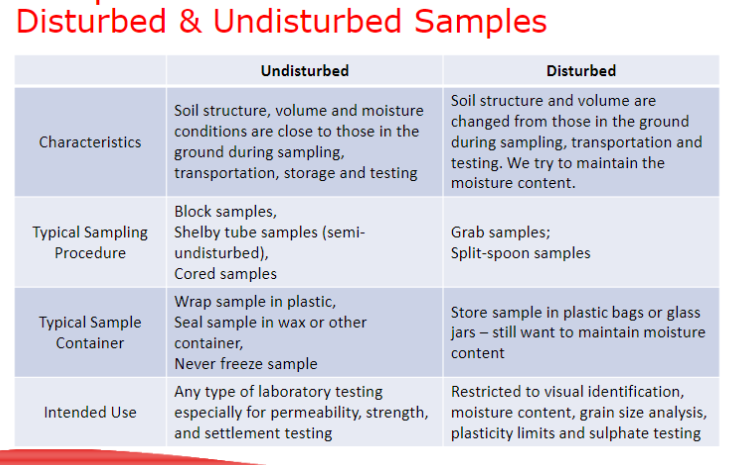
Once blow counts are recorded, the split spoon is opened to take a disturbed sample for testing
Samples are typically collected every 1.5 meters
The N value can be used to characterize shear strength
A SHELBY TUBE WILL GIVE US AN UNDISTURBED SAMPLE
A SPLIT SPOON SAMPLER WILL GIVE US A DISTURBED SAMPLE
Page 2
LAB 1 HYDROMETER AND SIEVE ANALYSIS
LAB 2 LIQUID, PLASTIC AND PLASTICITY INDEX
Atterberg limit is moisture content of fine-grained soils as they transition from a solid to liquid state. Liquid limit and Plasticity index is used in soil classification. The plastic limit is the point at which a soil becomes too dry to be plastic or mouldable.
LIQUID LIMIT
Using the casagrande cup, a soil sample is placed and the device cranked until the line down the middle is closed. The number of blows is recorded.
A drier sample will take more blows than a weter sample.
PLASTIC LIMIT
Roll the mass between the glass plate and hand until a uniform diameter of 1/8" or 3.2mm is achieved. once a sample can be obtained without crumbling, weight the sample and dry. Water % can then be obtained.
LAB 3 SOIL CLASSIFICATION - VISUAL/MANUAL
Felt the material, dry, wet moise. Odour. Colour. Coarse or fine.
LAB 4 MEASURING PERMEABILITY USING CONSTANT HEAD AND FALLING HEAD TEST
LAB 5: MOISTURE CONTENT/VOLUME RELATIONSHIP W/ STANDARD PROCTOR TEST
Volume/mass of mould is recorded, mould is filled with loose soil 1/3 at a time with 25 hammer drops each time.
Mould + compacted soil is weighed. Soil is pushed out and mass is taken. a sample is taken to measure MC%.
LAB 7 UNCONFINED COMPRESSIVE STRENGTH/TRIAXIAL TEST
Page 3
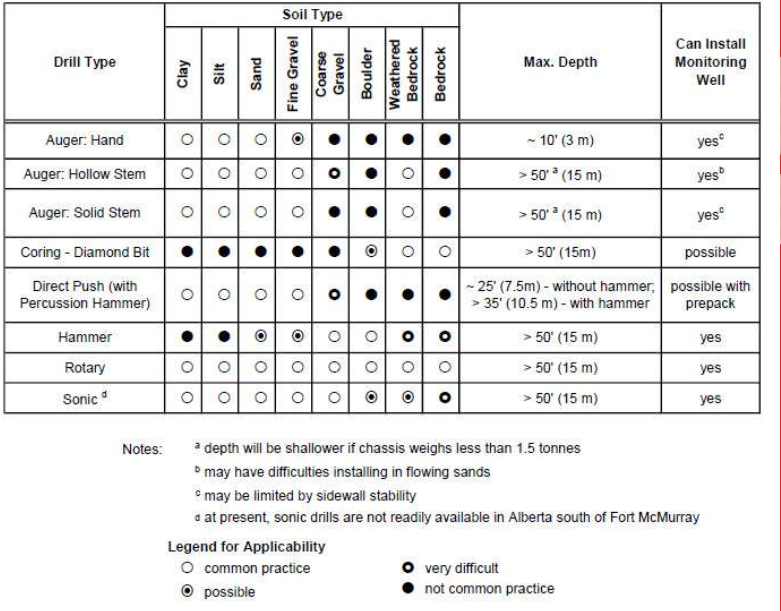
SOILS EXPLORATION METHODS.
NON DESTRUCTIVE TECHNIQUES:
GROUND PENETRATING RADAR
SEISMIC SURVEYS
TEST PITS
Page 4
Page 5
MODULE 1: GROUNDWATER
CAPILLARITY: RISE OF WATER FROM SATURATED ZONE TO A DRIER ZONE
FLOW: MOVEMENT OF WATER WITHIN SOIL
FROST HEAVE: VERTICAL EXPANSION OF SOIL CAUSED BY FREEZING WATER
The smaller the grain size, the smaller the void space therefore the greater the capillary rise.
Homogeneous clays make the best barriers to prevent soil and groundwater contamination.
Frost action- As the top of a frozen soil thaws there is nowhere for the water to go but up because the layer below is still frozen.
Coefficient of permeability of a soil can be determined in the laboratory using permeameters and in the field using pumping tests.
Information
- Description
- Note on Soil Mechanics MidTerm 2, created by Mohamed Chehabeddine on 27/03/2020.
- Created by
- Mohamed Chehabeddine
- Views
- 2
- Rating