
Soil Mechanics
91 resources created by 50 users
This Soil Mechanics page on GoConqr gathers community-made quizzes, mind maps, flashcards and notes, from soil classification and phase relations to compaction, permeability, consolidation, bearing capacity and liquefaction. It's built for university students working through a geotechnical course and teachers after ready-made material. There are over 80 resources here, including more than 40 mind maps, more than 20 flashcard decks and more than 9 quizzes, made by over 40 contributors. Pick a topic, try a quiz to spot your gaps, then make your own set.
Top Soil Mechanics resources
-
15 questionsGeotech II: Chapter 12 Quiz Questions True or False: The SHEAR STRENGTH of a soil mass is the internal resistance per unit area that the soil mas...
-
60 questionsStructures II - Exam I Soil is a three phase system. Which phases apply?
-
200 questionsCDC Studying (203) What design standards do you need to be aware for all military construction?
-
126 cardsGeotech review midterm Final draft How many Phases are in unsaturated soil
-
30 questionsGeotech 2 consolidation & slope stability Consolidation is gradual compression of a saturated soil under steady pressure and is due to the expulsion ...
-
28 cardssoils 2014 exam Explain the spt blow count normalisation
-
26 cardsGroundwater What is meant by the phreatic surface; the phreatic zone and the vadose zone?
-
22 questionsGeotechnical Engineering 2 Permeability The flow of water in soils normally occurs at very low velocities and hence is essentially a laminar flow r...
Quizzes
-
15 questionsGeotech II: Chapter 12 Quiz Questions True or False: The SHEAR STRENGTH of a soil mass is the internal resistance per unit area that the soil mas...
-
60 questionsStructures II - Exam I Soil is a three phase system. Which phases apply?
-
200 questionsCDC Studying (203) What design standards do you need to be aware for all military construction?
-
30 questionsGeotech 2 consolidation & slope stability Consolidation is gradual compression of a saturated soil under steady pressure and is due to the expulsion ...
-
22 questionsGeotechnical Engineering 2 Permeability The flow of water in soils normally occurs at very low velocities and hence is essentially a laminar flow r...
-
13 questionsEngineering workshop 5
-
22 questionsGeotech II - Chapter 13 The magnitude and distribution of lateral earth pressure depends on many factors, such as: (select all that...
-
17 questionsChapter 14 - Geo II In Coulomb's earth pressure theory, the retaining wall is considered to be rough.
Mind maps
See all 47 mind maps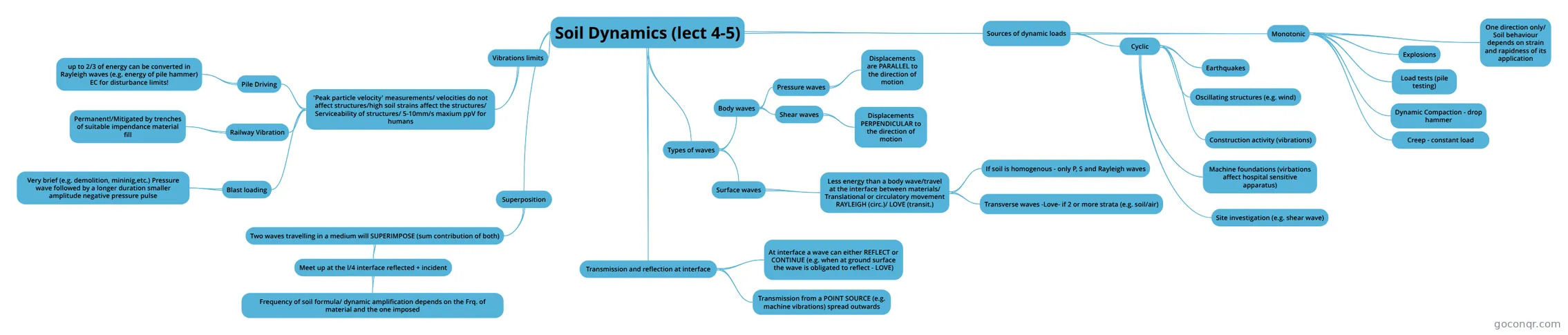
Flashcards
See all 25 flashcards-
126 cardsGeotech review midterm Final draft How many Phases are in unsaturated soil
-
28 cardssoils 2014 exam Explain the spt blow count normalisation
-
26 cardsGroundwater What is meant by the phreatic surface; the phreatic zone and the vadose zone?
-
16 cardsGeotech -> CH 6 - Soil Compaction
-
9 cardsConsolidation and 1D settlement What are the three sections on a typical load-settlement graph?
-
15 cardsGeotech 2 Permeability What is the definition of soil permeability?
-
23 cardsCh. 7 - Permeability
-
10 cardsBearing Capacity Definitions and Equations Total overburden pressure (σ or p)
Flowcharts
Notes
-
geo tech enginerring part 2 foundations
-
geotechnical engineering-civil engineering
-
General Bearing Capacity Equation General Bearing Capacity Equation Determination of the bearing capacity of a foundation The bearing capacity of a foundation can be determined in terms of a general shear mode, which is based on the theory of plastici...
-
Soil Mechanics MidTerm 2 A Site investigation is typically (6) Steps: Desk study - In this stage we are collecting and understanding information relating to the site such as: - Location of area - Details o...
-
Untitled Soil Classification - language of communication among engineers, it helps to categorize the soils according to its probable engineering behaviour. The most common Classification Systems: 1. Unified Soil Classifi...
-
SAND REPLACEMENT METHOD - created from Mind Map suitable for GRANULAR SOIL OBJECTIVE to determine the density of natural soil
Topics in Soil Mechanics
More Civil engineering and construction topics
About Soil Mechanics
GoConqr OriginalWhat this page covers
This unit sits in the Geotechnical Engineering strand of Civil engineering and construction. The resources follow a typical soil mechanics course. Early topics include soil classification and phase relations. Then come compaction, effective stress, flow of water and flow nets, stress distribution, settlement, consolidation and shear strength. Later ones reach bearing capacity, site investigation and liquefaction.
Where to start
If you are new to the topic, begin with the numbered mind maps. They run in order, from 1) Soils and their classification and 2) Soil Phase Relations through 3) Soil compaction, 4) Effective Stress and 6) Flow Nets to 11) Consolidation. Each one gives you a quick outline before you go deeper.
Flashcards for definitions and equations
Flashcards suit the terms you need to recall. Some useful decks:
- Ch. 7 - Permeability covers head, pressure head, elevation head, piezometers and Darcy's Law.
- Ch 9 - In situ stresses starts from total stress and how part of it is carried by water.
- Ch. 11 looks at types of settlement and the one-dimensional laboratory consolidation test.
- Bearing Capacity Definitions and Equations and Equations help with formulas.
Using quizzes with maps
Read a mind map first, then test yourself. The quiz Geotech II: Chapter 12 Quiz Questions opens with a true or false question on shear strength. The quiz Structures II - Exam I asks about the phases of soil and terms such as void ratio, porosity and degree of saturation. Go back to the map for any answer you miss, then try the quiz again.
For wider reading, there are maps on Terzaghi's Theory of Consolidation, ground improvement techniques, subsoil exploration and soil liquefaction. Teachers can pick a map or deck to share with a class.
Next step
Choose one topic, take a quiz on it, and then build your own flashcards from the gaps you find.
Frequently asked questions
Which resource should I start with?
Start with the numbered mind maps, beginning with the one on soils and their classification and the one on soil phase relations. They follow a course order. Then try the quiz Structures II - Exam I, which checks the phases of soil and related terms such as void ratio and porosity.
What do the mind maps cover?
The mind maps cover compaction, effective stress, flow nets, stress distribution, one-dimensional settlement, consolidation, strength, site investigation and soil exploration. There are also maps on liquefaction, ground improvement techniques and unsaturated soil, so you can go beyond the core topics.
Are the resources free to use?
Yes. Every resource listed here is free to open, study and take, with no account needed. A free account also saves your quiz scores and lets you make your own quizzes, mind maps, flashcards and notes.
Who made these resources?
They were made by GoConqr users, not by GoConqr itself. Over 40 contributors have added quizzes, mind maps, flashcards and notes, so the style and depth vary. It is worth checking a resource against your own course material.
Which level do these resources suit?
They are mainly written at university level, so they suit university students taking a geotechnical or soil mechanics course. Teachers can use them as ready-made material for revision or class work.
What if I can't find my topic?
Look through the mind maps and flashcard decks first, as topics are sometimes covered under a chapter name. For example, flow nets appear in several maps, and equations have their own decks. If a topic is still missing, you can make your own mind map or flashcards.