
Notes
Thermodynamics - Lecture 3
Content of the notes (1)
Page 1
Real gases
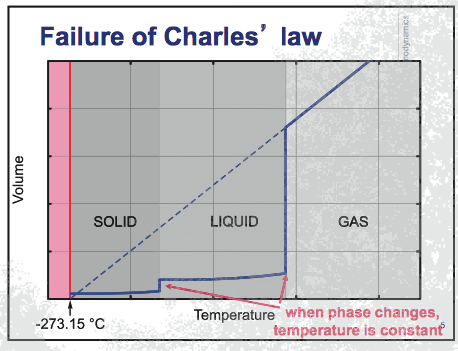
-when temp too low and V too small
-the attractive forces between atoms cause them to stick together, thus its CONDENSES to solid/liquid which is a PHASE CHANGE
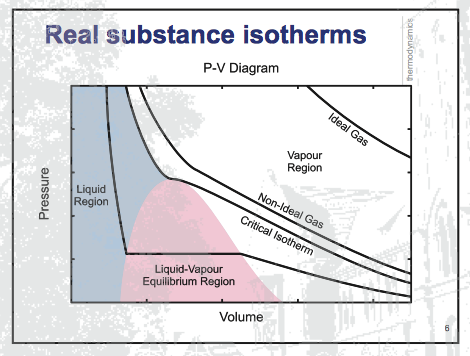
Sudden phase change doesn't occur when T exceeds critical temperature .
These pressures are highly dependant on pressure
Phase Change Region
-Where LIQUID and VAPOUR co-exist, PRESSURE is CONSTANT of isotherms thus independent of the volume
- Pressure determined ONLY BY TEMP
Saturated Vapour Pressure: the pressure when two phases co-exist
Phase diagram- how the saturated vapour pressure and temperature depend for each phase transition
Energy of Phase Change
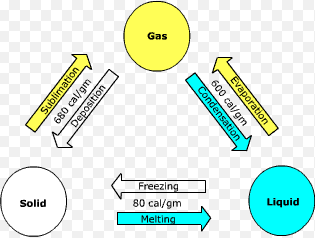
-when substances change phase, THERMAL ENERGY is required to OVERCOME the inter-atomic forces
-phase change = when temp constant
Latent Heat: thermal energy required to change 1kg of substance to change phase melt/vaporise
-depends on conditions ie TEMP
-usually given?
-add E to move molecules apart
Q=mL in kJ
No Change in T as phase change
+ when solid liquid/liquid gas (when melting) as thermal ENERGY ADDED
When moisture evaporates from skin, it uses large amount of thermal energy. Body uses this to regulate body temp.
Temperature Changes
Heat transfer without phase change
-Heat- (energy in motion) therefore thermal energy transferred from HOT to COLD when two objects in contact = Q in J
- Q is positive when thermal energy of object increases. (cold object)
- hot object will have -Q as its the heat lost
Q = mc(change in T) in J
c=specifc heat
m= mass
Always POSITIVE and always increases with temperature
Energy Conservation
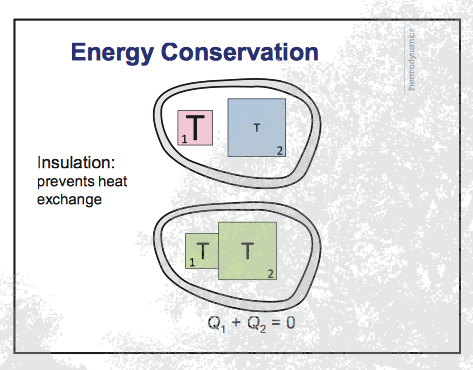
When two objects are brought together and are in THERMAL EQUILIBRIUM, energy is CONSERVED.
Q1 +Q2 + Q3 + Q4 = 0
Thus we can determine the Tfinal of both objects (they will have same temp)
Information
- Description
- Note on Thermodynamics - Lecture 3, created by Inika Gadgil on 12/04/2015.
- Created by
- Inika Gadgil · Apr 2015
- Updated
- Feb 19, 2016
- Views
- 2
- Rating