
Notes
Thermodynamics - Lecture 5
Content of the notes (1)
Page 1
Heat Transfer - in an isolated system when two objects are in thermal contact TOTAL THERMAL ENERGY is conserved.
Q1+Q2+Q3=0
-always hot to cold
Conduction - Contact heat transfer
- when moving electrons/molecules exchange energy through collisions
-good electrical AND heat conductors are metals, which have loose valence e-
-Good electrical insulators have tight valence e- therefore good thermal insulators
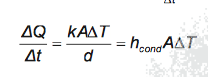
k=thermal conductivity
change in t- between two surfaces
hcond= conduction heat transfer coefficient (given i think) in wm-1K-1
Another equation for single slab = hcond = k/d
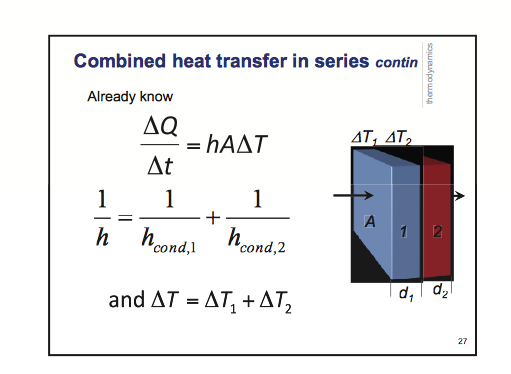
Conductive Heat transfer in series
When heat passes through two media, the temp differences are normally different.
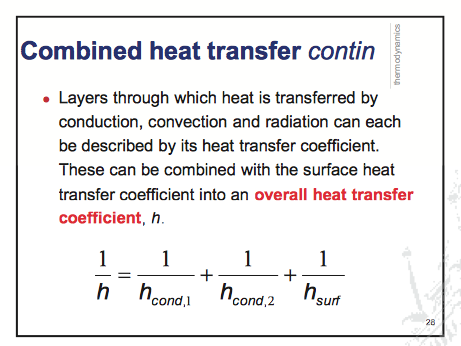
Rate of heat transfer (eq. below) is same for both slabs. So for two slabs in series 1/h= 1/hcondx +1/hcondy (Hcond=k/d)
h = overall heat transfer coefficient for both labs in series
1/h = thermal resistance
Convection
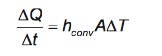
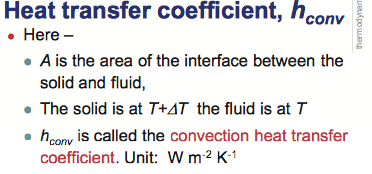
-similar to conduction but ONE MEDIA IS a MOVING FLUID
-very rapid, faster than conduction
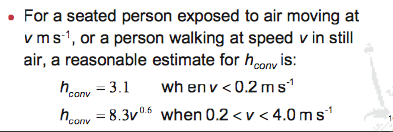
- the rate of heat transfer DEPENDS on velocity of fluid
- if no fluid motion , then temp diff would gradually decrease lowering the rater of heat transfer (as it depends on it)
Radiation
-when all objects radiate and absorb energy in the form of EM waves (even in vacuum)
-no contact or medium needed
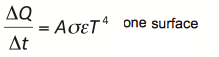
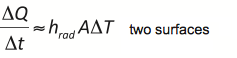

Emissivity - property of surface
Black surfaces - 0.9-1
Shiny - less than 0.1
Radiation emitted by objects at body temp are in Infared region, in this region almost all surfaces have emissivity of 0.9-1
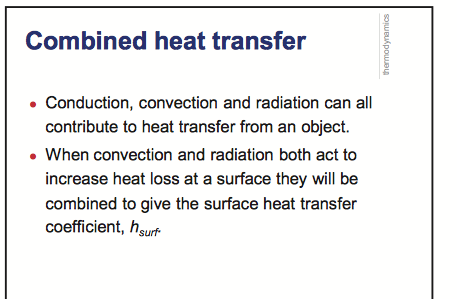
NOTE Change in T in this lecture refers to the DIFFERENCE in temperature of the two surfaces
Information
- Description
- Note on Thermodynamics - Lecture 5, created by Inika Gadgil on 12/04/2015.
- Created by
- Inika Gadgil
- Views
- 0
- Rating