Notes
Transport across membranes
Content of the notes (1)
Page 1
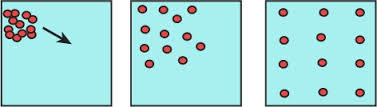
Diffusion is the net passive movement of particles (atoms, ions or
molecules) from a region in which they are in higher concentration to
regions of lower concentration. It continues until the concentration of
substances is uniform throughout.
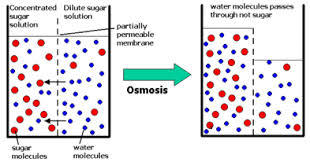
Osmosis is a special example of diffusion. It is the diffusion of
water through a partially permeable membrane from a more
dilute solution to a more concentrated solution – down the
water potential gradient)
Note: diffusion and osmosis are both passive, i.e. energy from
ATP is not used.
A partially permeable membrane is a barrier that permits the
passage of some substances but not others; it allows the
passage of the solvent molecules but not some of the larger
solute molecules.
Cell membranes are described as selectively permeable
because not only do they allow the passage of water but also allow the passage of certain solutes.
The presence of particular solutes stimulates the membrane to open specific channels or trigger
active transport mechanisms to allow the passage of those chemicals across the membrane.
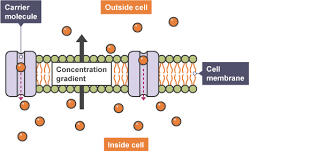
Active transport is the energy-demanding transfer of a substance across a cell membrane against its
concentration gradient, i.e., from lower concentration to higher concentration.
Special proteins within the cell membrane act as specific protein ‘carriers’.
The energy for active transport comes from ATP generated by respiration (in mitochondria).