
Notes
Periodic Table and Particles
Content of the notes (1)
Page 1
Compounds
pure substances
their properties are UNIVERSAL
they have a definite proportion by mass and cannot be decomposed by ordinary chemical or physical means
Terms:
molecule: neutral group of atoms that act as a unit
molecular compound: a compound that is composed of non-metals covalently bonded to one another; molecular compounds can be solid, liquid or gas at room temperature
ionic compounds: composed of a cation(s) and an anion(s); ions are arranged in orderly three dimensional patterns; they are electrically neutral; sum of all charges = 0; ionic compounds are crystalline solids are room temperature
*IONIC COMPOUNDS HAVE HIGH MELTING POINTS; COLORED SOLIDS WITH HIGH MELTING POINTS ARE TYPICALLY IONIC COMPOUNDS CONTAINING TRANSITION METALS
chemical formulas; shows the type and number of atoms in the smallest representative unit of a compound
molecular formula: shots the type and number of atoms present in a molecule of a compound ( same as chemical formula but specific to covalently bonded substances called molecules);
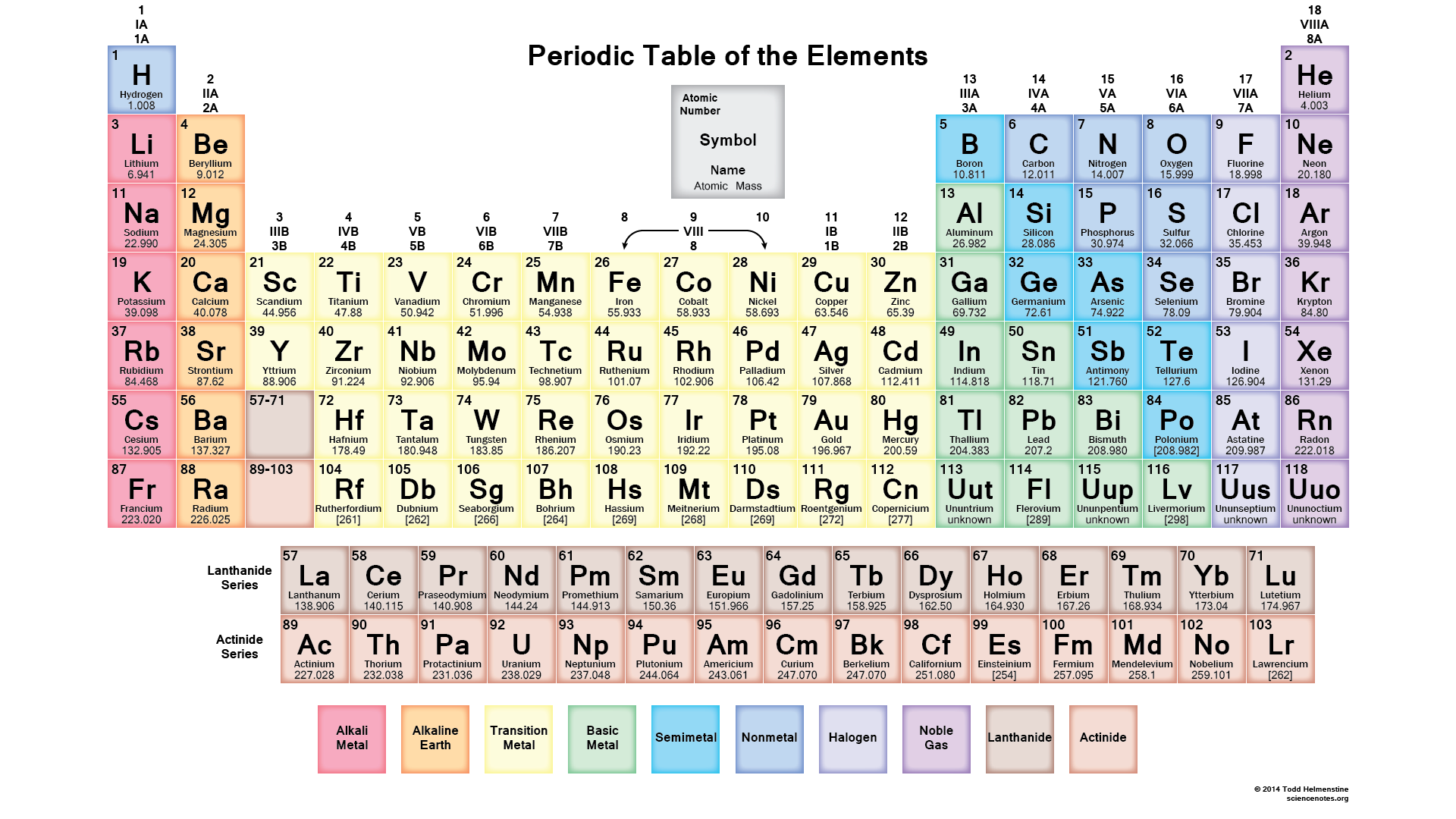
Columns are known as "groups" or "families"; some have specific names; alkali, alkaline, halogen, noble gases; others are known by the element at the top (boron family, carbon family, nitrogen family, oxygen family)
Rows are know as periods; there are seven periods; periods are known as energy levels; Principle Quantum Numbers 1,2,3,4,5,6,7.Most elements are metals; they are found from the far left to the step;
Metalloids are found along the step (note: Aluminum is NOT a metalloid); their properties are intermediate, somewhat like metals and somewhat like non-metals. SILICON, Si, is an extremely important metalloid used in the computer/semi-conductor industry
Alkali metals, column 1, always form +1 ions, very reactive metals that are soft, can be cut with a knife; they are greyish in color; HYDROXIDES of alkali metals are very strong bases; ionic compounds with alkali metal ions are white in color, brittle, with high melting points
Alkaline metals, column 2, always form +2 ions, reactive but not as much as alkali metals; denser than alkali metals because they have smaller atomic radii; Ca(OH)2 Ba(OH)2 and Sr(OH)2 are strong bases; ; ionic compounds with alkaline metal ions are white in color, brittle, with high melting points
Transition metals (center of chart over to step); have varying charges, are good coinage metals and structural materials. note: the charge of silver(+1), cadmium(+2) and zinc(+2) are fixed; ; ionic compounds with transition metal ions are colorful, brittle, with high melting points.
Ex: copper ions are blue in solution.
Halogens: good disinfectants, form salts with most metals, always form -1 anions, as elements halogens are found as diatomic molecules. F2 and Cl2 are gases at room temperature; Br2 is a reddish-brown liquid and I2 is a purple solid that sublimes
Noble gases: are inert, do not react, have complete valence shells.
Information
- Description
- Note on Periodic Table and Particles, created by ggabeau17 on 29/05/2015.
- Created by
- ggabeau17
- Views
- 2
- Rating