
Notes
Logical Reasoning Basics
Content of the notes (5)
Page 1
Premises and Conclusions
Premises and Conclusions:
What is a premise?
A premise is a fact, proposition, or statement from which a conclusion is made
What is a conclusion?
A statement or judgment that follows from one or more reasons
Episode 1.4: Premises and Conclusions (Embed)
How to Identify Premises and Conclusions
Indicator words
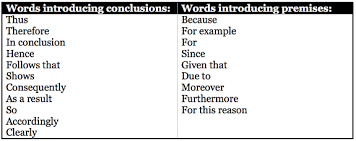
words such as because, since, for example, for, due to, etc indicate a premise
Words such as thus, therefore, hence, consequently, as a result, etc indicate a conclusion
How to Approach
When reading a stimulus lookout for indicator words
Try to identify "claims", if a claim is identified, look for the conclusion to follow
Ex: Fraud has cost the insurance industry millions of dollars in lost revenue. Thus, Congress will pass a stricter fraud control bill since the insurance industry has one of the most powerful lobbies
Premise- Fraud has cost the insurance industry millions; since the insurance industry has one of the most powerful lobbies
Conclusion- Thus, congress will pass a Stricter fraud control bill
In this example there are two premises that are connected by the conclusion (thus). "Since" os also a premise word
Identify the conclusion | Example | Logical reasoning | LSAT | Khan Academy (Embed)
Counter-Premises:
A counter-premise is a premise that actually contains an idea that is counter to the argument and would generally weaken it
Can also be ideas that compare and contrast with the argument, or work against a previously raise a point
Indicated by words such as furthermore, moreover, besides, in addition, what's more, and after all
Further Practice:
Complete Premise-conclusion worksheet
Make Indicator word chart for study materials
Complete Practice Drill
Page 2
Complex Arguments
Complex Arguments:
Complex arguments are arguments that have more than one conclusion
One is the main conclusion, and one is subsidiary
The argument uses one conclusion as fuel for the main conclusion
One of the most commonly used complex argument forms is to place the main conclusion in the first sentence of the argument, and then to place the sub conclusion in the last sentence of the argument, preseeded by a conclusion indicator
LSAT Logical Reasoning 1b - Complex Arguments (Embed)
Further Practice:
Complex argument worksheet
Page 3
Decoding Text
Killer Sentences:
sentences that contain large amounts of information, while also being hard to read and understand
How to address Killer Sentences:
break down the sentence into smaller parts
do this by separating the sentence at things like commas, colons, semi-colons, dashes
rephrase the sentences so they make sense to you
Use context clues and simplification to understand the main points of these sentences
Breaking down sentences in Reading Comprehension (Embed)
Reference Words:
words used to refer back and forth to ideas in the stimulus without explicitly naming that idea
This/that/these/those
It
They/Them/Their
Further Reference:
PowerScore reference pages 47-49 (resources)
Page 4
Understanding the Stimulus
Truth vs. Validity
when evaluating LSAT arguments, primarily be concerned with the validity
look at the pieces of the argument and how well the premises prove the conclusion
Do not look into the reality of the argument, the argument can be unrealistic
Identifying Strong and Weak Arguments
Do the premises strongly or weakly impact the conclusion of the argument?
How persuasive does the argument seem?
Are there any questions left after the conclusion or is the argument air-tight?
Inference v. Assumption
Inference is something that must be true
what follows from an argument
An assumption is an unstated premise
Do not use these words interchangeably
Quantity and Probability Indicators
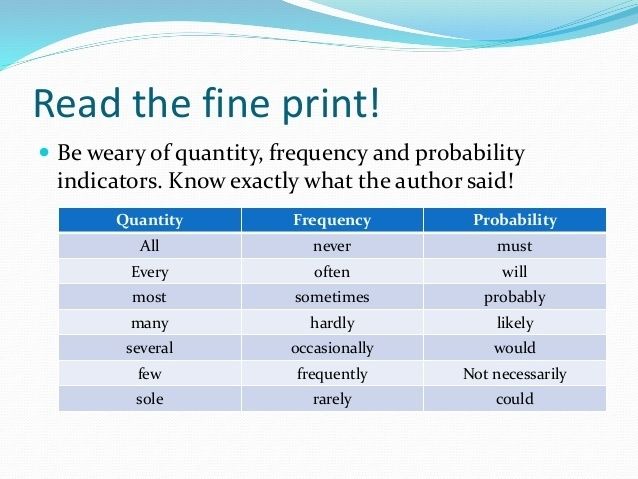
quantity indicators refer to the amount or quantity in the relationship
probability indicators refer to the likelihood of an occurrence
Scope:
the scope of an argument is the range which premises and conclusions encompass certain ideas
Narrow vs. Broad arguments
Test Strategies:
summarize arguments so that you understand them in your own words
Further Practice:
PowerScore Premise and Conclusion Anaysis Drill pp. 65-70
Identify the Conclusion Examples, Khan Academy (logical reasoning lessons)
Page 5
Chapter Summary
This chapter went over:
premises and conclusions
Complex Arguments
Killer Text and Decoding them
Understanding Stimuli
Important Terminology
Premise
Conclusion
Complex Argument
Comma
Colon
Dash
Indicator Word
Further Reference:
How To Master LR | LSAT Logical Reasoning (Embed)
LSAT Logical Reasoning | Logical Reasoning Basics (Embed)
Fill In The Blank Worksheet (application/pdf)
Further Practice:
fill in the blank worksheet, attached
Khan Academy Logical Reasoning practice section
Information
- Description
- LSAT logical reasoning Note on Logical Reasoning Basics , created by Ruby Daughtry on 18/04/2021.
- Created by
- Ruby Daughtry
- Views
- 2
- Rating