
Notes
Topic 3b: integumentary system
Content of the notes (7)
Page 1
Aka skin, cutaneous membrane. Made of a variety of tissue types to match diverse functions. Acts as a membrane and as an organ.
Function: protects internal organs from physical, chemical, and biological damage, conserves water, eliminates waste, synthesizes Vitamin D, regulates temperature, relays sensory information to the CNS
Structure:
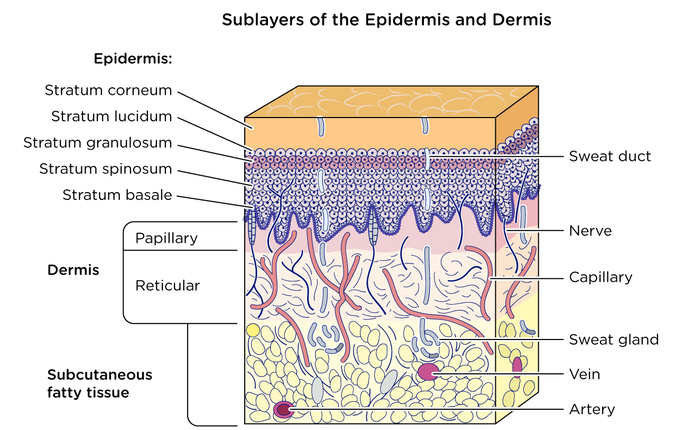
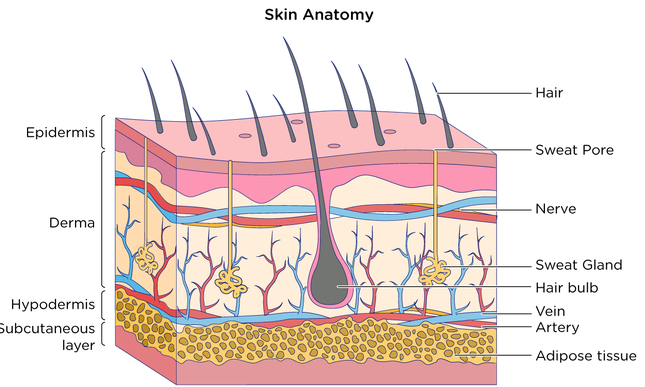
epidermis: Most superficial layer, functions are touch sensation and protection against microorganisms.
dermis: much thicker than the epidermis, its function is to support and anchor the epidermis
hypodermis: also known as the subcutaneous layer, it supports the upper layers of the skin. It has a great blood supply and is made up of loose connective tissue.
Page 2
epidermis: a thin layer on the surface of the body made of 5 layers of stratified squamous epithelial tissue connected to the dermis via basement membrane.
stratum corneum: dead skin cells shed into the environment, helps repel water
stratum lucidum: only on palms and bottom of feet
stratum granulosum: keratin production
stratum spinosum: provides strength and flexibility
stratum basale: keratinocytes and melanocytes constantly divide to replace cells lost to shedding, and as they move upwards through the epidermis, they die due to lack of nutrients and O2
Main cell types:
Melanocytes in the bottom layers produce melanin, a pigment that protects from UV damage
keratinocytes: make keratin (waterproofing protein); nails are specialized keratinized structures that protect the ends of the extremities
contains only epithelial tissues, no blood vessels to provide O2 and nutrients, so they must diffuse from the dermis
Page 3
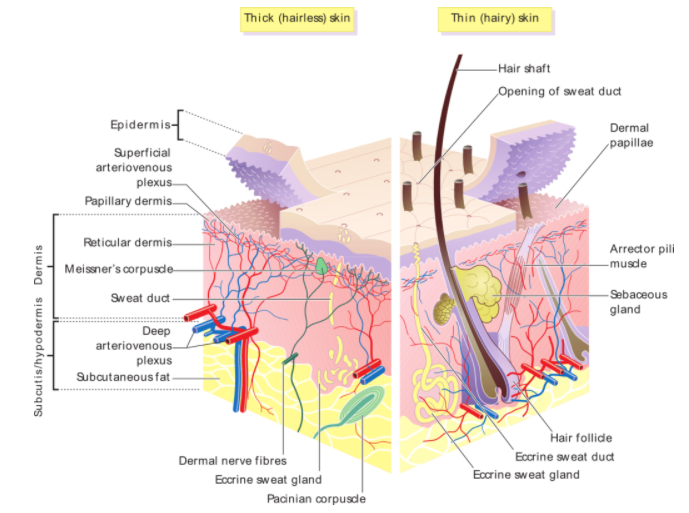
dermis: has good blood supply and many sensory neurons as well as accessory structures. It is made up of connective tissue with collagen and elastic fibers
blood vessels: supply nutrients and O2, bring immune cells to fight infection, and carry away waste
nerves: relay signals like temperature, tactile sensations, pain, pruritus, pressure
collagen: gives skin strength and stretchability
accessory structures:
Hair and hair follicles: in mammals used to conserve heat, however humans do not have much hair on their bodies so this is a vestigial structure like the appendix. Hair is made up of dead keratinized epidermal cells coming out of the hair follicle. Each hair follicle is attached to a small arrector pili muscle, which adjusts the position of the follicle. When the muscle contracts, this causes hair to raise and provide insulation to conserve heat. In humans, this action causes goosebumps. Further, since muscle contractions generate heat, shivering as a result of rapidly contracting muscles—including the arrector pili muscles—also generates heat.
Sweat glands: under the control of the nervous system, they regulate body temperature by cooling through evaporative action of water on the skin surface; They also eliminate small amounts of waste (urea and electrolytes) through excretion. Sweat glands may secrete directly onto skin surface or into hair follicles.
Sebaceous (oil) glands
Page 4
hypodermis: Serves as an anchor (connect skin to muscles and the deeper tissues) and insulator (thermoregulation due to the presence of adipose tissue also known as subcutaneous fat).
Page 5
Role in homeostasis and thermoregulation:
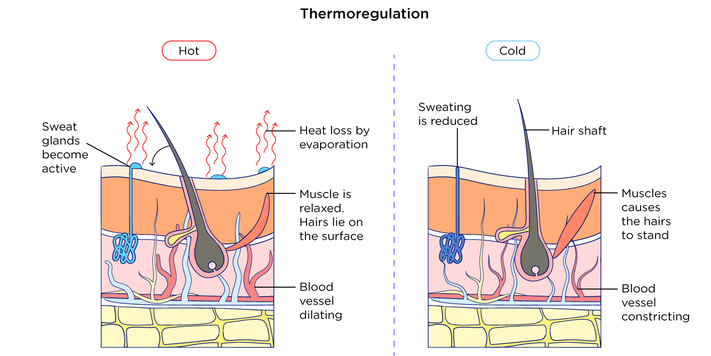
skin reacts differently to change in conditions to maintain body's internal temperature via: radiation, convection, conduction, perspiration, and action of arrector pili muscle
Blood is warmer than tissue, meaning that the pattern of circulation of capillaries in the dermis and hypodermis can be used to contribute to body temperature.
Vasoconstriction: blood vessels constrict keeping heat close to the body.
Vasodilation: blood vessels dilate allowing some heat from the blood to escape through the surface of the skin
Release of heat via radiation (transfer of heat into space via electromagnetic waves)
convection: based on the distance of blood vessels from the skin (vasoconstriction vs dilation), the loss of heat d/t circulating air or fluids coming contact with large amounts of surface area of the skin
arrector pili muscle: when erect, they raise hair up instead of it laying flat. When hair is raised, air is trapped in the hairs to prevent heat loss. When hairs are flat, heat is lost via convection. Cause of goosebumps
conduction: direct transfer of heat from a hotter surface in contact with a cooler surface
perspiration: limited by level of humidity d/t gradient between air and skin
fat is not exactly a thermoregulation mechanism, however it does insulate
osmoregulation: active regulation of osmotic pressures of bodily fluids to maintain the homeostasis of body's water content
kidneys are the major osmoregulatory organs, however skin and lungs also have a role
sweat helps moisturize and cool the skin, helps excrete waste.
Page 6
Physical protection:
keratin toughens skin
Langerhans cells: help immune system fight off bacterial infection
Sebaceous (oil) glands: Associated with hair follicles, secrete sebum which lubricates the hair follicles and the skin, and protects from bacteria. Excess secretion of sebum may result in accumulation of bacteria leading to the inflammatory appearance of acne
melanocytes: produce melanin which protects from UV light damage
fat: cushions internal organs against physical trauma
sensory receptors: help us move away from potential sources of damage/danger
synthesis of Vitamin D: protects from fracture by strengthening bones
minor/localized injury: ex--> callus, when there is repeated abrasion to your fingers or toes, stratum basale increase rate of division to increase thickness of skin at site of trauma
hair: protects from sun damage, traps dust, allergens, and microbe particles. Has sensory functions, is more sensitive to changes in the environment than the skin surface.
nails: specialized keratin structures at the tips of fingers and toes
nail body: formed on the nail bed/root, protects the farthest extremities as they are the parts of the body that experience the maximum mechanical stress. Composed of keratin rich densely packed dead keratinocytes.
nail bed/root: rich in blood vessels, causing it to appear pink except at its base where it has a white crescent shaped region called lunula
lateral nail folds: anchor the nail bodies with folds of skin overlapping the nail on its side
eponychium: aka the nail cuticle meets the proximal end of the nail body.
hyponychium: the area beneath the free edge of the nail where debris get lodged.
Page 7
Hormonal and Nervous Control/Regulation:
Sympathetic nervous system can control perspiration, vasodilation/constriction
2 types of sweat glands:
Apocrine:
Odor from sweat is a result of bacterial activity on the secretions from these glands.
Inactive until they are stimulated by hormonal changes (adrenaline) during puberty.
Main function is believed to be production olfactory pheromones to attract potential mates.
Found in particular locations such as the axillae, areolae of the breasts, ear canals, parts of the external genitalia.
Eccrine:
major sweat glands of the body, found virtually in all skin.
Produce a clear odorless substance made of water and NaCl. NaCl can be reabsorbed in the duct to reduce sodium loss.
Active in thermoregulation. When stimulated by the SNS, involuntarily secrete sweat, which increases skin conductivity; this is an indication of psychological and physiological arousal.
vasodilation and vasoconstriction occur in response to the SAM pathway, a neural pathway originating from the hypothalamus in response to danger or stress dad results in secretion of epinephrine and norepinephrine.
Information
- Description
- Note on Topic 3b: integumentary system, created by 000 000 on 10/01/2022.
- Created by
- 000 000
- Views
- 4
- Rating