
Notes
Topic 5E: enzymes
Content of the notes (4)
Page 1
6 classes of enzymes:
Oxidoreductases: catalyze redox reactions or reactions involving electron or H+ transfer
Transferase: catalyze reactions in which groups are transferred from 1 place to another
Hydrolases: regulate hydrolysis reactions
Lyases: catalyze the addition of functional groups to double bonds, or the formation of double bonds via removal of functional groups
Isomerases: catalyze reactions in which isomers are produced via group transfers WITHIN a molecule
Ligases: catalyze coupled condensation reactions
other important enzyme classes: kinases, phosphatases, and proteases
Page 2
Characteristics of enzymes:
Specificity: a single enzyme typically interacts only with a single class of substrates
Each enzyme has an optimum temperature and pH for activity; changes in conditions can lead to denaturation, which can be irreversible sometimes
have no effect on reaction equilibrium, no effect on thermodynamic spontaneity
Mechanism of action:
the enzyme-substrate complex lowers activation energy of the reaction, thereby speeding up reaction rate
work by bringing reactants in close proximity to one another (covalent catalysis, acid-base catalysis)
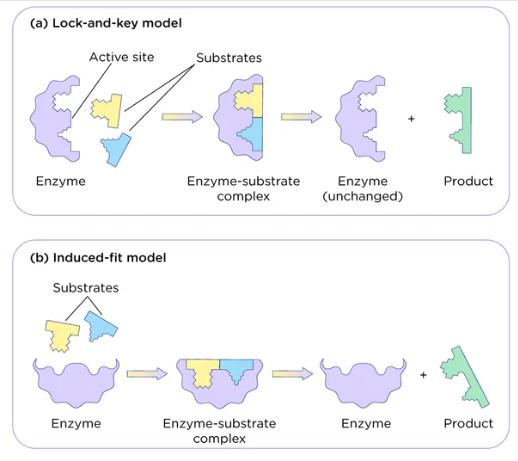
Induced fit model: substrate binds to active site, conformational change occurs to tighten binding b/w enzyme and substrate, to facilitate the reaction.
Ensures the correct substrate binds to the enzyme, as if the substrate does not have the right shape, conformational change does not happen.
Formerly, lock and key model was popular theory
cofactors: ions that bind to the enzyme that are required for enzyme to be able to function
coenzymes: organic materials typically derived from vitamins or diet that bind to enzyme and are essential for enzyme function
substrate binding mechanisms:
ping-pong mechanism: aka double-displacement reaction, change in enzyme into intermediate form when the first substrate is changed to product
ordered mechanism: 1 substrate must bind 1st before the next substrate can bind
random sequential mechanism: substrates and products are bound and released in random order
Page 3
Kinetics:
Michaelis-Menten mechanism: describes the relationship between initial rection rate and [substrate]
[substrate] and [enzyme] are directly related to rate of reaction/activity of enzyme
rate of rxn can be measured by the appearance of product or disappearance of substrate
as [substrate] increase, rate of reaction decreases.
Saturation: point beyond which [substrate] has no effect on reaction rate.
This is a fundamental characteristic of enzyme-catalyzed reactions and is NOT seen in uncatalyzed reactions.
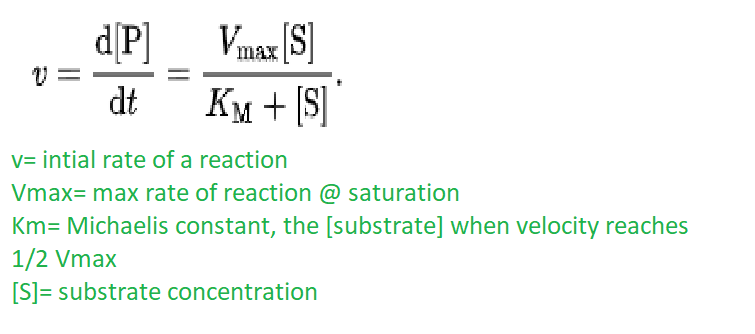
The Michaelis constant (Km) is also an indicator of enzyme affinity; they are inversely related.
Vmax and Km are constants for any given enzymes; they are INDEPENDENT of [substrate]
Vmax is a function of [enzyme]; Vmax will increase if the reaction is run at a higher enzyme concentration
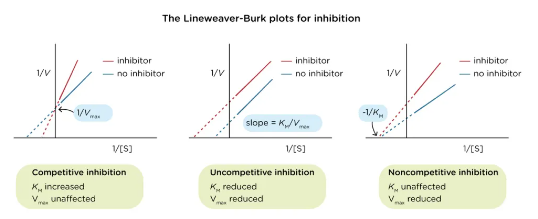
double-reciprocal plots can be used to analyze enzyme activity using Michaelis-Menten relationships
Page 4
Regulation of enzyme activity:
Proteolytic cleavage: aka irreversible covalent modification, the cleavage of specific bonds on the enzyme can activate or destroy a zymogen (proenzyme, the enzyme in its active form)
Reversible covalent modification: activation vs deactivation via phosphorylation or the addition of another modifier (like AMP); this is reversible because the covalent bond b/w the enzyme and the modifier can be hydrolyzed
Control proteins: protein subunits that associate with certain enzymes and modulate their activity (i.e. G proteins)
Allosteric interactions: the modification of an enzyme’s configuration via binding of an activator or inhibitor at the allosteric site
when a repressor molecule binds to the allosteric site, there is conformational change in active site, so substrate is not able to bind anymore, and enzyme activity is halted or decreased. This is a reversible process.
Activator molecules can also bind, and in some enzymes, they are only active when the activator is bound to the allosteric site
cooperativity: allosteric regulation observed in proteins made of multiple identical subunits (like Hgb)
the binding of substrate to 1 subunit increases the other unbound subunits’ affinity for substrate by inducting a conformational change
Hill coefficient: measure of cooperativity in a binding process; if >1, shows positive cooperativity binding, coefficient of 1 indicates independent binding
Inhibitors:
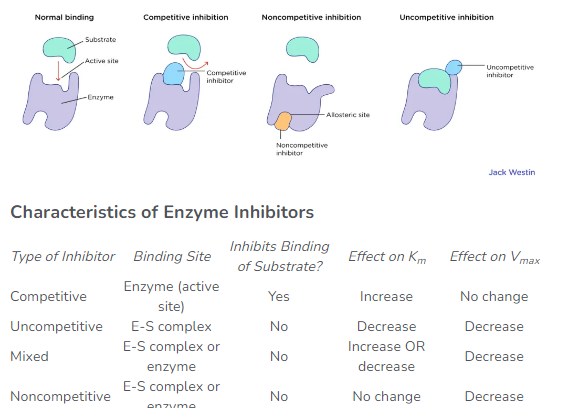
Competitive: similar in shape to substrate, competes with the substrate to bind to the active site, which ultimately decreases enzyme activity.
Increasing [substrate] does help increase enzyme activity
Noncompetitive (allosteric): bind to allosteric sites and change active site conformation to decrease enzyme activity. Substrate is still able to bind, but it is not catalyzed
Increasing [substrate] has ZERO impact on enzyme activity
Mixed inhibitor: bind at a site other than the active site, so they do not prevent the substrate from binding. Able to bind the enzyme itself, and/or the enzyme-substrate complex. They ALL lower Vmax.
Km will increase if the mixed inhibitor behaves like a competitive inhibitor (binds the enzyme before substrate)
Km will decrease if the mixed inhibitor binds the enzyme-substrate complex
Uncompetitive: bind at a site other than active site. Bind only after E-S complex forms, which means increasing [substrate] WILL NOT overcome inhibitor effects. Km decreases, Vmax decreases proportionally. Can exert a positive feedback effect
Information
- Description
- Note on Topic 5E: enzymes, created by 000 000 on 25/07/2022.
- Created by
- 000 000
- Views
- 0
- Rating