
Enzymes and Enzyme Kinetics
289 resources created by 210 users
This Enzymes and Enzyme Kinetics page on GoConqr gathers community-made quizzes, mind maps, flashcards and notes, from enzyme classification and Michaelis constant (Km) to inhibition and covalent modification. It's built for university students and professional candidates revising a topic or filling gaps, and for teachers after ready-made material. There are over 280 resources here, including more than 60 quizzes, 80 mind maps and 120 flashcard decks, all at university level. Pick a quiz to find your gaps, then build your own maps.
Top Enzymes and Enzyme Kinetics resources
-
32 questionsBiochemistry MCQ Exam 1- PMU 2nd Year Which of the following amino acids have charge at ph 7.0?
-
Mind map Th1L07 Regulation of enzyme activity
-
7 questionsEnzyme Regulation - Allosteric Enzymes Which answer best describes Allosteric Enzymes?
-
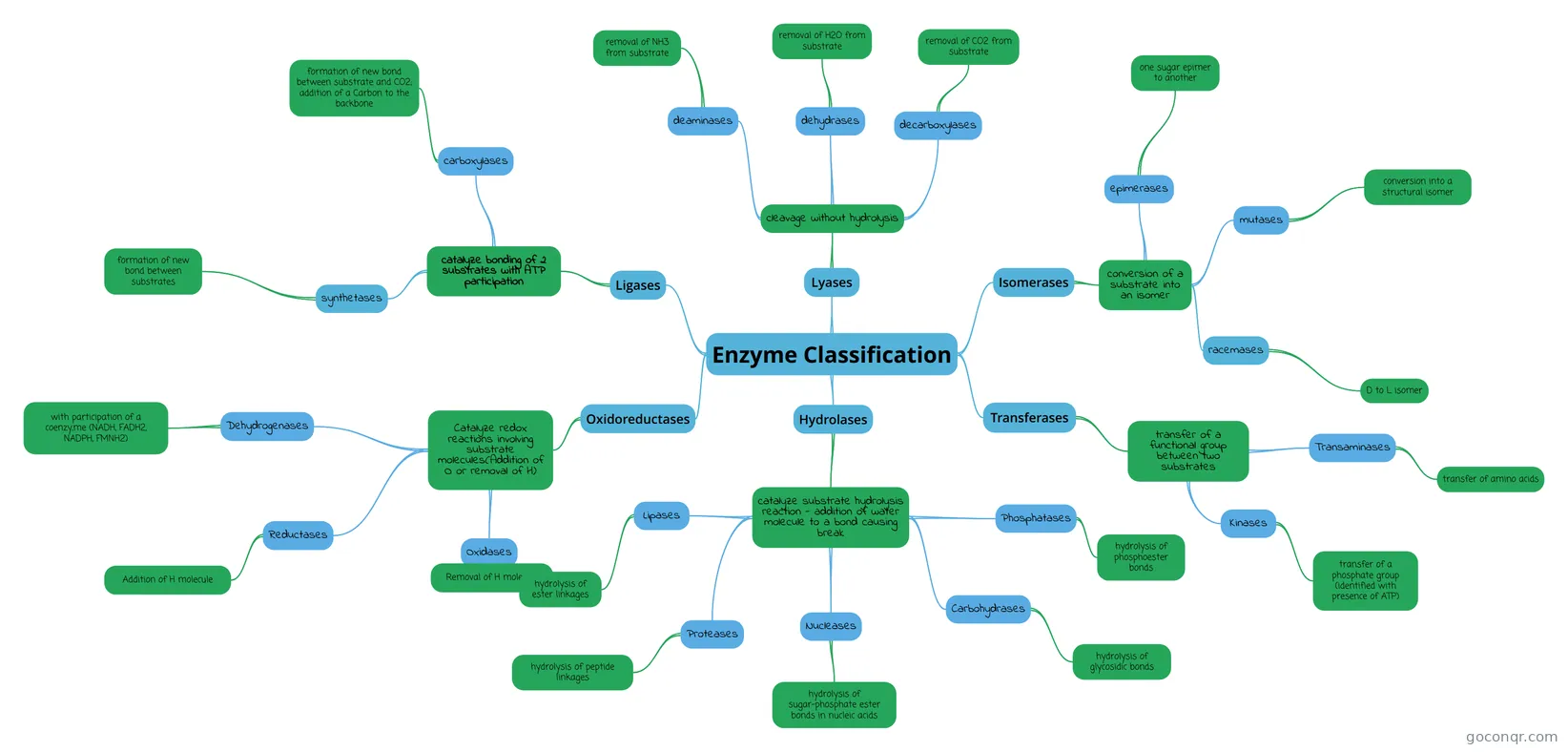 Mind map Enzyme Classification Stoker, H.S. 1998. ORGANIC AND BIOLOGICAL CHEMISTRY. Major and Subclasses
-
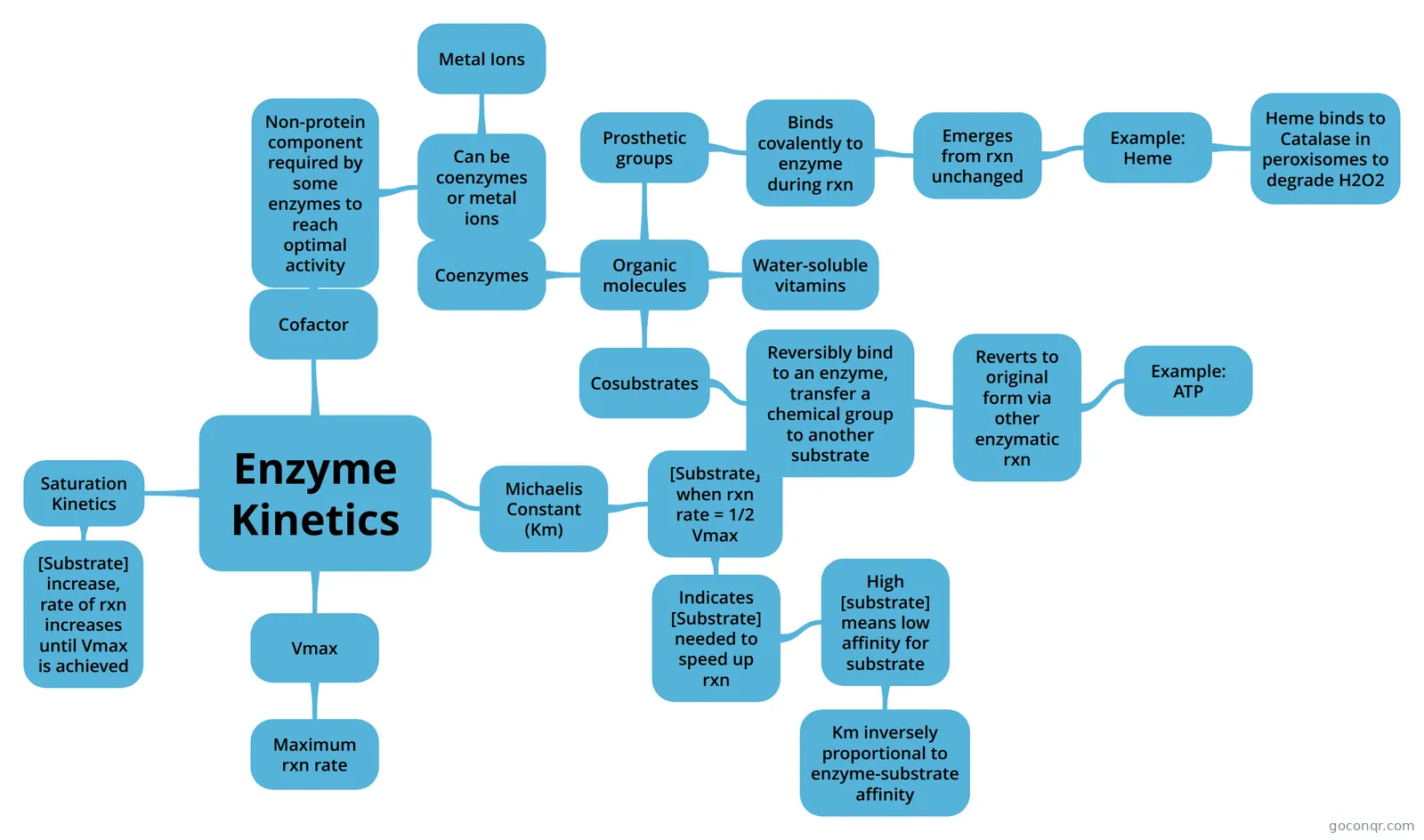 Mind map Enzyme Kinetics Enzyme kinetics maps
-
9 cardsEnzyme Commission Number
-
Mind map Enzyme Kinetics
-
58 cardsCHEM 3012 - Molecular biology and enzymes (enzymes) What does a V1 rate of reaction =
Quizzes
See all 62 quizzes-
32 questionsBiochemistry MCQ Exam 1- PMU 2nd Year Which of the following amino acids have charge at ph 7.0?
-
7 questionsEnzyme Regulation - Allosteric Enzymes Which answer best describes Allosteric Enzymes?
-
42 questionsch 6 One of the enzymes involved in glycolysis, aldolase, requires Zn2+ for catalysis. Under conditions of zinc ...
-
36 questionsEnzymes/N-metabolism Years 2013-2009 MULTIPLICATION OF UBIQUITIN TAGGING:
-
1 questionsOn test Questions Enzymes: Biochemistry Exam 1 Multi reactant Enzymes -Most enzymes have two or more substrates and products 3 different types of Enzymati...
-
46 questionsBiochem Midterm March 2020 in cation exchange the stationary phase is positively charged
-
15 questionsEnzyme Kinetics 1 Which are true about Lineweaver-Burk plots?
-
35 questionsUntitled Enzymatic reactions can be inhibited by reversible and irreversible processes. Reversible processes involve...
Mind maps
See all 81 mind maps-
Th1L07 Regulation of enzyme activity
-
Enzyme Classification Stoker, H.S. 1998. ORGANIC AND BIOLOGICAL CHEMISTRY. Major and Subclasses
-
Enzyme Kinetics Enzyme kinetics maps
-
Enzyme Kinetics
-
Enzymes II
-
Enzymes
-
Biochemistry - Enzymes
-
Enzyme Activity and Bioenergetics A web of the workings of enzymes, inhibitors, high energy molecules, bioenergetics, and kinematics
Flashcards
See all 130 flashcards-
9 cardsEnzyme Commission Number
-
58 cardsCHEM 3012 - Molecular biology and enzymes (enzymes) What does a V1 rate of reaction =
-
96 cardsBchem 393 Flashcards 2 Enzymes
-
73 cardsFNM [002] Enzymes and catalysis What are enzymes? What makes AA different?
-
24 cardsIntro to Enzymes What are enzymes?
-
32 cardsMCAT enzymes what are enzymes?
-
46 cardsProteases what are proteases?
-
33 cardsBIOS 301 Unit 2 Review Draw a dipeptide bond.
Flowcharts
Notes
See all 12 notes-
Enzyme Regulation - Irreversible Covalent Modification Irreversible Covalent ModificationsIrreversible changes in covalent structures are largely restricted to extracellular process. This process involves proteolytic cleavage. This is an important process in digestion, bl...
-
Enzyme Regulation - Reversible Covalent Modification Reversible Covalent ModificationReversible covalent modification is the making and breaking of a covalent bond between a non-protein group and an enzyme molecule. The most common reversible modification is the additio...
-
Week 2 Enzymes and Proteins 1. What are enzymes? Enzymes are protein catalysts of biological origin.2. How do enzymes work? Enzymes work by decreasing amount of free energy of activation necessary.3. What is an international un...
-
Synthetic Enzymes - created from Mind Map MedicineThe enzymes made into medical applications can be divided into 3 kinds of medicines:treatments towards disorders; helping with metabolism; helping manufactured in medicine.( Peter,2012) Industries(Articles,201...
-
Topic 5E: enzymes Characteristics of enzymes: Specificity: a single enzyme typically interacts only with a single class of substrates Each enzyme has an optimum temperature and pH for activity; changes in conditions can lead to denatur...
-
Enzyme Regulation - Allosteric Enzyme Regulation Allosteric Regulative FeedbackA method of controlling metabolism is through allosteric regulative feedback. Allosteric enzymes are distinguished by their response to changes in substrate concentration in addition to t...
-
Enzyme Regulation - Macromolecular Inhibition Protease InhibitorsProteases are important in digestion, blood clotting and defence. The presence of active proteases is disastrous, therefore cells produce specific protease inhibitors. The inhibitors are potent, the...
-
Properties of Enzymes
Topics in Enzymes and Enzyme Kinetics
More Biochemistry topics
About Enzymes and Enzyme Kinetics
GoConqr OriginalWhat this unit covers
The resources here follow enzymes from first principles to regulation. Mind maps such as Enzyme Classification set out the six classes: oxidoreductases, transferases, hydrolases, lyases, isomerases and ligases. The Enzyme Kinetics maps explain the Michaelis constant (Km) as the substrate concentration at half of Vmax, and why a high Km means low affinity for the substrate.
Where to start
Begin with a broad map, then move to detail.
- Open the Enzyme Kinetics mind map to see substrate, product and enzyme-substrate complex laid out together.
- Read the note What does the Km value really mean? to firm up the idea.
- Try the quiz Enzyme Kinetics 1, then Enzyme Kinetics 2.
- Move on to the quiz Enzyme Kinetics and inhibition and the map Competitive and Noncompetitive Inhibitors.
Regulation and classification
A tidy run of notes, flashcards and quizzes covers enzyme regulation. The note on irreversible covalent modification describes proteolytic cleavage, mostly in extracellular processes. The note on reversible covalent modification covers the making and breaking of a bond between a non-protein group and an enzyme. The quiz Enzyme Regulation - Allosteric Enzymes asks about cooperative behaviour and how it appears on a graph.
For naming, the flashcard deck Enzyme Commission Number pairs EC numbers with enzymes such as alkaline phosphatase and aspartate aminotransferase.
Using quizzes and maps together
Read a map first, then take a quiz on the same topic and note what you missed. Go back to the map for those branches. For exam-style practice, the MCAT enzymes flashcard deck is there, and the community has also shared past-paper style quizzes such as Enzymes Past Papers.
Where it fits
This unit sits in the strand Enzymes, Coenzymes and Bioenergetics, within Biochemistry. Teachers can pick a map or quiz to set as a ready-made task. Choose one resource today and see how far it takes you.
Frequently asked questions
Which resource should I open first?
Start with the Enzyme Kinetics mind map. It lays out substrate, product, the enzyme-substrate complex and the Michaelis constant on one page. Then try the quiz Enzyme Kinetics 1 to check what stuck, and move to the inhibition resources once Km feels comfortable.
What do the mind maps cover?
There are over 80 mind maps. They cover enzyme classification, kinetics, properties, competitive and noncompetitive inhibitors, regulation, cofactors, the chymotrypsin reaction and other proteases, plus clinical uses of enzyme measurements. Several are simply titled Enzymes, so open a few and pick the layout that suits you.
Are the resources free to use?
Yes. Every resource listed here is free to open, study and take, with no account needed. They were made by GoConqr users rather than by GoConqr, so styles and depth vary. A free account lets you save quiz scores and make your own quizzes, maps, flashcards and notes.
Which levels and exams do these suit?
The resources are all at university level, so they suit university students and professional candidates, and teachers looking for ready-made material. Exam practice is mentioned for the MCAT, for example in the MCAT enzymes flashcard deck. Other resources follow individual course exams and midterms.
Is there anything on enzyme regulation?
Yes. You will find notes, flashcards and quizzes on allosteric regulation, reversible and irreversible covalent modification, and macromolecular inhibition. Work through the notes first, then use the matching quiz for each topic to see which ideas you still need to revisit.
What if I can't find a topic I need?
Try a neighbouring title, since many resources are simply called Enzymes and cover a mix of topics. If a gap remains, you can build your own flashcards, mind map or quiz on it and keep it for revision.