
Notes
Energy and Matter
Content of the notes (1)
Page 1
Energy Transfers
Thermal
Light
Electrical
Potential (elastic and gravitational)
Sound
Kinetic
Chemical
Nuclear
Conservation of Energy Energy is neither created nor destroyed, it is converted from one form to another.
Efficiency Efficiency = useful energy output / total energy input
Sankey Diagrams
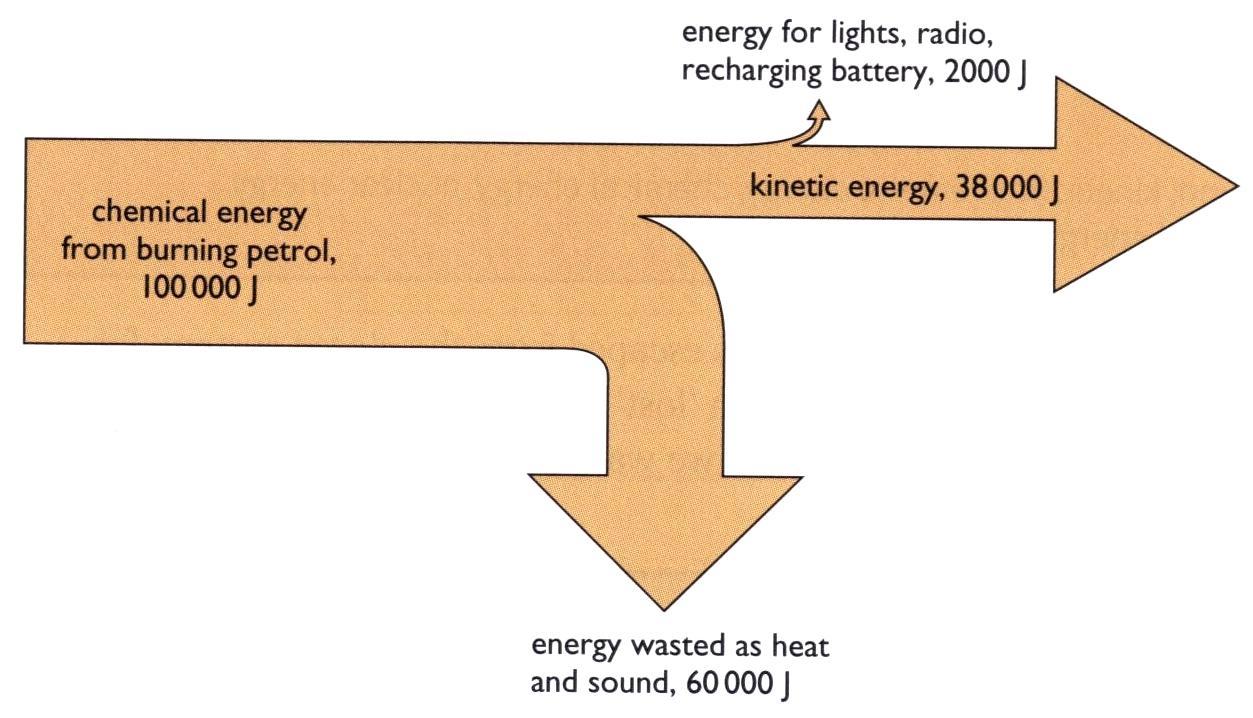
Sankey diagrams show the flow of energy by using arrows whose width is proportional to the amount of energy involved. Energy flow from a car is shown in a sankey diagram below.
Thermal Energy
Thermal Conduction: the transfer of thermal energy through a substance without the substance itself moving.
In solids, when one end is heated, the vibrational energy of the molecules increase. The energy is transferred from molecule to molecule. Fast process in metals because electrons are free to move and carry energy through the material quickly.
Example: a copper rod is heated with wax at one end. As the heat energy is conducted along the rod, the wax melts away.
Thermal Convection: transfer of thermal energy through fluids by the upward movement of warmer, less dense regions in the fluid.
Heated gas or liquid expands, which means it will be less dense, so the warm fluid floats upwards as the cold fluid pushes it out.
Example: in a two-storey house, it will be warmer in the second floor because warm air rises, so it will be cooler on the first floor.
Thermal Radiation: the transfer of thermal energy in the form of infrared waves. It is the only method of heat transfer through a vacuum.
IR waves travel at the speed of light in space, and almost as fast in air. Their heat can travel at any direction.
Example: the earth is warmed by the IR rays from the sun.
Convection in Everyday Phenomena
When the Earth is heated by the sun, the warm air rises above the equator as it is displaced by cooler, less dense air sinking to the North and South poles. This results in huge convection currents causing winds across oceans/continents.
Insulation Air is a bad conductor of heat, so many insulators use trapped air to prevent heat from escaping.
Reducing conduction: double glazing windows - trapped air between two glasses creating a vacuum so conduction does not take place
Reducing convection: cavity walls - insert foam in between walls to trap air, preventing circulation of air
Reducing radiation: shiny surfaces - reflects IR waves
Generating Electricity from Energy Transfers Wind: renewable; sun's pressure in atmosphere drives wind; converts kinetic energy into other forms
Water: renewable; sun and move causing tidal movement generates waves; kinetic energy of sea drives water turbines as tide comes in; water trapped behind dam is used to drive turbines once tide goes out
Geothermal resources: renewable; produced by the heat of the Earth's core
Solar heating systems: renewable; focusing mirrors heat water to produce steam
Solar cells: renewable; use solar heat exchangers to provide hot water for domestic use
Fossil fuels: nonrenewable; uses oil, gas and coal to drive transportation
Nuclear power: nonrenewable; produces almost an infinite amount of heat
Advantages and Disadvantages of Large Scale Electricity Production How much does it cost? Is it renewable/non-renewable? How does it impact the environment? How much can be supplied with the demand? Does it produce greenhouse gases? Where should it be produced?
Density Density: measured in kilograms per meter cubed
Density (ρ) = mass (m) / volume (V)
Pressure
Pressure: measured in newtons per meter squared
Pressure (P) = force (F) / area (A)
Information
- Description
- International General Certificate of Secondary Education Science (Physics) Note on Energy and Matter, created by Anneka de Leon on 29/11/2015.
- Created by
- Anneka de Leon · Nov 2015
- Updated
- Feb 19, 2016
- Views
- 2
- Rating