
Notes
Waves
Content of the notes (1)
Page 1
Waves
Units used in this section: Degree (˚), Hertz (Hz), Meters (m), Meters/Second (m/s) and seconds (s).
Properties of waves.
Longitudinal and transverse.
Longitudinal:
-Vibrations are in the same direction are the wave. (Backwards and forwards.) Compressions are where the vibrations are close together.
- Sound waves, travel this way.
can be shown by use of spring
Transverse:
-Vibrations/oscillations go up and down across a mid-point.
-Light and electromagnetic waves, travel this way.
Can be shown by use of water or spring or rope.
Amplitude, frequency, wave length and period of a wave.
Amplitude=distance between mid-point and the top of the peak.
Frequency= the number of waves per second. (Hz.)
Wave length= the distance between one wave to the next. eg. peak to peak.
Time period=Time taken to complete one complete wave.
Waves transfer energy and information without transferring matter.
The relationship between wave speed, frequency and wave length is:
Wave speed = frequency X time
The relationship between frequency and time period is:
Frequency=1/time period.
Diffraction.
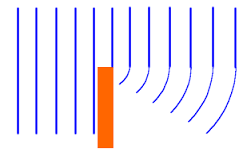
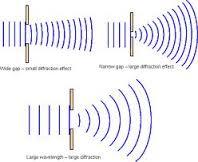
Waves can be diffracted when they pass an edge and by passing through gaps.
- This happens with radio waves and hills or water waves and islands.
- This happens in water.
diffraction means waves bend round edges and through gaps allowing waves to bend round corners.
If the gap is equal to wavelength there is maximum diffraction.
If it is a bit wider there is diffraction at edges.
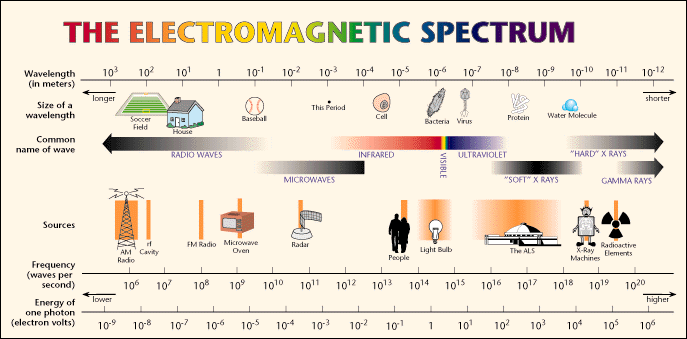
The Electromagnetic spectrum.
Uses of electromagnetic radiation:
Radio waves=broadcasting and communication
Information
- Description
- GCSE Physics Note on Waves, created by owens.ek on 04/01/2016.
- Created by
- owens.ek
- Views
- 1
- Rating