
Notes
Terminal Velocity
Content of the notes (1)
Page 1
Terminal velocity, steady speed achieved by an object freely falling through a gas or liquid. A typical terminal velocity for a parachutist who delays opening the chute is about 150 miles (240 kilometres) per hour. Raindrops fall at a much lower terminal velocity, and a mist of tiny oil droplets settles at an exceedingly small terminal velocity. An object dropped from rest will increase its speed until it reaches terminal velocity; an object forced to move faster than its terminal velocity will, upon release, slow down to this constant velocity.
Terminal velocity is achieved, therefore, when the speed of a moving object is no longer increasing or decreasing; the object’s acceleration (or deceleration) is zero. The force of air resistance is approximately proportional to the speed of the falling object, so that air resistance increases for an object that is accelerating, having been dropped from rest until terminal velocity is reached. At terminal velocity, air resistance equals in magnitude the weight of the falling object. Because the two are oppositely directed forces, the total force on the object is zero, and the speed of the object has become constant.
Three stages of falling When an object is dropped, we can identify three stages before it hits the ground:
At the start, the object accelerates downwards because of its weight. There is no air resistance. There is a resultant force acting downwards.
As it gains speed, the object's weight stays the same, but the air resistance on it increases. There is a resultant force acting downwards.
Eventually, the object's weight is balanced by the air resistance. There is no resultant force and the object reaches a steady speed, called the terminal velocity.
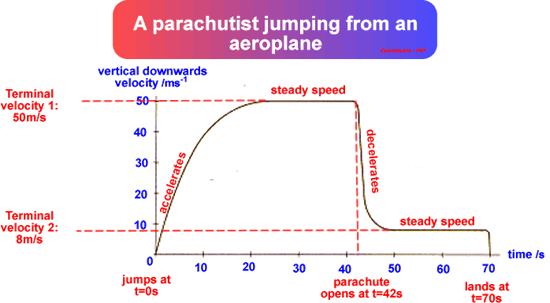
When s/he steps out of the plane his/her vertical velocity component is 0 m/s so air resistance is zero. That means only the force of gravity acting on his mass - his weight - is acting. That means his vertical velocity rapidly increases.
As the speed of the skydiver increases every second as he or she plummets towards the ground there is an increase in air resistance (as this gets bigger as his/her speed increases). This results in a smaller net force acting on the skydiver. S/he is still getting faster, but not at the same rate as s/he did initially. Look at the graph representing how the vertical velocity changes duing the fall. You can see that the gradient decreases as the speed increases.Eventually the gradient of the graph is zero.
That happens when Fw = FAR
No net force means no acceleration and that means the velocity will remain constant. It is the final velocity - terminal velocity.
Terminal Velocity Formula is given by:

Where, g is the acceleration due to gravity,
h is the height from the ground
Terminal velocity is used to calculate terminal velocity, acceleration due to gravity or height if some of these quantities are known. It is expressed in meter per second (m/s).
Information
- Description
- 4 Science Note on Terminal Velocity, created by Lewis Surtees on 10/03/2016.
- Created by
- Lewis Surtees
- Views
- 19
- Rating