
Forces and Newton's Laws
792 resources created by 628 users
This Forces and Newton's Laws page on GoConqr gathers community-made quizzes, mind maps, flashcards, slides and notes, from vectors and scalars to terminal velocity, moments, momentum and Hooke's Law. It's built for school students revising a topic and teachers after ready-made material. There are over 4,600 resources here, including more than 350 quizzes, over 2,400 mind maps and more than 1,500 flashcards, most of them pitched at secondary level. Pick a resource, try a quiz to find your gaps, then make your own set.
Top Forces and Newton's Laws resources
-
Mind map Physics Section 3 - Mechanics and Materials Physics Section 3 - Mechanics and Materials revision mind map
-
27 questionsPHYS 200 Final Exam 1 The corners of a square lie on a disk of radius r = 51 cm. What is the area of the square, expressed in squ...
-
29 cardsPhysics GRE Prep - Classical Mechanics Blocks on Ramps: Force Parallel and Force Perpendicular
-
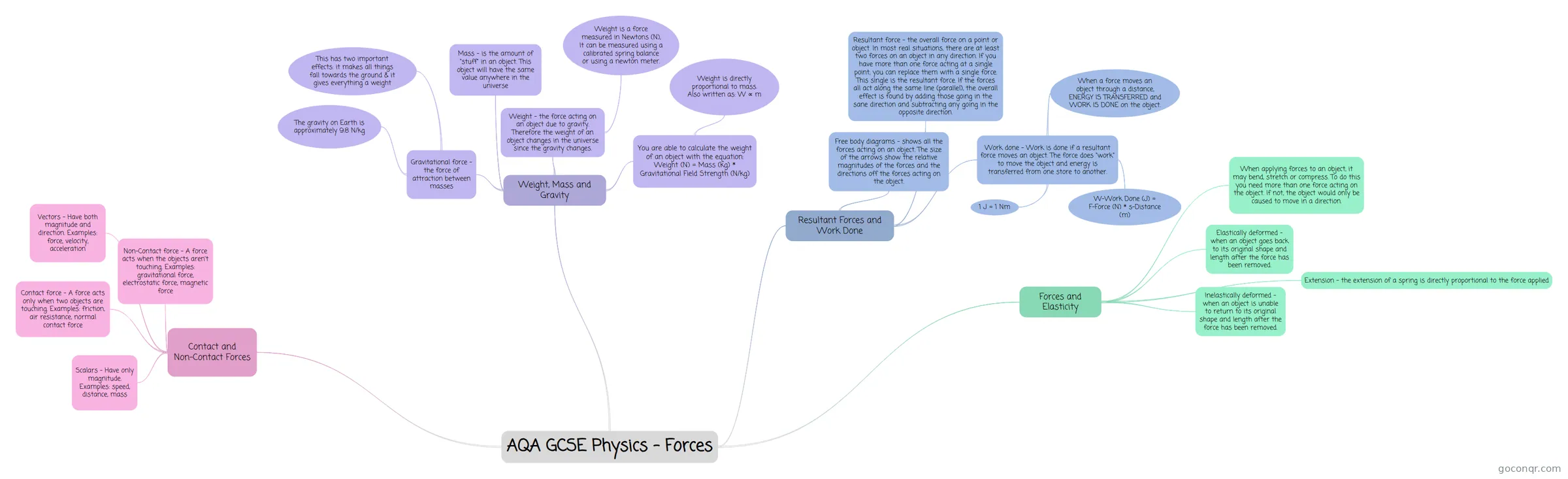 Mind map AQA GCSE Physics - Forces The entire topic of forces from the AQA GCSE revision guide in one mind map.
-
Mind map Chapter 7 - Laws of motion and momentum
-
40 questions0654 Coordinated Sciences Topics P1 & P2 Motion & Matter and Forces Quiz A horizontal force of 120 N is used to pull a 25 kg bag of sand 10 m along a floor. How much work is done b...
-
35 questionsTopic 1 Mechanics The acceleration of free fall on the Moon is one-sixth of that on Earth. On Earth it takes time t for a sto...
-
27 cardsNewton's Laws What is true about the inertia of two cars, Car A of mass 1,500 kilograms and Car B of mass 2,000 kilograms...
Quizzes
See all 134 quizzes-
27 questionsPHYS 200 Final Exam 1 The corners of a square lie on a disk of radius r = 51 cm. What is the area of the square, expressed in squ...
-
40 questions0654 Coordinated Sciences Topics P1 & P2 Motion & Matter and Forces Quiz A horizontal force of 120 N is used to pull a 25 kg bag of sand 10 m along a floor. How much work is done b...
-
35 questionsTopic 1 Mechanics The acceleration of free fall on the Moon is one-sixth of that on Earth. On Earth it takes time t for a sto...
-
15 questions0654 Coordinated Sciences Effects of Forces Quiz A spring obeys Hooke’s law. Which graph is obtained by plotting the extension of the spring against the loa...
-
31 questionsPhysics Regents Practice Questions Which term identifies a scalar quantity?
-
30 questionsOCR Gateway GCSE P3 Revision Quiz Why is average distance used?
-
26 questionsForces and Motion Practice Test A change in position in a certain amount of time is called
-
16 questionsEdexcel IGCSE Physics - Forces and Motion (HT, Single Award) Which of the following is a vector quantity?
Mind maps
See all 262 mind maps-
Physics Section 3 - Mechanics and Materials Physics Section 3 - Mechanics and Materials revision mind map
-
AQA GCSE Physics - Forces The entire topic of forces from the AQA GCSE revision guide in one mind map.
-
Chapter 7 - Laws of motion and momentum
-
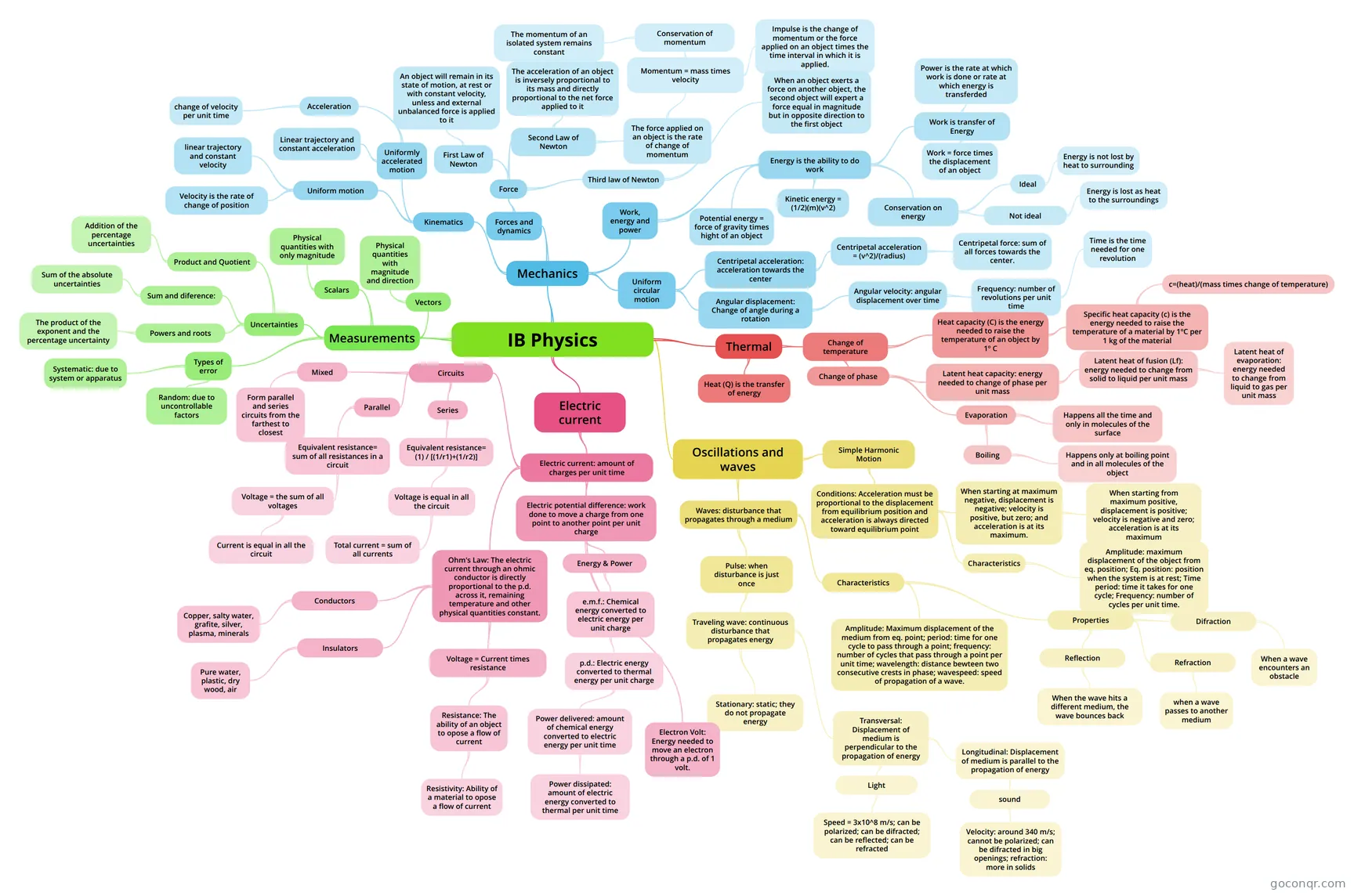 IB Physics
-
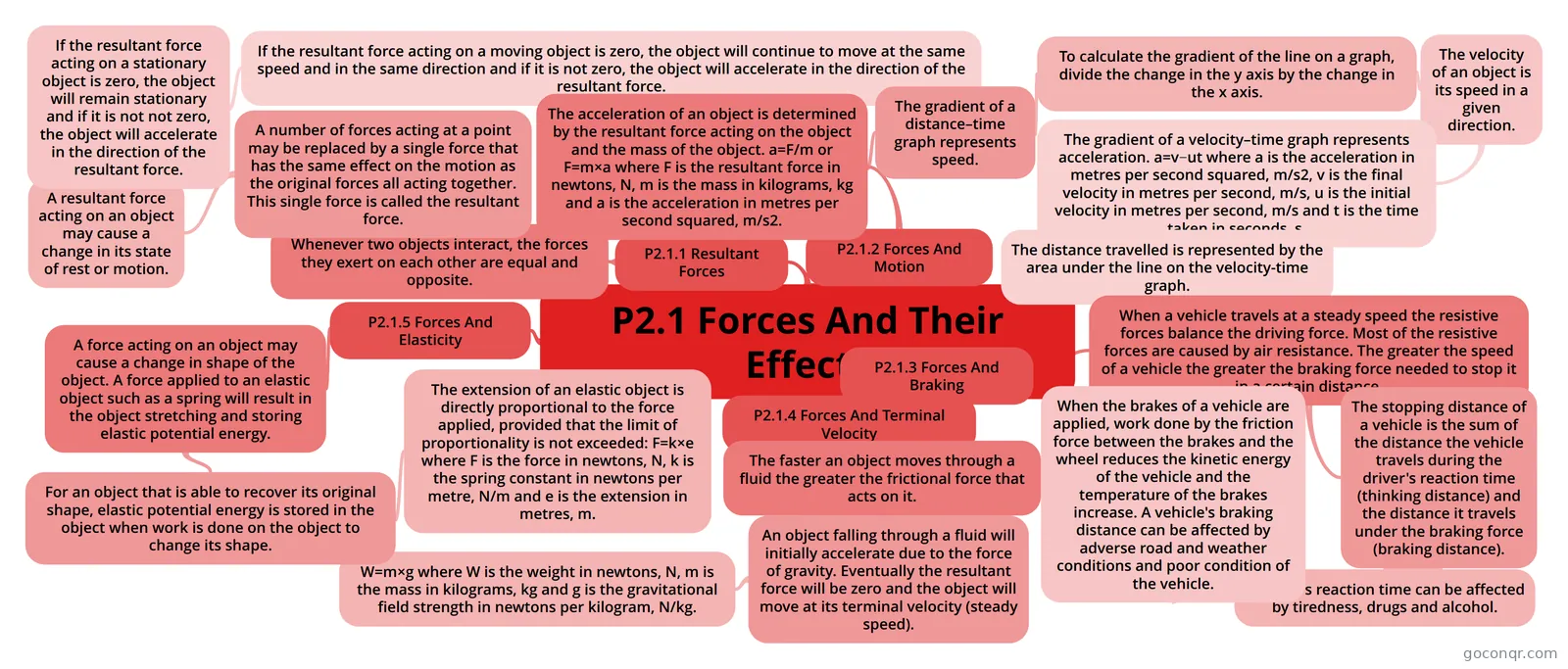 P2.1 Forces And Their Effects
-
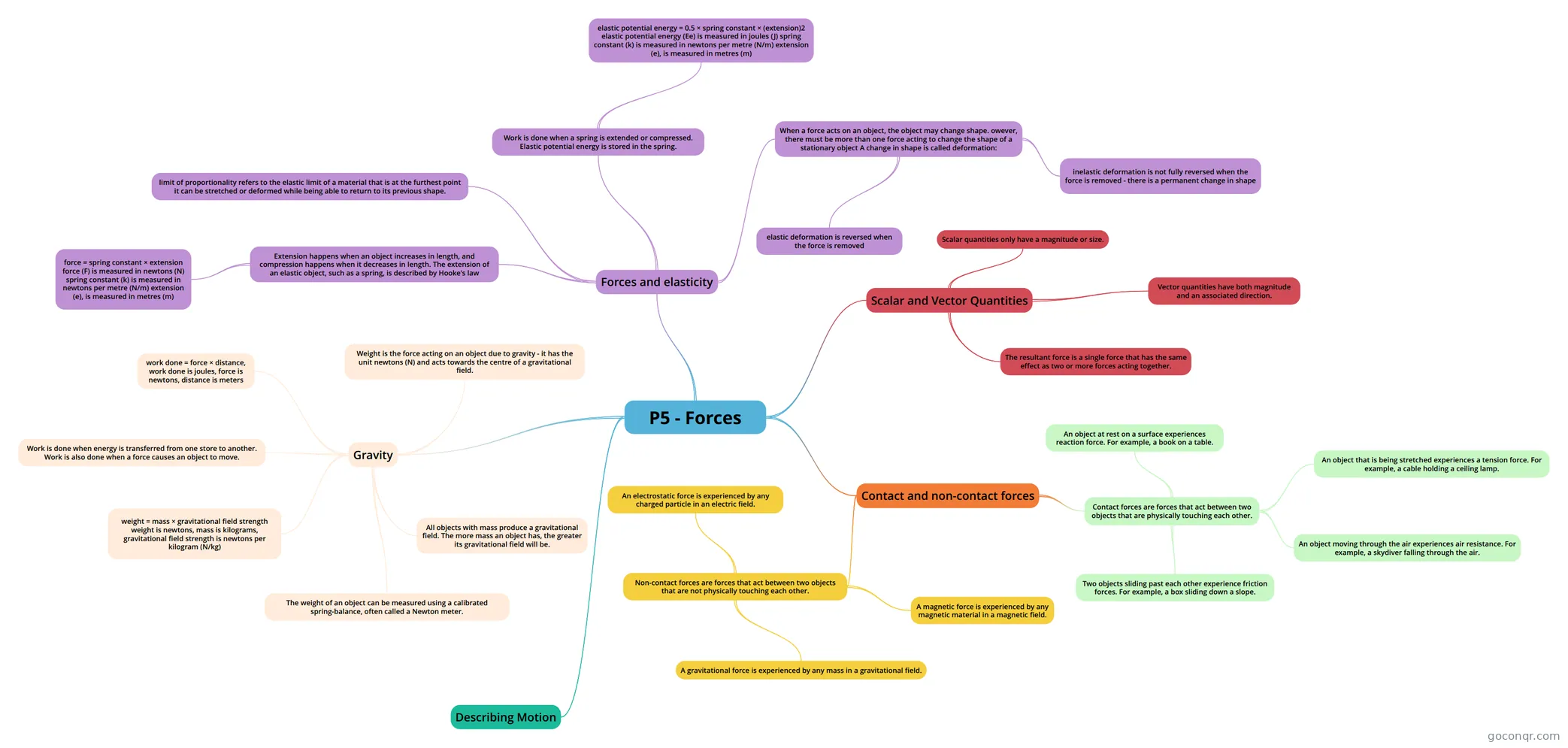 P5 - Forces
-
Physics 2 physic p2
-
Newton's Laws of Motion Isaac Newton's Laws of Motion! :)
Flashcards
See all 325 flashcards-
29 cardsPhysics GRE Prep - Classical Mechanics Blocks on Ramps: Force Parallel and Force Perpendicular
-
27 cardsNewton's Laws What is true about the inertia of two cars, Car A of mass 1,500 kilograms and Car B of mass 2,000 kilograms...
-
33 cardsOCR Gateway Physics P3 flashcards Speed can be measure in..... [3]
-
40 cardsLeaving Cert Physics mechanics definitions Flashcards on Physics mechanics definitions, created by Aoife Clooney on 28/05/2017.
-
40 cardsForce and Motion and Newton's 2nd Law_Science Study Guide What is a push or pull exerted on matter?
-
35 cardsForce and Motion 8th Grade What is force?
-
17 cardsMYP 1 Forces PPT What is Force? 1
-
20 cardsNewton's Laws of Motion What can force do?
Flowcharts
Notes
See all 54 notes-
Forces and motion : D-T and V-T graphs Distance time graphs Velocity Time graph Velocity is speed in direction e.g 30 mph north or 20 m/s,060 degreesparticular
-
Physics section 1: Forces and motion
-
Derive and Apply - Practice Questions and answers for AS Physics A OCR - Mechanics G481
-
Physics: Unit 4 - Fields and Further Mechanics (Notes 1 of 2) Momentum ConceptsMomentum (kgm/s) = mass (kg) x velocity (m/s)Assuming that no external forces (eg. friction) act during a collision or explosion, momentum will always be conserved; total momentum before = total momen...
-
Section 1: forces and motion c) forces, movement and shape
-
GCSE Physics Revision notes IN general... A force is a push or a pull A force can: change the shape of an object or can change its state of rest or motion or change the direction of an object The unit of force is the Newton (N) Balanced forces W...
-
Centre of Mass... What is it?The centre of mass of an object is the point at which the mass of the object is thought to be concentrated.The centre of mass of an object is the only place where that object will balance on a point. CENTRE...
-
Mathematics: Mechanics 2 (Notes 1 of 2) The weight of an object is considered to act at it's centre of mass (or centre of gravity). So 'the total effect of gravity on each bit of a body is the same as one force at the centre of mass'.The centre of mass will...
Slides
See all 13 slidesMore Physics topics
About Forces and Newton's Laws
GoConqr OriginalWhat the resources cover
This unit sits in the Mechanics strand of Physics. The listed material runs from basic ideas to further mechanics. The AQA GCSE Physics - Forces mind map separates contact and non-contact forces, and vectors from scalars. The mind map called Chapter 7 - Laws of motion and momentum sets out Newton's first and third laws. Other maps look at inertia, moments, buoyancy, pressure and forces in equilibrium.
Where to start
If forces are new to you, begin with the KS3 Forces Quiz or the Forces and Motion Practice Test. They cover naming forces, speed and simple calculations. Then move to the Adding forces quiz and the Scalar and Vector quantites quiz before tackling Newton's laws.
- Read a mind map such as Newton's Laws to see the whole topic.
- Take a quiz such as Newton's Laws of Motion to test it.
- Go back to the notes on any weak point.
- Use flashcards to fix definitions and equations.
Using quizzes and maps together
Mind maps give you the shape of a topic. Quizzes show what you can actually recall. Try a map first, then a quiz, then return to the map and look at the branches you missed. The Forces and Newton's Laws of Motion Pretest is a handy check before you begin.
Going further
Once the basics are secure, the page lists material for exam courses. These include the AS Level Physics quizzes on resolving vectors, force-time graphs and impulse, and the IB Physics mind map. There are also GCSE sets, such as the OCR Gateway Physics P3 flashcards, and 0654 Coordinated Sciences quizzes on Hooke's Law and on mass and weight. The PHYS 200 Final Exam quizzes include measurement and uncertainty questions. Teachers can pick slides, notes and flashcard decks to use with a class.
Make it your own
Nothing here covers your exact course? Choose the closest resource, then build your own quiz, mind map or flashcards from it. Start with one topic today.
Frequently asked questions
Which resource should I start with?
If forces are new, try the KS3 Forces Quiz or the Forces and Motion Practice Test. Both are gentle and cover naming forces, speed and simple calculations. When those feel easy, move on to the Newton's Laws mind maps and the quizzes on adding forces and on vectors.
What do the mind maps cover?
They cover contact and non-contact forces, vectors and scalars, Newton's laws, inertia, moments, pressure, buoyancy, terminal velocity and forces in equilibrium. Some follow a specific course, such as the AQA GCSE Physics - Forces map, while others are general overviews of motion and forces.
Are the resources free to use?
Yes. Every resource listed here is free to open, study and take, with no account needed. They were made by GoConqr users, not by GoConqr itself. A free account also saves your quiz scores and lets you make your own quizzes, mind maps, flashcards and notes.
Which exams do these resources suit?
Most are aimed at secondary level. The resources mention GCSE Physics, AQA GCSE Physics, IGCSE Physics, A-level Physics, AS Physics, OCR Physics A and IB Physics. There are also items for MCAT and Junior Certificate, so check each title for the course it matches.
Can teachers use this material?
Yes. Teachers can pick slide sets such as Forces and Motion, flashcard decks on Newton's laws, and quizzes for a quick class check. Because everything is free to open, you can look through the options and choose what fits your lesson.
What if I can't find my exact topic?
Look for a nearby resource, such as a mind map on forces or a quiz on motion, and use it as a base. You can then make your own quiz, mind map, flashcards or notes to fill the gap.