
Notes
1.71 Energy
Content of the notes (4)
Page 1
1.71 Energy
Energy
Energy
can be transformed from one type to another and stored, it cannot be
created or destroyed. This is known as the principle of conservation
of energy.
Energy is Measured in joules.
Types of Stored Energy
G.P.E
- Gravitational Potential energy
Kinetic
– The energy an object has due to its movement – e.g. a person
running gains kinetic energy
Chemical
– Stored energy, released in chemical reactions – e.g. a battery
Strain
– Energy stored when an object changes shape – e.g. a stretched
rubber band
Nuclear
– Stored energy released in nuclear reactions e.g. energy
stored in the sun
Internal
Energy – The total kinetic and potential energies of the
particles in an object
Types of Transfer Energy ( Energy
on the move from place to place)
Electric
– Energy carried by an electric current
Sound
– Energy carried by a sound wave
Thermal
(heat) energy – The energy released when the temp of a hot
object decreases due to a decrease in internal energy
Light
– Energy given off – e.g. by very hot objects
Energy is transfered during events and processes
Heat energy can be transfered from a hot object to a cooler one
Kinetic energy can be transferred from one car to another in a collision
Electrical energy can be transferred in a circuit
Principle of conservation of energy
Energy cannot be created or destroyed. It is transformed from one form to another
( view diagram on page 39 )
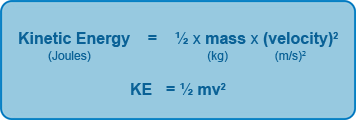
Kinetic energy
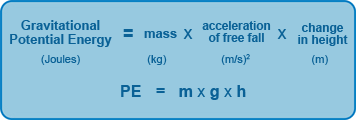
Change in Gravitational portential energy
Change in GPE = mgΔh
Acceleration of free fall = 10m/s²
Page 2
1.72 Energy Resources
Nuclear Fusion
The process of nuclear fusion is carried out in the Sun. Hydrogen nuclei collide at great speed in the sun and fuse together to form helium nuclei. This releases energy in the form of heat and light. The sun is therefore the source of all energy resources, except geothermal, nuclear and tidal
Coal,oil and gas fired power stations
Burn the chemical fuel to release chemical energy, which is transformed to heat energy.
The heat is then used to heat a liquid such as water and increase its internal energy which is then turned into steam.
The pressure from the steam is used to spin a turbine, transferring its kinetic energy to them.
The kinetic energy is transformed to electrical energy in the generators
Advantages
Coal will not run out for many years
Reliable source of energy
Disadvantages
Produces gaseous polution - Carbon dioxide ( contributes to global warming ) & Sulfur dioxide ( causes acid rain )
Non-renewable
Geothermal power stations
Possible to use the natural heat of the earth to generate electricity.
Cold water is first pumped underground gaining heat energy from hot rocks underground
The heat energy is then converted to kinetic energy in turbines
The turbines turn the generator to produce electrical energy
Advantages
Renewable
Doesn'tproduce carbon dioxide or sulphur dioxide
Reliable source of energy
Disadvantages
Few areas where it is available
Hydroelectric power stations
The G.P.E of falling water is transformed to kinetic energy as it passes through turbines
The turbines turn the generator, producing electrical energy
Advantages
Renewable
No carbon dioxide or sulphur dioxide
Energy can be stored as GPE of water
Disadvantages
Land is flooded to build reservoirs - destroys farmland, habitats and peoples homes
Solar Cells
The light energy from the sun is transformed to electrical energy in the solar cell
Advantages
Can be used remotely
No carbon dioxide or sulphur dioxide
Renewable
Low maintenance
Disadvantages
Solar cells are inefficient and expensive - payback time is long
Unreliable - can't be used at night and input during cloudy weather is low
Solar power station
Heat energy from the sun is concentrated by a series of mirrors , focusing energy into one place
This heat energy converts water to steam
The steam turns the turbines giving them kinetic energy.
The kinetic energy is transformed to electrical energy in the generators
Advantages
Renewable
No carbon dioxide or sulfur dioxide
Disadvantages
The array of mirrors occupy a large area
Unreliable
Wave power
Turbines bob on the surface of the sea,transforming G.P.E into kinetic energy
Kinetic energy is then transformed into electrical energy in the generators
Advantages
Renewable
No carbon dioxode or sulfur dioxide
Disadvantages
Unreliable - cannot be used in stormy conditions & output is low on a calm day
DIfficult maintenance
Interferes with shipping
Tidal Power
As the tide comes in water builds up behind a dam gaining G.P.E
When the water is released G.P.E is transformed to kinetic energy
The kinetic energy is transformed into electrical energy in the generator
Advantages
Renewable
No carbon dioxide or sulfur dioxide
Reliable - ( two tides a per day )
Disadvantages
Expensive to build
Few places with suitable conditions
Nuclear power
The nuclear energy stored in uranium-235 is released when uranium nuclei split in a process called nuclear fission ( REMEMBER this is different to nuclear fusion )
The nuclear energy is transformed to heat energy
The heat energy is used to turn water to steam
The steam turns the turbines, transforming the energy into kinetic energy
This kinetic energy is transformed into electrical energy in the generator
Advantages
Plentiful supply of uranium 235
Concerntrated energy resource - a large amount of energy for small amount of fuel
No carbon dioxide or sulfur dioxide
Reliable source of energy
Disadvantages
Non-renewable
Disposal of nucleur waste is problematic - it has a long half-life and the emitted radiatio nis dangerous
Wind power
The kinetic energy of moving air is transferred to the blades
The blades spin, turning the generators
In the generator kinetic energy is transformed into electrical energy
Advantages
Renewable
No carbon dioxide or sulfur dioxide
The area around wind turbines can be used as farmland
Disadvantages
Unreliable - cannot be used in very winds & output is low on calm days
Noisy & unsightly
Page 3
1.73 Work
To lift an object, you need a store of energy. You give the object more g.p.e. The force is your means of transfering energy from you to the object. The name given to this type of energy transfer by a force is doing work. The more work a force does, the more energy it transfers,so: Work done = energy transferred
The amount of energy transferred by a force depends on two things:
The size of the force - the greater the force, the more work it does
The distance moved in the direction of the force - the further it moves, the more work it does
So a big force moving through a big distance does more work than a small force moving through a small distance
Calculating work done
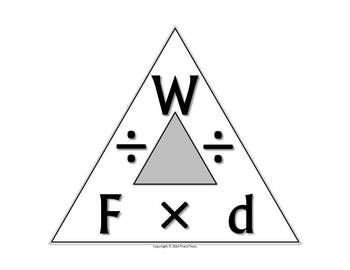
We know that the amount of work done = change in energy ( or ΔE ) so :
work done (joules) = force (n) x distance moved by the force in the direction of the force (m)
or W = F x D = ΔE
Page 4
1.74 Power
In physics the word power has a special meaning. It means the rate you do work. The more work you do, and the shorter the time in which you do it, the greater your power. Power is therefore the rate at which energy is transferred or the rate at which work is done. It is measured in watts, that is joules per second.
In summary, the power in watts is the work done per second or energy transformed per second
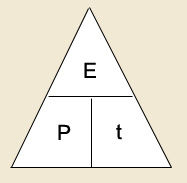
Power (w) = energy transferred (j) ÷ Time (s)
or
P = ΔE ÷ T
Information
- Description
- IGCSE Physics Note on 1.71 Energy, created by mayaleggett on 16/03/2016.
- Created by
- mayaleggett · Mar 2016
- Updated
- Apr 6, 2018
- Views
- 0
- Rating