
Notes
Superposition and Coherence
Content of the notes (2)
Page 1
Superposition Happens When Two or More Waves Pass Through Each Other
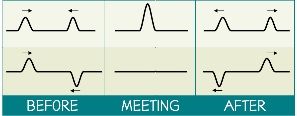
At the instant the waves cross, the displacements due to each wave combine.
The principle of superposition says that when two or more waves cross, the resultant displacement equals the vector sum of the individual displacements
Interference can be Constructive or Destructive
A crest plus another crest will give a superposed trough. The same principle can be applied for the troughs of waves. These are both examples of constructive interference
A crest and a trough will result in no overall displacement. The two displacements cancel each other cancel each other out. This is called destructive interference
If the crest and the trough do not have equal amplitudes, the destructive interference is not toal. For interference tp be noticeable, the two amplitudes should be equal or thereabouts.
Phase - Two Points on a Wave that are In Phase will Interfere Constructively
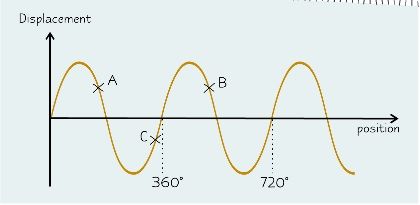
Two points on a wave are in phase if they are both at the same point in the wave cycle. Points in phase have the same displacement and velocity.
Two points with a phase difference of zero or a multiple of 360 degrees (i.e a full cycle) are in phase
Points with a phase difference of odd-number multiples of 180 degrees (π radians, or a half cycle) are in antiphase (completely out of phase)
Two different waves may also be in phase. In practice, this occurs when both waves came from the same source. In other situations, there will nearly always be a phase difference between the two waves.
In the diagram below, points A and B are in phase. Point C however is not.
Page 2
To Obtain Interference Patterns the Two Sources Must Be Coherent
Interference occurs when observing waves of different wavelength and frequency but it is often difficult to detect. In order to get clear interference patterns, the two or more sources must be coherent and in phase
Two sources are coherent if they have the same wavelength and frequency and a fixed phase difference between them
Constructive or Destructive Interference Depends on the Path Difference
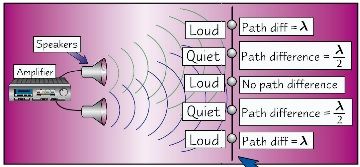
Whether an interference pattern is constructive or destructive depends on how much further one wave has travelled than the other wave to get to that point
The amount by which the path travelled by one wave is loger than the path travelled by the other wave is called the path difference
At any point an equal distance from two sources that are coherent an in phase, constructive interference will occur. Constructive interference will also occur at any point where the path difference is an integer number of wavelengths. At these two points, the waves are in phase and reinforce each other. However at points where the path difference is half a wavelength, one and a half wavelengths,etc. the waves arrive out of phase and destructive interference occurs

Information
- Description
- A2 Physics (Waves) Note on Superposition and Coherence, created by Leonie Jenkins on 06/01/2017.
- Created by
- Leonie Jenkins
- Views
- 3
- Rating