
Notes
What is the Conscience?
Content of the notes (8)
Page 1
Introduction
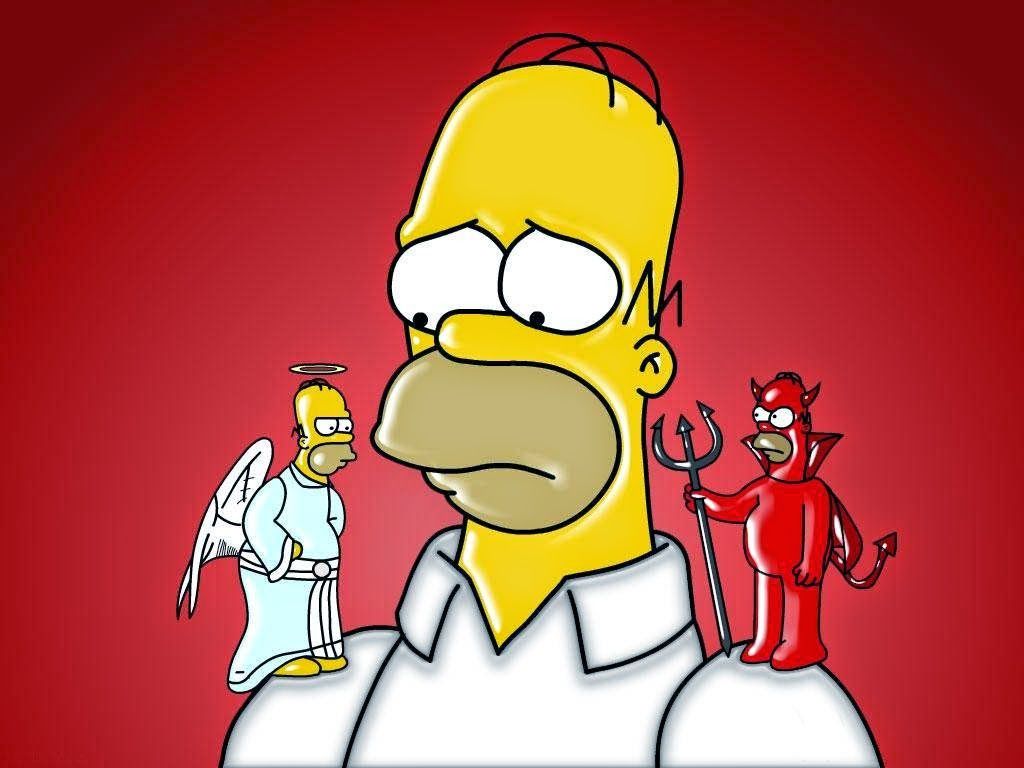
The conscience is classically defined as 'the little voice inside your head.' This voice helps you determine right from wrong. Some theologians argue that the conscience is God-given and is closely linked with God's commands for humanity. As well as the Divine Command Theory, other theologians take their view of the conscience from Biblical teaching. By contrast, psychologists such as Sigmund Freud argue that the conscience is a product of societal norms and upbringing. Regardless of its source, our conscience is our moral guide that is intrinsic to our everyday lives, as it is used for every moral decision we make. Other secular views of the conscience originate from sociology, humanitarian and authoritarian views.
There are four main questions to ask when considering views on the conscience:
What is the conscience?
Where does it come from?
Is it innate or acquired?
What is its function in ethical decision making?
http://www.rsrevision.com/Alevel/ethics/a2conscience/
http://jakedoesrevision.blogspot.co.uk/2013/01/a2-religious-studies-conscience.html
Some noteworthy examples of conscience being applied (or not) include:
Schindler's List - Oskar Schindler was a German industrialist, spy and a member of the Nazi party, who is credited with saving the lives of 1,200 Jews during the Holocaust. Schindler's connections in the Abwehr, the Nazi intelligence service, allowed him to send bribes and luxury, black market gifts to Nazi officials, to prevent over 1,000 of his Jewish workers from deportation, torture and execution in concentration camps. Initially, he did this in the interests of his business, an enamelware factory in Krakow, Poland. But eventually, he came to see that the most valuable thing wasn't profit, but the lives of his workers. In 1993, a film was made that remembered his life. In this ending scene, Schindler is expressing his grief at being too fond of his money, and not saving more lives. Schindler's life is a classic example of the conscience at work - his ideas and mind were changed over time because of his experiences.
Terrorism - The cases of Hiroshima and 9/11 are prominent examples demonstrating the relativism of conscience itself.
"I have noticed my conscience for many years, and I know it is more trouble and bother to me than anything else I started with."
- Mark Twain
Mark Twain is the author of the famed Adventures of Tom Sawyer. The story itself describes a child who tricks others into painting his fence for him and it addresses the issue of using others for personal gain. This could be what Twain is referring to, as the guilt of doing something wrong often causes more problems than it solves. This quote also seems to say that Twain believes that the conscience is innate, and that he 'started with' it.
By contrast, Christopher Reeve, who originally played Superman, takes a different view:
"I think we all have a little voice inside us that will guide us. It may be God, I don't know. But I think that if we shut out all the noise and clutter from our lives and listen to that voice, it will tell us the right thing to do." - Christopher Reeve
He highlights how important our conscience is in guiding our actions and telling us to do the right thing.
Strengths of using the conscience to make decisions:
It prevents us from doing immoral actions (whether or not the action is immoral by our own standards of morality is still debatable).
Our conscience gives us knowledge of consequences of various actions, which is helpful in prevention of immoral actions.
Weaknesses of using the conscience to make decisions:
Everyone's conscience is different, and people may manipulate morality and use their conscience to justify immoral behaviour. For example, the Al Qaeda plane hijackers involved in 9/11 believed they were doing something heroic for their country.
We can also be enticed by immoral actions and choose to ignore what our conscience says.
Page 2
God-Given
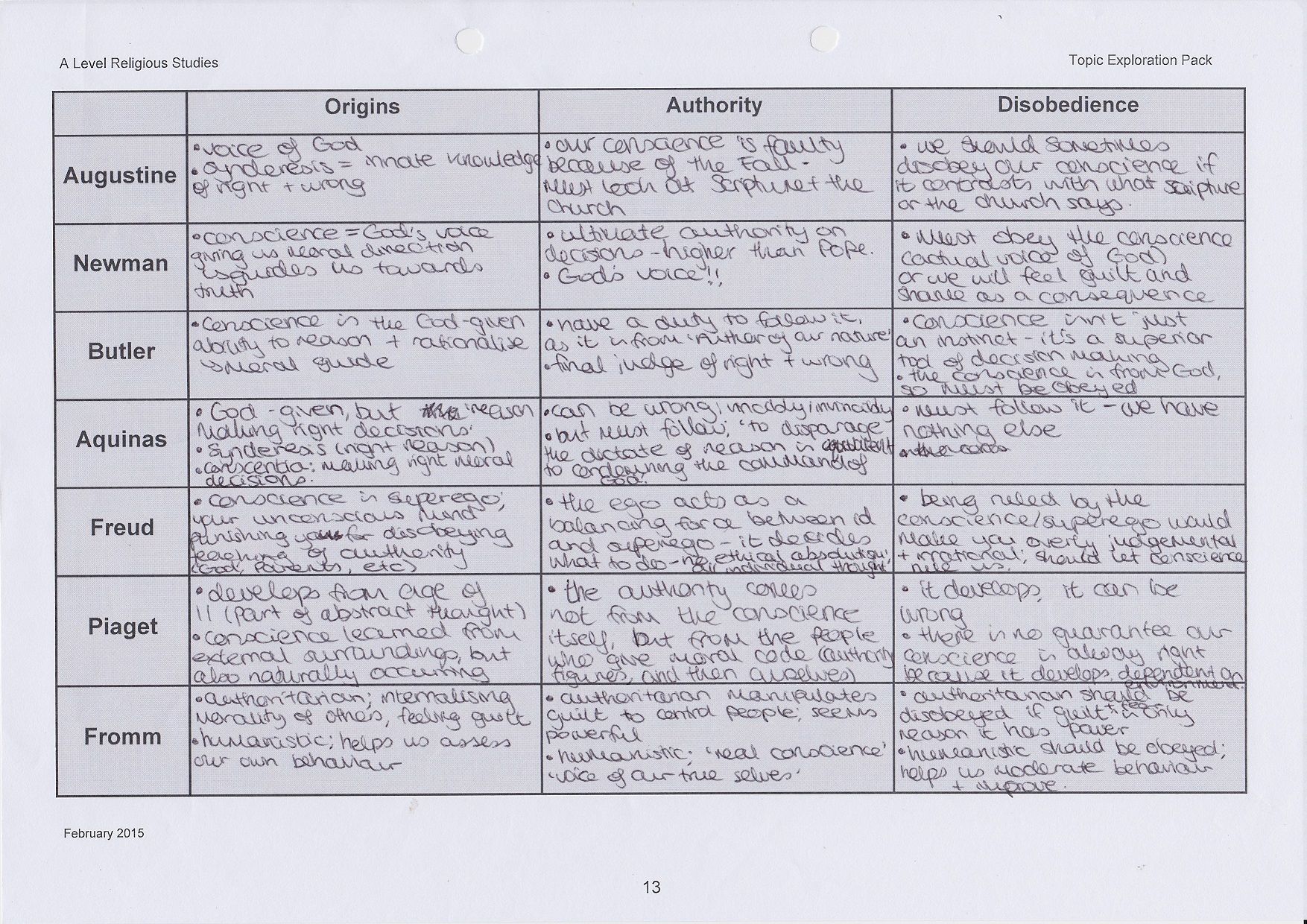
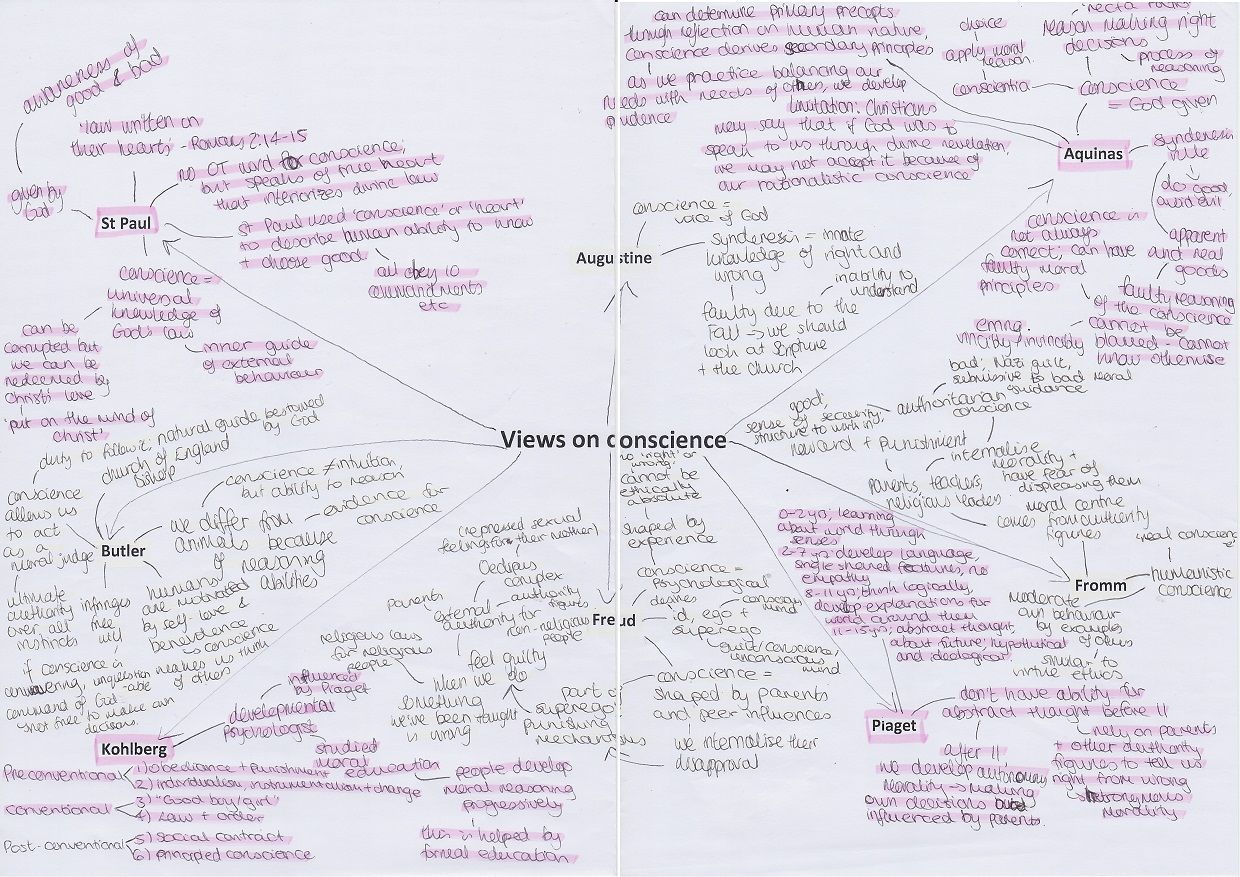
This is the belief that God gave each person a conscience at conception or imparted this knowledge to us at some stage in our lives. For some philosophers (Newman, St Augustine and Butler) it is the actual voice of God that speaks directly to us, and for others (Aquinas, St Jerome and St Paul) it is the ability to determine right from wrong that comes from God.
However, regardless of this distinction, conscience is believed to be a gift from God that allows humans to be moral. Hence, as morality comes from God, we must use our consciences and reasoning ability to understand what is right, rather than our conscience being shaped by our experiences or opinions.
Conscience is the actual voice of God
St Augustine
St Augustine believed that conscience was literally the voice of God, informing us of what is right and wrong. The conscience is God's love poured out to human beings: God speaks to the individual and the conscience reveals itself in solitary moments. We receive this message intuitively. Augustine advocated that all goodness came from God and God knows our actions and motivations to do them. He also maintained that hiding your actions from God would lead to a distance between God and man. Divine love binds all the aspects of virtue to the one virtue which is God, and conscience emerges from the outflow of divine love.
"Return to your conscience... question it... see God as your witness."
Limitations:
The conscience's authority and truth cannot be questioned, because it is the direct, infallible voice of God. This causes problems when the conscience contradicts Biblical teaching.
It's not possible to verify the conscience as the voice of God or as self-delusion.
Some people struggle with the idea that God may contradict himself - the conscience tells different people to do different things. (Abortion example with Catholics and CofE)
Another example of the conscience contradicting itself: in 1551, Protestant citizens of Toulouse rose in revolt against their Catholic rulers. They were 'lead by their consciences' to do so. Several weeks later, they were butchered by the Catholics, whose consciences tole them Protestantism was a cancer to the French state and must be destroyed. It could be argued that neither side demonstrated 'Agape' nor the 'love of God.'
Cardinal Newman
Newman stated that our nature means we have a conscience, which is a voice from God telling us what to do. However, he took a less literal approach than Augustine, claiming the conscience was a sort of messenger between the individual and God, rather than God's literal voice. This message is received intuitively, but the conscience is more of a truth detector than a truth inventor.
Conscience is the ability to reason and reflect
St Thomas Aquinas
Aquinas developed the theory of Natural Law, which is part of an intellectual, rational approach to derive from basic laws which ought to be done in a particular situation. It is linked to moral virtues and 'the Golden Mean,' in applying knowledge to the activity.
Aquinas argued we have an inbuilt ability to understand the difference between right and wrong, which was given to us by God, as well as the desire to do good and avoid evil (called the 'synderesis rule'). Aquinas distinguishes between synderesis (Greek for conscience) and conscientia (Latin).
Synderesis: identified with 'right reason,' an intellectual process of gaining knowledge and sifting through evidence logically. It is not a command.
Conscientia: the process of applying right reason to a specific issue.
Conscience for Aquinas comprises these two elements: the application of right reason to life issues. Aquinas did not consider the conscience to be intuitive, but instead claimed the conscience was a 'rational power, since it is not found in brute animals,' which allows a level of human reasoning and phronesis (practical wisdom). Thus, Aquinas has a more rationalist approach.
http://www.aquinasonline.com/Questions/conscience.htm
Limitations:
The same natural yet ethical laws guide all human beings. Different societies may have different moral laws and as a result, their consciences may vary.
The conscience of each human being points to the telos of goodness, which is not variable from person to person. How can Aquinas' theory explain that people reach entirely different conclusions on important ethical issues? (Aquinas would counter this by claiming that this wouldn't be the case if 'right reason' were employed.)
The conscience is grounded in natural law. It is argued that the fundamental understanding of nature is that this theory is based on is no longer consistent with a modern understanding of how nature works.
Principles can be linked to reality - the theory can be applied to reality. Something precedes its existence, moral principles examined in the conscience lead to practical, material decisions. Butler argues this is an impossible step from a moral principle to an action.
Kant argues that you cannot move from an 'is' to an 'ought.' For instance, simply because Aquinas claims that natural law states that killing people is wrong, does not mean that abortion or euthanasia is wrong. There is a gap between moral principles and the application, which is where individuals vary.
Some Christians would say that Aquinas' rationalistic approach does not consider that revelation comes from God. (Aquinas would counter this by arguing that conscience is reasoning used correctly to find out what God sees as good.)
Joseph Butler
"Conscience comes from God."
Like Aquinas, Butler believed that the conscience could determine and judge the rightness/wrongness of an action and thoughts. Butler argued that our ability to reflect on our actions is a God-given quality that makes humans different to animals. The idea that having a conscience makes us more human is supported by the mass media, as orchestrators of genocide are often depicted as less than human. In Butler's view, the conscience is a process of intuitive judgement against conflicting desires, rather than a rational reflection. This is not a direct instruction from God, but the ability to make our own judgements. Conscience has special authority in decision making because it does not require us to consult it as it 'magisterially exerts itself' and has the final say in moral decisions.
Because the conscience comes from God, it must absolutely be obeyed if a person wants to be happy. In other words, the conscience is infallible. He didn't regard mistakes as a problem as he believed that in any moral dilemma, most people will intuitively see what is the right thing to do.
Limitations:
Self-esteem should not be the basis of conscience - it doesn't exist to make humans think they are good, but to convict them when they are wrong.
It could be argues that criminals are not wrongdoers through lack of self-respect but not too much of self-regard.
The optimism of this view of human nature has been undermined by the atrocities of the twentieth century. Tragedies such as the Holocaust shows that nature is in fact brutal, undermining this view.
https://revisionworld.com/a2-level-level-revision/religious-studies/ethics/conscience/conscience-jos...
St Jerome
St Jerome called described, 'the spark of conscience... with which we discern that we sin.' St Jerome thought of the conscience as the ability to distinguish good from evil, that is intrinsically important for moral well-being and relationship with God.
Page 3
Innate within us
The idea that the conscience is innate within us means that is doesn't depend on our experiences or any sort of social conditioning or learning. instead, within each one of us there is a conscience that is either part of us when we were created or is part of how our brain is wired by genetics due to previous human evolutionary design or development. Some religious and secular approaches could accept this approach in some way, as it provides a framework to explain the need to be moral that is evident in all of us. It would seem that it is normal to have a conscience of some sort, which would suggest that everyone must have an innate skill, which we refer to as conscience.
However, this idea may lead us to believe that, if we all have the same innate conscience, we should all therefore follow the same principles. Aquinas believed that though the conscience may be innate, it still requires instruction and training, whilst some sociologists and psychologists may suggest that this innate idea is the human need to be accepted, which in turn must be justified with the conscience.
The conscience needs two things to work successfully - freedom and a knowledge of the good. Unless you are free, having a conscience is pointless. The conscience implies and innate knowledge of what is goo. If it is innate then everyone should have one and they should be almost identical. However, the fact that people hold different moral principles and have different ideas of what is right in different situations suggests that it is not.
Freud and other psychologists challenge the traditional idea of conscience but the question is whether it is the conscience itself that is acquired or the moral skills. The skill may be innate, but the moral principles that guide it seem to be acquired.
Page 4
Instilled by society
Some secular approaches suggest that the conscience is really a result of society's expectations upon us. Something is acceptable if society in general accepts it, therefore our conscience will generally accept these ideas of morality that are a reflection of society's values and rules. The culture in which we are raised plays a large part in the development of our moral reasoning.
George Hegel
Hegel referred to 'the spirit' of each age that not only defined cultural awareness but moral awareness as well. He would suggest that we make our judgements according to the conscience society has formed.
Page 5
Instilled by our parents
For the majority of us, our values and morals originate in our upbringing. In many ways, we are the products of our parent's example as moral teachers. We accept the morality of what our parents teach us, at least to around the age of ten. Even after this age, when we make our own decisions, using autonomous morality, we are still likely to be influenced by the moral awareness that was instilled in us by our parents. Sociologists propose the concept of conscience is significantly reinforced by the upbringing and influences we have in our early years.
Piaget
"Not everyone has the same conscience."
Piaget, a developmental psychologist, focused his research into discovering how children develop their thinking from birth to approximately age eleven. His research can then be applied to the issue of morality, although Piaget didn't focus on it explicitly. Piaget argued that we do not develop the ability to think abstractly, which includes thinking about morality until age eleven, so prior to age eleven, we must rely on others to tell us what is right or wrong. These 'others' are normally parents, but can be God or other authority figures. In early childhood, we have what is called 'heteronymous' morality, where the 'right conduct' is enforced by the expectation of punishment or reward. As our ability to think abstractly develops, we also develop a more 'autonomous' morality which draws on social norms and an appreciation of consequences, but it it autonomous because we now have the cognitive ability to think through consequences by ourselves.
Some people never fully develop their morality, and continuously rely on others for guidance, within heteronymous morality. The rest reach autonomous morality and develop their conscience fully.
Limitations:
Simplicity of the theory is regarded as a major weakness.
There is a dependence on empirical and questionable studies on children.
Some question the claims that Piaget found a route through which all humans travel in their discovery of a moral conscience.
Many modern philosophers/psychologists question the importance given to human nature. Is there even a definitive human nature - or is it just a social construct?
Lawrence Kohlberg developed Piaget's ideas further, identifying specific stages of development of the conscience.
Page 6
Instilled by authority figures
Another approach suggests that our conscience is formed and moulded by the authority figures we have around us, such as police officers, teachers, parents or politicians. They provide role models for us concerning what is right and wrong. This influence can be both positive and negative, yet these figures would seem essential to explaining who we are as adults. Many serial killers or paedophiles would claim that their reasoning and motivation for their horrendous crimes and who they have become were due to negative authority figures in their early years.
Sigmund Freud
Freud did not see the conscience as intuitive or rationalist, but as a pre-rational function of the unconscious mind. Freud maintained that human personality and behaviour are determined by three structures of the mind, the id, the ego and the superego. The id is the selfish part of the personality, containing basic drives and repressed memories, which demands instant gratification. The id is also amoral, with no regard for right or wrong, but it is only concerned with itself. The ego, or the conscious mind, attempts to satisfy the id, in socially acceptable ways. The conscience is found in the superego, and it is a punishing force, punishing the ego with feelings of guilt when it gives in to the id's demands. The conscience is merely a construct of the mind responding to an externally imposed authority by internalising the disapproval of others.
The conscience is therefore most clearly connected with the sense of guilt we feel when we go against it. Freud also linked his ideas about the conscience to his Oedipus complex. The Oedipus complex is the concept that young boys have sexual feelings towards their mothers, but repress them, out of guilt or fear that their fathers will castrate them for these feelings.
Freud didn't believe in any absolute moral laws, and held that all our moral codes are shaped by our experiences. The conscience is culturally dependent, as Freud explains the variation in conscience as the result of various moral codes of different societies.
Limitations:
Being relativist in nature weakens this psychological approach - therefore there is no meaning to it. (Relativism being self-defeating).
Human beings share many things in common but also have minds that are individually unique. Conscience will vary from person to person, making obeying your conscience a meaningless concept. (What moral guidance can we use instead?)
Your conscience merely obeys what your mind is telling it to do. This is hardly an objective sense of moral truth. (But does it have to be?)
The conscience has become the inner voice rather than the voice of God.
Freud's theory, especially in regards to the Oedipus complex, does not explain why females feel guilt and where their conscience comes from.
This theory also ignores the positive aspects of conscience: we consider the needs of others before ourselves, we live according to the rules of society causing greater social cohesion etc.
Fromm
Fromm was a psychoanalyst, who originally considered the conscience to be authoritarian, derived from a fear of displeasing authority, which led to guilt, causing greater submission to authority. This fear was apparently so strong that it could lead people to blind, rigid thinking, not all of which is correct. Fromm applies this idea to the Nazi's methods of manipulating the conscience during their years of power. It is important to note that Fromm was a Marxist who escaped from Nazi Germany in 1934.
He argues that all humans are influenced by external authorities; parents, teachers, politicians and church leaders, who apply rules and enforce punishments for breaking them, and these rules are internalised by the individual. This has close parallels to Freud's theory of the superego and the conscience as a punishing force. Our sense of right and wrong is formed in us by authority figures that we have a desire to obey. Disobedience results in guilt, weakening of our power and making us more submissive to authority. A guilty conscience is a result of displeasing authority, and if that authority is God, then the fear of being reprimanded will have a powerful influence on an individual.
However, Fromm later changed his views. His later consideration of the conscience was humanitarian one, which saw all human beings as free, and with the capacity and drive for self-actualisation. This view of the conscience is much healthier, as it helps us to assess or evaluate our behaviour. He argued we all have the ability to judge and evaluate our behaviour and ourselves as people, making us our own authority figures. We use our own discoveries in life and the teachings/examples of others to give us personal integrity and moral honesty, quite the opposite of the slavish obedience and conformity of the authoritarian conscience. Fromm's humanitarian conscience may conflict with Aquinas, Butler and Newman's views, but doesn't rule out the idea of God having a role in our conscience.
Limitations:
Fromm argues that all humans are predetermined creatures, which sits uncomfortably with his view that life offers hope, and that we have free will.
How is it possible to rise above alienation if we are determined to be alienated? (Fromm responded that to be set free it is necessary to be conscious/a person of conscience.)
Critics argue Fromm analysed the situation but didn't establish a cause.
It is questionable whether the conscience works to give joy, hope and love.
Michael Foucault argued the conscience works to condemn, not liberate, the individual.
How is a conscience based on the 'love of' and 'love for' life to be used? (Fromm says it is to enhance the quality of life, and designed to empower every individual.)
Page 7
Summary
"If the conscience goes, then everything else collapses around us." - Cicero
Page 8
Strengths and Weaknesses of the Conscience
Strengths:
Butler argued that the conscience is innate, but that our morality does develop. He argued that everything the conscience encourages us to do is for God, which means that its teachings should (in theory) be correct and good. Additionally, the need for our consciences to be educated allows us free choice of how our consciences develop and grow, by immersing ourselves into different situations and refusing/accepting moral teachings from various sources.
Catholic teaching states that the conscience is God-given and that we should follow it, as it forms the basis of our moral identity.
Weaknesses:
Catholicism
The ethics of the conscience may in conflict with religious teaching. For example, the Roman Catholic church do not allow people to bend the rules outlined in Scripture, such as allowing an abortion after rape has resulted in pregnancy.
These religious teachings can also be undermined by laws, such as the one stating that premature babies who are younger than 24 weeks and are stillborn should not be resuscitated. This is of course, in conflict with the Christian doctrine of the sanctity of life.
The doctrine of the double effect confuses matters of the conscience. The doctrine states that an action is allowed if it has a good, intended consequence, even if it does cause a bad, unintended consequence. For example, an abortion is allowed to save the mother's life, even if it does kill the child, as it is often considered the lesser of two evils than to potentially let both die.
The corporate/collective conscience is where a group of people all share the same moral beliefs and ethical principles. This in theory sounds beneficial, but in practice, it has led to some catastrophic results. A few notable examples include ISIS, the Rwandan genocide and Nazi Germany.
The collective conscience, especially when shared by a large group in a given society, means that individuals who break the norms feel they have to conform. For example, homosexuals in heteronormative families and communities feel they have to hide their sexuality.
Information
- Description
- A-Level (Year 2) Ethics (4) The Conscience) Note on What is the Conscience?, created by Summer Pearce on 07/01/2017.
- Created by
- Summer Pearce
- Views
- 12
- Rating