
Notes
2. Sound is a Wave
Content of the notes (4)
Page 1
2. Features of a wave model can be used to account for the properties of sound
2.1 – Sound consists of vibrations travelling through a medium
Identify that sound waves are vibrations or oscillations of particles in a medium
Sound waves are vibrations of the medium through which it is travelling as longitudinal waves – compressions and rarefactions
Sound waves are mechanical waves – they require a medium to travel through
They can travel though solids, liquids and gases – they travel though solids faster than liquids or gases because the particles in solids are denser
They travel faster in warmer air because the air particles are vibrating faster and are able to pass on the energy more quickly
In air, a drum causes a difference in air pressure due to the vibration of a drum membrane
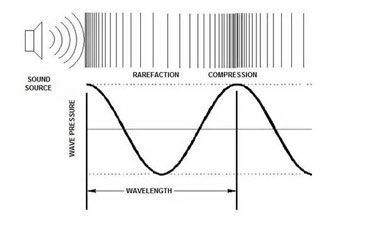
2.2 – Sound waves can be graphically represented as transverse waves because longitudinal waves such as sound are difficult to draw
Relate compressions and rarefactions of sound waves to the crests and troughs of transverse waves used to represent them
Longitudinal waves can be represented as a transverse waves by replacing displacement (of transverse wave particles) with pressure
Page 2
2.3 – The physics of pitch and volume
Explain qualitatively that pitch is related to frequency and volume to the amplitude of sound waves
Pitch is how high or low a note is, directly related to the frequency of the wave:
- The higher the pitch, the higher the frequency of the wave as there are more vibrations
- In this case, the amplitude of the wave is irrelevant and remains the same
Volume is how loud or soft a note is, directly related to the amplitude of the wave:
- The higher the volume, the higher the amplitude of the wave as there is more energy emitted
- In this case, the frequency of the wave is irrelevant and remains the same
2.4 – Echoes have practical applications
Explain an echo as a reflection of a sound wave
As sound is a wave, when it meets an obstacle, it is either absorbed or reflected
The harder the surface, the greater the reflection
Echo occurs as sound is reflected from an object back to its original source and is heard again after some time due to the relatively slow speed of sound as a wave
eg. Emitting a sound in the direction of a cliff 1km away means you will hear it again as an echo after about 6 seconds. Speed of sound is about 340m/s – 2000m (full distance sound travels to cliff and return) divided by 340 ≈ 6 seconds
Practical applications of Echoes include sonar – sound navigation and ranging – used in depth sounders on boats, fish finders, and is used as a way of navigation for bats
Page 3
2.5 – Waves can add to form a resultant wave
Describe the principle of superposition and compare the resulting waves to the original waves in sound
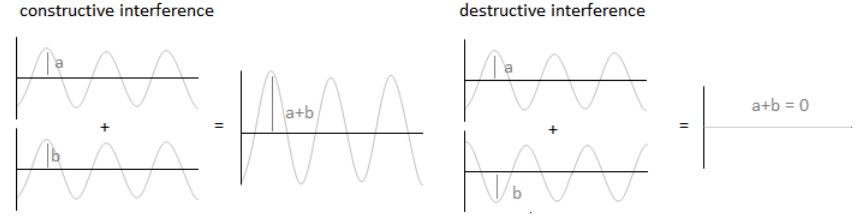
When waves of the same type coincide or meet, they interact to form a new resultant wave
The resultant wave can be determined by adding the displacements of the contributing waves
Superposition is when 2 or more waves of the same type exist at the same lace at the same time; the resultant wave will be found by adding the displacements of each individual wave
his addition will result in a wave with either an increased amplitude or a decreased amplitude
Constructive interference occurs when the crests and troughs of waves coincide when the waves meet, resulting in an increased amplitude. This means a reinforcement of sound
Destructive interference occurs when the crests of one wave coincide with the troughs of another wave, resulting in a smaller amplitude. This means a cancellation of sound
Page 4
Information
- Description
- Year 12 Physics (1. The World Communicates) Note on 2. Sound is a Wave, created by Phillip Kristyono on 06/02/2017.
- Created by
- Phillip Kristyono
- Views
- 0
- Rating