
Notes
Past Paper AI 2016
Content of the notes (7)
Page 1
2016 Past Paper
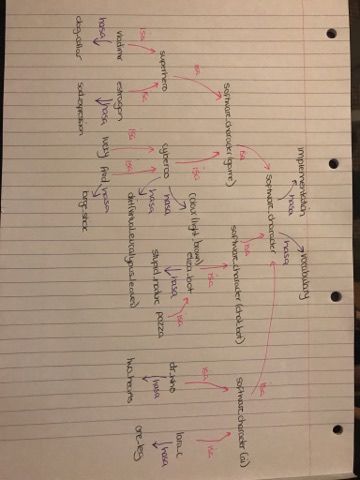
1) Vladimir and Estragon are superheroes who are Game software_characters. Vladimir has a dog collar, Estragon has a sad expression. Heresoftware_characters are defined as having an implementation and avocabulary. They include Game software_characters, Chatbotsoftware_characters and AI software_characters. Pozzo is an eliza_bot whichhas a stupid nature but is one of the Chatbot software_characters. Cyber_roos are light brown Game software_characters, Lucky being one ofthem. They have a diet of virtual_eucalyptus_leaves. Fred is a cyber_roo witha large_stick. Dr Who is an AI software_character with two hearts and LaraC
is an AI software_character with one leg.
(i) Draw a semantic net to represent the information presented in this paragraph
using only the relationships isa/2 and hasa/2.
[8 marks]
i)
Page 2
(ii) Now represent your semantic network as a Prolog program. [8 marks]
isa(software_character(game),software_character).
isa(software_character(ai),software_character).
isa(software_character(chat_bot),software_character).
isa(superhero,software_character(game)).
isa(cyberoo,software_character(game)).
isa(vladimir,superhero).
isa(estragon,superhero).
isa(lucky,cyberoo).
isa(fred,cyberoo).
isa(eliza_bot,software_character(chat_bot)).
isa(pozza,eliza_bot).
isa(dr_who,software_character(ai)).
isa(lara_c,software_character(ai)).
hasa(software_character,implementation).
hasa(software_character,vocabulary).
hasa(vladimir,dog_collar).
hasa(estragon,sad_expression).
hasa(cyberoo,colour(light_brown)).
hasa(cyberoo,diet(virtual_eucalypus_leaves)).
hasa(fred,large_stick).
hasa(dr_who,two_hearts).
hasa(lara_c,one_leg).
Page 3
(iii) Define a predicate called colour/2 which behaves as follows
?- colour(lucky,Colour). Colour=light_brown yes
?- colour(fred,Colour). Colour=light_brown yes
colour(Name, Colour) :-
hasa(Name, colour(Colour). /*stopping condition*/
colour(Name, Colour):-
isa(Name, Thing),
colour(Thing, Colour). /*move up the tree */
Page 4
2 Give a description and example of each of the following.
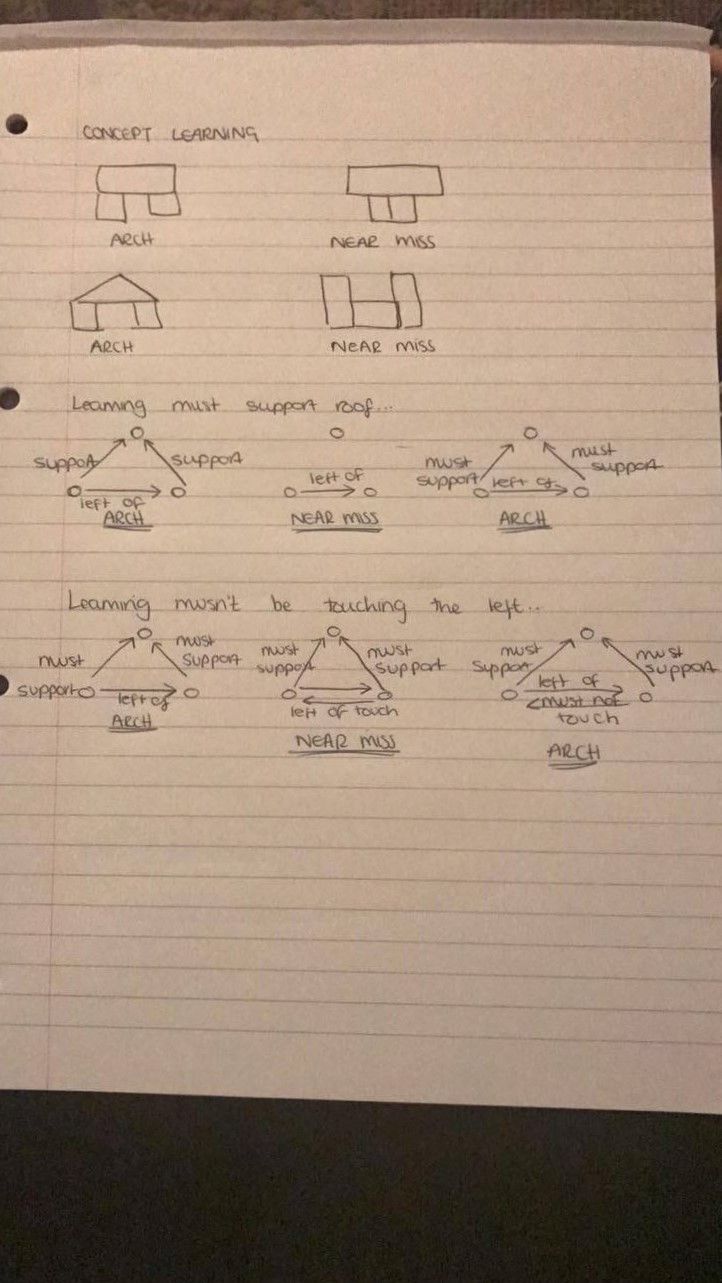
(i) Machine Learning Using Examples (e.g. an arch). [5 marks]
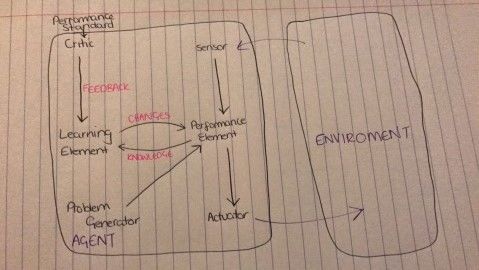
A machine learning agent has four components.
It has a learning element which is responsible for making improvements to the system and can make changes to any of the knowledge components.
It also has a performance element which is responsible for the external actions and sends knowledge to the learning element.
It has a problem generator which creates problems for the generator so that it can experience new situations and continue to learn.
It has has a critic which determines how well the system is doing and modifies the performance element if necessary.
Here is a diagram of a learning agent:
An example of machine learning would be this concept learning example of an arch being built:
Page 5
(ii) An Agent that has Beliefs, Desires, and Intentions (BDI). [5 marks]
An agent with beliefs, desires and intentions has the following components:
Beliefs - Beliefs are what the agent believes about the world. They are usually stored in a database. The reason we call them beliefs and not knowledge is because what a system believes may not always be correct. They also include inference rules which allow chaining which leads to new beliefs.
Desires-Represent objectives or situations the agent would like to accomplish. Goals are desires that have been given active pursuit by the agent.
Intentions-Intentions are what they system is going to do to get their desires. It is a desire it has committed too. It means a plan has been executed. Plans are a series of actions which will achieve one or more intentions.
Events-Events are what makes the system react. It can update beliefs, trigger plans and modify desires.
Page 6
(iii) Machine Learning Concepts using a Version Space. [5 marks]
Versions spaces have a set of possible hypothesis. Both ends of a version space s generalised and has regions of inconsistency.
The following diagrams show version space and the candidate elimination algorithm:
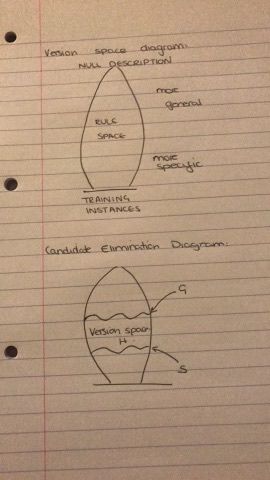
The candidate elimination diagram:
Do not modify the version space (H) unless you absolutely have to.
When testing the hypothesis, if the results are positive you move G down.
However, if the results are more negative you move S up.
When there is only one hypothesis left, the elimination is over.
Page 7
(iv) An Agent that uses a Grammar to Understand Natural Language. [5 marks]
A language is made up of semantics, syntax and pragmatics.
Syntax is what makes a sentence legal.
Semantics is do the words mean.
Pragmatics are how the language is used.
For an agent to try to understand this from a user, it needs to use grammar. Every language has grammar. The agent must determine what each word from the user is. Examples of what the words may be are:
Noun Phrase (short hand NP) - These are either the subject of the sentence or an object.
Verb Phrase (short hand VP) - These is usually the major verb phrase.
Perceptual Phrase (short hand PP) - These are usually before the noun phrase
Determiner(short hand Det) - Examples include a, the etc.
A sentence is usually made up of a major noun phrase, a second noun phrase and the verb phrase.
The major noun phrase is the subject of the sentence.
The second noun phrase is an object in the sentence.
The verb phrase is the objective of the sentence.
The agent uses this knowledge to determine what the user is inputting, and response in the correct way.
Information
- Description
- Note on Past Paper AI 2016, created by lucy copp on 16/05/2017.
- Created by
- lucy copp
- Views
- 8
- Rating