
Notes
1.1 Population Dynamics
Content of the notes (13)
Page 1
Population Distribution and Density; Trend of World Population
Population: the total number of people living in a place
Population Density: describes the population distribution pattern of a place [ total population / area (km2) ]
Population Explosion: a sudden increase in population
Population distribution: how a population is spread out in an area over a certain period of time
Descriptions from general to specific:
-dense or sparse?
-even or uneven?
-compass point description
-compare between countries
-general pattern spotted?
-specific or examples to the areas mentioned
-highest or lowest?
-any anomalies [ something that does not fit in ]
REASONS: historical (h), physical (p), socio-economic (se)
resources or service accessed? (p)
MEDC or LEDC? (h)
climate is temperate or extreme? (p)
agriculture (p)
transport and communication (se)
infrastructure (p)
relief or geographical location (p)
intrinsic values (h)
Physical : relief and soil ; climate
Socio-economic : industrial areas ; good transport networks
Historical : social cultural traditions
Page 2
Factors affecting population size
Birth rate: number of live births per 1000
-low birth rate = higher female literacy because they choose education over family
Death rate: number of deaths per 1000
Natural increase or natural decrease: number of births minus number of deaths (B>D = increase ; D>B = decrease)
immigrants: people moving into the country
emigrants: people moving out of the country
net migration: the difference between immigrants and emigrants (I>E = gain ; E>I = loss)
Page 3
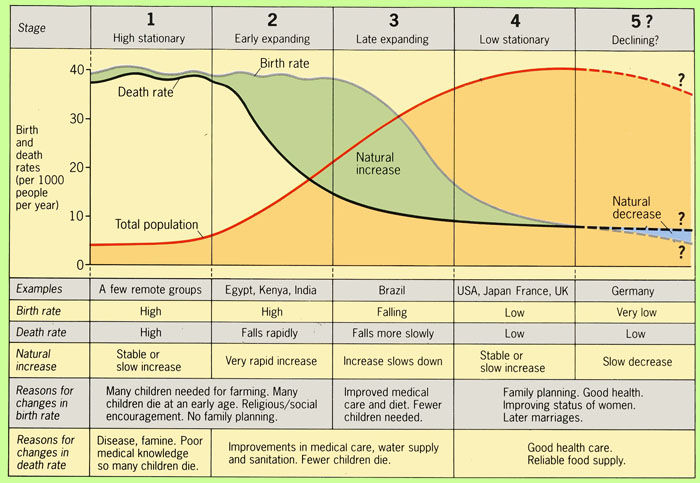
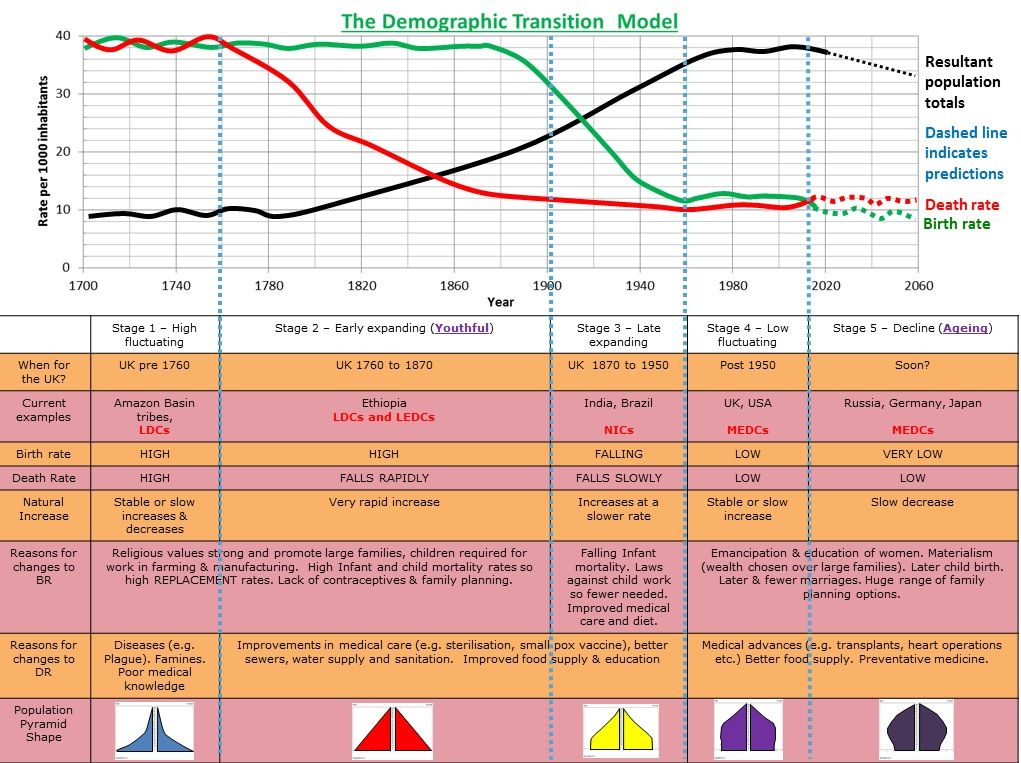
Demographic Transition Model (DTM)
-describes how birth and death rates change over time
Stage 1: LEDC ; Stage 5: MEDC
Page 4
CASE STUDY: HIV/AIDS BOTSWANA
Statistics:
23.9% of the population is diagnosed with HIV/AIDS which 33.2 million
currently no vaccine or cure
2007: killed 2.1 million people
population of 2303000
Page 5
Population Structure and Pyramid
two main features: sex and age shown by population pyramid
y-axis: 17 age groups with 5 years apart
x-axis: left for male and right female
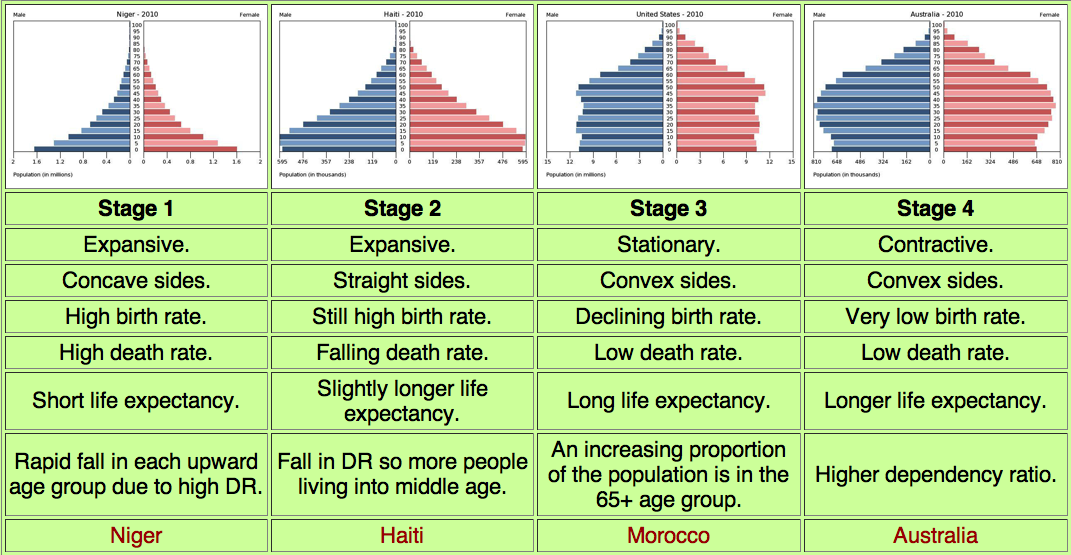
concave: inwards ; convex: outwards
tall: long life expectancy
narrow top: less elderly aka elderly dependent (older or 65)
wide body: more working population / independent / economically active(15-64)
narrow base: lower birth rate with better education and more young dependent (0-14)
Dependency Ratio: how the number of young dependent and elderly dependent depend on working population
[ (% of children + % of elderly) / % of working population x 100 ]
World average : 52 *no unit*
HIGH DEPENDENCY RATIO = MORE PRESSURE / ECONOMIC BURDEN / STRAIN ON THE WORKING POPULATION
Page 6
How does population structure differ among countries?
Shape:
base
apex
concave / straight /convex
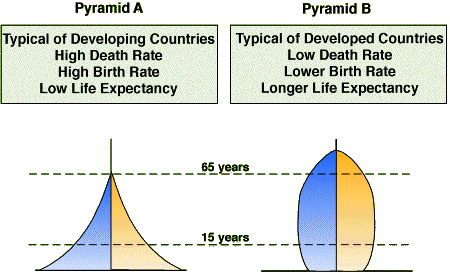
A LEDC
narrow apex: fewer elderly
steep-sided pyramid: high infant mortality rate
wide base: high birth rate
future: more young people to become an economically active population and have a larger working population
B MEDC
narrow apex: fewer elderly
taller pyramid: longer life expectancy
straighter sides: lower infant mortality rate
narrow base: low birth rate because females are more educated
future: lower future working population and more elderly dependent hence more strain and economic burden on working force
Page 7
Issue 1: Overpopulation and Underpopulation
Carrying capacity: the number of people that a region can support without environmental degradation eg deforestation and pollution
degradation: negative effects or destruction
If the population size does not equal to the availability of natural resources, it will cause population problems (under and over) which lowers standard of living:
food shortages
environmental damage
prevents economic development
CASE A
The land can provide enough resources for the population. It reaches its carrying capacity.
CASE B
The land cannot provide enough resources for the population. There are more people living in an area than the capacity of that area can support. It is unbalanced.
High population = low productivity = lower and shortage of resources, arable (good land), oil resources and water resources per person is below world's average
In case B, the available resources are not enough to support its population. The problem of overpopulation occurs. There is an uneven distribution of population distribution.
PROBLEMS
Shortage of resources
When a place is overpopulated, there will not be enough resources such as land and crops, to grow enough food to meet the demands of the people. When the food demand is greater than the food supply, famine shortage will occur as higher population means more demand for food.
Damage of the environment
A large population places large and high pressure on resources. In order to obtain resources, people destroy land and cause land, air and water pollution.
1. more demand for natural resources will cause more extracting eg mining
2. more demand for land will cause destruction of the natural habitat
3. high human activity may increase pollution
Hold back economic development
Many of the resources have been used to satisfy the basic needs of the large population. Only a small amount of resources is left for education, agriculture and industrial development. This slows down economic growth and leads to a vicious cycle of poverty. Government needs to feed population and therefore cannot invest in education health care etc. which will decrease amount of income and quality of education, causing more poverty.
Page 8
CASE STUDY: CHINA (OVERPOPULATED)
Statistics:
2000, 90% of foetuses aborted in China were female
estimated: there is more men than women by 60 million nowadays
total population in 2008 is 1.3 billion
famine in 1959-1961, 15 million deaths out of 633 million
pollution index in 2016 mid year China ranked 7th out of 211 countries
52 million of rural poor
Page 9
CASE STUDY: AUSTRALIA (UNDERPOPULATED)
Page 10
Issue 2: Ageing Population
ageing population: where the median age of a country or region increases due to rising life expectancy and/or declining fertility rate
PROBLEMS
Economic
-less working population which lowers government income from tax which means less money invested in development
-less economically active population so there is a big burden and economic strain on them
-less technology development and hence has fewer people to make scientific innovations
Social
-families must spend more time and money for elderly which is an extra economic burden
-cultural differences or lost when passing down with communication problems due to the huge age gap
-there are more elderly dependent so more elderly medical facilities are needed, which means less money spend in facilities for the young eg education
-lower population = lower productivity = lower GDP
-lower the retirement age so population cannot get pensions till later
Page 11
CASE STUDY: JAPAN
Statistics:
2010: 23% of the population are elderlies
incentives for children are $5060 per year until they are 10 years old
Page 12
Issue 3: Migration
migration: movement of people from one place to live or work
-internal: within a country
-international: between countries
Positives
Impact on countries of origin
-less pressure on resources (government)
Impact of countries of destination
-less pressure on working population with more working people coming into the country
-higher birth rate which stabilises or balance out population
-workers willing to work for lower wages
-higher cultural diversity
Impact of migrants themselves
-better living standards eg health and education
-less discrimination
-less threat of war
Negatives
Impact on countries of origin
-lost of young populations => brain drain: lost of smart people ie skilled or educated leaving the country so theres is less future working population
Impact of countries of destination
-more pressure on resources and social services
-population pressure especially for housing
-conflict between migrants and locals which can lead to violence and protests against migrants
Impact of migrants themselves
-separation from family
-arrested if an illegal immigrant
-problems integrating in the new society
refugee: a person who has been forced to leave their country of origin in fear of their lives, they run away often with no idea where they will end up and with no permission to stay in another country due to persecution war or an environmental disaster.
internally displaced person: someone forced to flee his or her home but also remains within his or her country's borders
asylum seeker: a person who as left their country of origin for fear or persecution and has asked for permission to stay in another country and wait for a decision on this
push factor: negatives that push people out of a place
pull factor: positives that attract people to a place
(TREND: LEDC TO MEDC)
Page 13
CASE STUDY: SYRIA TO SWEDEN
Statistics
6.6 million people in Syria internally displaced
from EU country to South West Europe
civil war causes 250000 deaths
Syria population 22.85 million
Sweden population 9.593 million
Syria GDP $2080 USD (2007)
Sweden GDP %53000 USD (2007)
Sweden has raised tax into 31% minimum of GDP
2030 days of civil war
Information
- Description
- IGCSE Geography (1.1 Population Dynamics) Note on 1.1 Population Dynamics, created by Audrey Ching on 07/06/2017.
- Created by
- Audrey Ching
- Views
- 1
- Rating