
Notes
REGEX - REGULAR EXPRESSIONS
Content of the notes (8)
Page 1
LANGUAGE PCRE
From Perl, a bit more complex, but far more fast and performing than POSIX.
Fonctions (the more interesting ones) :
preg_grep
preg_split
preg_quote
preg_match
preg_match_all
preg_replace
preg_replace_callback
NB : All have their particularities, while they all use a similar syntax to do the researches.
E.G. : PREG_MATCH
return a boolean (ie true it there is a match with what we've searched)
it takes two args :
The regex (regular expression)
The chain where you want to search
I.E. : preg_match chain/file regex
Chain : I Love to play guitar
Regex : #guitar#
return true
be careful of CAPITALISATION, it count a lot!
I.E. : if the chain was Guitar it would have return false
NB : Not if you're regex was "#guitar#i" this option after the second diese tell the regex to not take care about capitalisation.
Page 2
SIMPLE SEARCHES
# : open and close the regex
| : or
^ : at beginning of the chain
$ : at end of the chain
CLASS OF CHARACTERS
SIMPLE CLASSES :
#gr[io]s# : between the bracket their is a class of characters which tells to the computer we're looking eather for the letter "i" or "o"
IE : #aeiouy$# is the regex for a chain
Interval of classes :
#[a-z]# : all min cap letter of the alphabeth (powerfull) /** unless I option 4 **/
#[A-Z]# : all MAJ cap letter of the alphabeth (powerfull) /*** ya follow ?***/
#[0-9]# : all digit numbers
Now guess what am I looking for if I type this insainely powerful regex [a-zA-Z0-9] ?
Tips
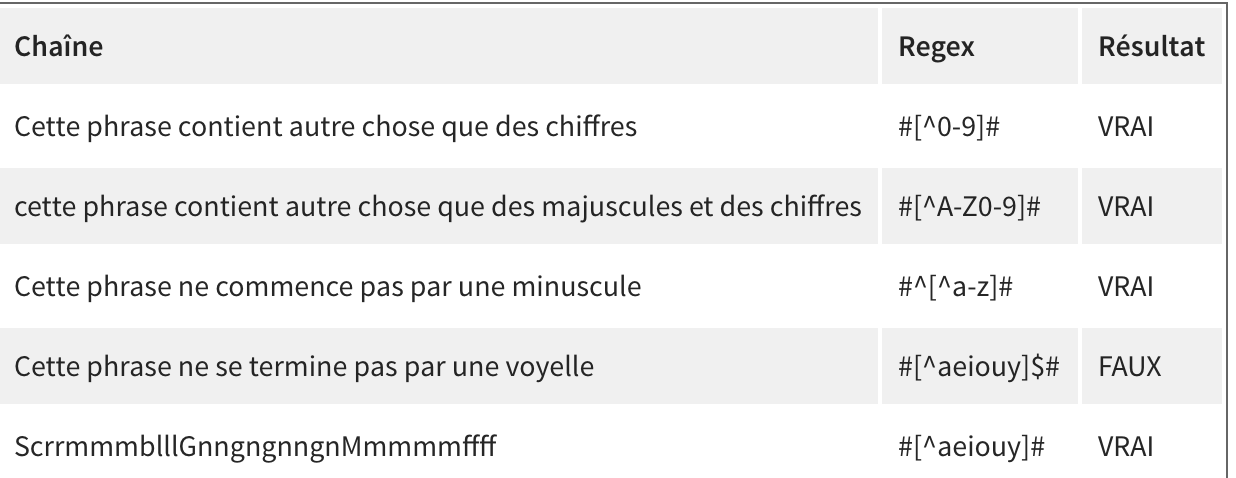
#[^0-9]# : .. won't tell all my whisperer's secret bitch (their untoldable btw.)
A GOOD EXEMPLE FOR THOSE WHO CAN'T SEE :)
(in french :/)
Page 3
Quantificator
Usual symbols :
? : mean this letter is facultative (it can be there 0 OR 1 time)
+ : mean this letter must be their, at least one time ( 0 OR ++ )
* : meant this letter could be their one time, many time (occurence) or not at all ( 0 OR 1 OR ++ )
("")* : mean those letters between parentheses can be repeated many times (i.e. : #ay(ay)*# => ayayayayya)
Bracket : Be precise like a ninja :supersayan:
The 3 ways of bracket-fu :
{nbr}: I simply put a number to the letter (or the group of letters between parentheses ;)
{nbr1,nbr2} : now we can have the letter (or the grp of ltr ;p) number of time equal to a number as nbr1 <= nbr of occurence <= nbr2
i.e. : #a{3,5}# > if i call grep_match with this regex as arg, it'll tell me :
for "..aaa.." , "..aaaa.." , "..aaaaa.." : true
for "a", "aa","aaaaaa" : false
{nbr, } : finaly we can have the grp of /ltr each number of time it is more or equal than the nbr :)
Page 4
METACHARACTER ? (Do it sound like it's Chinese ?)
# : indicate the end of the regex !
/!\ To use it you must antisash \ it, be very careful..
!
^
$ : indicate the end of a chain
(): makin grp of characters
{} : repetition of a pattern
[] : classes
] : /!\ To use it you must antisash \ it, be very careful..
? : facultatif
+ : include one time or more
* : not include, include once or more (anyway :)
. :
/!\ To use it you must antisash \ it, be very careful..
\ : useful :)
| : or
- : interval
/!\ To use it you must antisash \ it, be very careful..
it define an interval of class as [a-z] and, if you want add "-" in your search then you should type [a-z0-9-] or [-a-z0-9]
NB : they have no concrete signification for us but they are full of sense for the computer ;)
Why I need it though ?
Because, How could you search for a "What ?" ?
A moron, could eventualy type, as I did #What ?# > Guess what ? It's gat damn WRONG !!!
You'd rather type sthing like : #What \?# and actually you could chose the i option just in case of..
Page 5
Abreviated Classes
/!\ They're kind of shortcuts so it is very handy
\d : indicate that we're looking for a digit number
Same as typing [0-9]
\D : indicate that this NOT A DIGIT NUMBER
[^0-9]
\w : indicate an alphanumerque character or a "_"
[a-zA-Z0-9_]
\W : indique this is NOT an alphabetical character (or NOT a word)
[^a-zA-Z0-9_]
\t : indicate a tabulation
\n : indicate a new line
\r : indicate a return to the line
\s :indicate a white space
\S : indicate what is not a white space (\n; \t; \r)
. : indicate anycharacter (everything is athorised !)
Page 6
HOW TO : CONSTRUCT A COMPLETE REGEX 1/2
Phone NUMBER :
Firt number always a 0;
Second one is from 1 to 7;
The eight others can be any number!
> REGEX :
#^$#
#^0$#
#^0[1-7]$#
#^0[1-7][0-9]{8}$# | #^0[1-7]\d{8}$#
If number are like that : 06.11 | 06-11 | 061.1 .. :
Here is regex magic :
There is the 0 then the numbr between 1 and 7
Then there is either a space a tiret or a point > [-_. ]
/!\ but this is not an obligation .. > [-_. ]?
Then there there is two numbers > \d{2} | [0-9]{2}
Then we repeat this 4 times
You can make a poster with it : #^0[1-7]([-_. ]?[0-9]{2}){4}$# |
Page 7
HOW TO : MAKE A COMPLETE REGEX 2/2
For an E-mail adress (to test their validity) :
First we have the pseudo : Variable Chain of alphanumeric characters
> [a-zA-Z0-9._-]+ | > \w+
Secondly, We get the > @
Thirdly and finally, there is domain name : a long alphanumeric and a shorter alphabet chain of separated by a point
REGEX > [a-zA-Z0-9.-_]{2,}\.[a-z]{2,4} | > \w{2,}\.[a-z]{2,4}$
Page 8
CAPTURE & SUBSTITUTION with the magic "()"
Capturing Parenthese : "You can't imagine everythings parentheses could do for you :)"
Each () create a variable containing what it's actually embrace
I.E.: REGEX > #\[b\](.+)\[b\]#
WATCH OUT THE "\" before the bracket are only relevant in PHP !
MEANING : "FIND in the CHARACTER CHAIN a [b] FOLLOWED by ONE or MORE character, whatever they are FOLLOWED by [/b]"
The first variable is called ($1 and then $2 ..)
FUNCTION in PHP PREG_REPLACE :
ie : preg_replace('#\[b\](.+)\[b\]#','<strong>$1</strong>', @text
NB : If you don't want your parentheses to be capturing then you need it to start with ':'
I.E. : #(anti)co(?:nsti)(tu(tion)nelle)ment#
$0 : anticonstitutionnellement
$1: anti
$2 : tutionnelle
$3 :tion
Information
- Description
- Note on REGEX - REGULAR EXPRESSIONS, created by Fen Pin on 27/07/2017.
- Created by
- Fen Pin
- Views
- 0
- Rating