
Quiz
Clinical Medicine - Approach to the Patient
Este quiz tem tipos de pergunta que abrem no player de sempre.
Perguntas do quiz (41)
1Which of the following is characteristic of OBSTRUCTIVE pulmonary diseases (select all that apply)
- AReduction in airflow due to increased resistance in airways (e.g. narrowing of airway lumen)
- BDyspnea resulting from net reduction in lung volume
- CDecreased elastic recoil of pulmonary parenchyma surrounding the airways, effectively reducing lumen caliber
- DReduction in lung compliance, requiring greater pressure to inflate lungs
2Which of the following are considered OBSTRUCTIVE pulmonary diseases? (select all that apply)
- Achest wall tumors
- Bcystic fibrosis
- CARDS
- Dbronchiolitis
- Easthma
3Which of the following may be related to RESTRICTIVE pulmonary diseases? (select all that apply)
- AAsthma
- BSilicosis
- CCystic fibrosis
- DSevere Scoliosis
- EARDS
4Restrictive lung diseases are often complicated with pulmonary hypertension and cor pulmonale (i.e. right ventricular dilation to lung disease)
- AVerdadeiro
- BFalso
5Which of the following are characteristic of bronchiectasis? (select all that apply)
- APx: wheezing, crackles, clubbing, hypoxemia
- BPx: productive cough, hemoptysis, chest pain
- Cacquired or congenital disorder of large bronchi, causing abnormal dilation and loss of bronchiole wall tone
- Dusually the result of a disorder such as cystic fibrosis
- Ereversible with treatment
6A purulent pleural effusion caused by the spread on infection to the pleural space is termed:
- AHemothorax
- BChylothorax
- CPneumothorax
- DHyrdothorax
- EEmpyema
7Which of the following may be the cause of a pleural effusion?
- ACollagen vascular disorder
- BMetastatic cancer
- CSystemic infection
- DA & B Only
- EAll of the above
8Lymph fluid in the pleural space (due to thoracic duct trauma or obstruction) is termed:
- APneumothorax
- BEmpyema
- CHydrothorax
- DChylothorax
- ELymphothorax
9Which of the following is most typically found in the setting of congestive heart failure?
- AHydrothorax
- BPneumothorax
- CEmpyema
- DHemothorax
- EChylothorax
10A tension pneumothorax refers to a pneumothorax in which the defect acts as a valve, causing air to enter the pleural space on inspiration but preventing air from leaving on expiration.
- AVerdadeiro
- BFalso
11A pneumothorax (air in the pleural space) can be secondary to:
- ACOPD
- Basthma
- Clung abscess (communicating w/ pleural space)
- DA & C only
- EAll of the above
12Which of the following may be classified as a pulmonary hemorrhage syndrome?
- AGoodpasture's syndrome
- BWegener's granulomatosis
- CChurg-Strauss syndrome
- DBoth A & B
- EAll of the above
13Which of the following are items used on the COPD population screener (COPD-PS) questionnaire? (check all that apply)
- ADuring the past 4 weeks, how much of the time did you feel short of breath?
- BDo you ever cough up any "stuff", such as mucus or phlegm?
- CIn the past 12 months, I do less than I used to because of my breathing problems.
- DHave you smoked at least 100 cigarettes in your entire life?
- EHow old are you?
14Hypoxia refers to decreased levels of oxygen in the arterial blood.
- AVerdadeiro
- BFalso
15Which of the following terms/definitions are NOT correctly paired? (select all that apply)
- AOrthopnea - SOB that begins or increases when lying down
- BParoxysmal nocturnal dyspnea - sudden onset of SOB after a period of sleep
- CPlatypnea - dyspnea that decreases when in upright position
- DHypercapnea - dyspnea related to increased CO2 in blood
- ETachypnea - rapid rate of breathing
16Increased tactile fremitus on physical exam may indicate the presence of consolidation of pneumonia.
- AVerdadeiro
- BFalso
17Decreased tactile fremitus on physical exam may indicate (check all that apply)
- Aipsilateral pneumothorax
- Bpleural effusion
- Cpneumonia
- Dpleural scarring
- Ehyperinflation of lungs
18Chest X-Ray Findings
[blank_start]Air-space diseases[blank_end] may show poorly defined opacities that obliterate normal shadows.
[blank_start]Interstitial diseases[blank_end] may show linear, reticular, septal lines, bronchovascular thickening, multiple small opacities.
[blank_start]Lymphasdenopathy[blank_end] may show an abnormal mediastinal contour- AAir-space diseases
- BInterstitial diseases
- CLymphadenopathy
- DAir space diseases
- EInterstitial diseases
- FLymphadenopathy
- GInterstitial diseases
- HLymphasdenopathy
- IAir-space diseases
19What clinical finding is apparent on this x-ray?
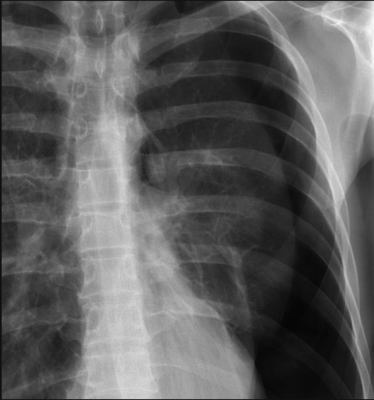
- APneumonia
- BPneumothorax
- CInterstitial lung disease
- DMultiple nodules/masses
- EPleural effusion
20Clinical finding on this chest x-ray
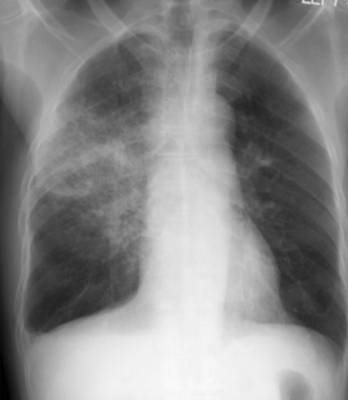
- Apneumonia
- Bpneumothorax
- Cinterstitial lung disease
- Dlung mass/nodule
- Epleural effusion
21Clinical finding on this chest x-ray
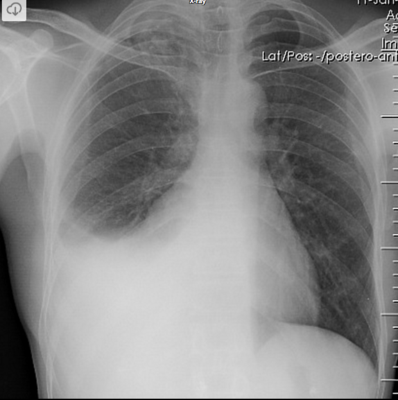
- Apneumonia
- Bpneumothorax
- Cpleural effusion
- Dmass/nodule
- Einterstitial lung disease
22Clinical finding on this chest x-ray
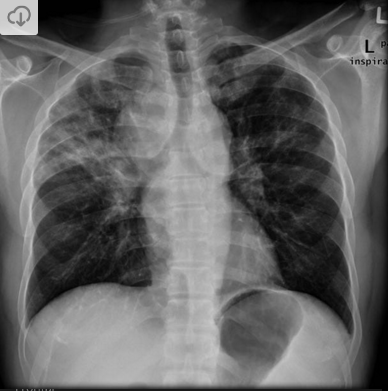
- Apneumonia
- Bpleural effusion
- Cinterstitial lung disease
- Dmass/nodule
- Epneumothorax
23Clinical finding on chest x-ray
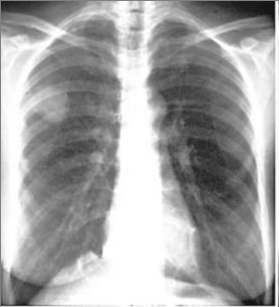
- Apneumonia
- Bpneumothorax
- Cinterstitial lung disease
- Dpleural effusion
- Elung mass/nodule
24Which of the following is the primary imaging method used for detecting a pulmonary embolism?
- AAP & Lateral Chest x-ray
- BCT angiography
- CPET scan
- DMRI
- EUltrasound
25A chest CT increases contrast by a factor of 200 but also increases radiation exposure by nearly 60x.
- AVerdadeiro
- BFalso
26This imaging method may be preferred when evaluating mediastinal masses (w/ vascular involvement) and pulmonary hypertension.
- AChest x-ray
- BUltrasound
- CCT
- DMRI
- EPET scan
27Which of the following statements are accurate regarding pulmonary function testing (PFT)
(check all that apply)- Ameasures external lung function
- Buseful for evaluation of pts w/ dyspnea and wheezing
- Cquantifies the degree and reversibility of a disease
- Dused to measure disease progression
- Emay assess thoracic structural abnormalities
28Forced Vital Capacity (FVC) is the volume of air expired after a full inspiration and may be...
(check all that apply)- Anormal in obstructive lung disease
- Bslightly decreased in obstructive lung disease
- Cslightly increased in restrictive lung disease
- Dnormal in restrictive lung disease
- Edecreased in restrictive lung disease
29Forced Expiratory Volume in 1 second (FEV1) is reduced in both obstructive and restrictive lung diseases.
- AVerdadeiro
- BFalso
30FEV1/FVC in normal patients is usually around 70-80% (0.7 - 0.8)
- AVerdadeiro
- BFalso
31Check all of the following statements which are true regarding expected FEV1/FVC percents.
- AFEV1/FVC is expected to be decreased in patients with obstructive lung diseases
- BFEV1/FVC is expected to be increased in patients with obstructive lung diseases
- CFEV1/FVC may be normal in patients with restrictive lung diseases
- DFEV1/FVC may be increased in patients with restrictive lung diseases
32Forced mid-expiratory flow (FEF, 25-75%) is expected to be decreased in both obstructive and restrictive lung diseases.
- AVerdadeiro
- BFalso
33Diffusing capacity of the lung for carbon monoxide (DLCO) is decreased in parenchymal lung disease and COPD (especially emphysema) but is expected to be normal in asthmatic patients.
- AVerdadeiro
- BFalso
34When would a peak flow meter be used?
- Aevaluating the effectiveness (pre & post) treatment
- Bat home by an asthmatic pt. to track lung function
- Cmeasuring FEV1 or FVC when other PFTs are unavailable
- DBoth A & B
- EAll of the above
35Capnography is a noninvasive measurement of exhaled CO2 and cardiopulmonary function.
- AVerdadeiro
- BFalso
36Acute bronchitis is more often associated with respiratory viruses than a bacterial infections.
- AVerdadeiro
- BFalso
37Signs & Sxs associated with Acute Bronchitis (check all that apply)
- ACough (initially nonproductive but later mucoid sputum may be present)
- BTracheitis (burning substernal pain associated w/ respiration)
- CSigns of consolidation and/or opacity on chest x-ray (after 7-10 days)
- DRhonchi and coarse crackles
- EHemoptysis
38Which of the following medications is NOT generally recommended in the treatment of bronchitis:
(check all that apply)- AAnalgesics
- BAntihistamines
- CBeta-2 Agonists
- DAnti-tussives
- EExpectorants
- FMucolytics
- GAntibiotics
39Influenza vaccines vary in effectiveness from 20% - 90%
- AVerdadeiro
- BFalso
40Complications of influenza may include which of the following (check all that apply)
- Apneumonia
- Bmyocarditis or pericarditis
- CToxic shock syndrome
- Dtransverse myelitis
- EGuillian-Barre
41Which of the following are used in the treatment of influenza?
- ANeurominidase inhibitors (e.g. zanamivir, oseltamivir)
- BAdamantane agents (e.g. amantadine, rimantadine)
- CSupportive care/treatments
- DBroad-Spectrum Antibiotics
- ELeukotriene Receptor Antagonist
Informações
- Descrição
- Approach to the Patient with Pulmonary Disease Lecture 11/17/15
- Autor
- campbellpa2017
- Idioma
- English
- Visualizações
- 63
- Etiquetas
- Avaliação
- Ainda sem avaliações Avalie este quiz