
Flashcards
Dynamic Earth and Earthquakes
Flashcards do conjunto (68)
- 1When did the universe beginAt the Big Bang
- 2How are stars formedAs the cloud collapses, a dense, hot core forms and gathers dust and gas.
Not all the material ends up as a part of a star, it can become a planet, asteroid or dust - 3What did Big Bang Nucleosynthesis form?Lighter Elements:
Hydrogen
Helium
Lithium
Beryllium
Boron - 4What elements formed from stellar nucleosynthesisHeavier Elements (Atomic numbers 6-26)
Carbon to Iron - 5What formed during a supernovaeElements with atomic numbers of over 26
Heavier elements
E.g. uranium - 6What elements does small star nuclear fusion produceElements from Hydrogen to Carbon
- 7What do large stars do and what do they produceLarge stars burn out faster and they produce elements from Carbon to Iron
- 8What are the two groups of planetsTerrestrial
Jovian - 9Which planets are terrestrialMercury
Venus
Earth
Mars - 10Which planets are JovianJupiter
Saturn
Uranus
Neptune - 11Formation of the moonEarth and Theia collided
Vaporised earth chunks thrown into space
Gravity pulled particles together
Created the moon - 12What are comets made up ofIce fragments orbiting the sun
- 13What elements is the earth made up ofIron (Fe) = 35%
Oxygen (O) = 30%
Silicon (Si) = 15%
Magnesium (Mg) = 10%
Other 88 elements = 10% - 14How do meteorites represent the elemental composition of earthMeteorites called chondrites give us the best estimate of the bulk composition of the earth
Iron meteorites estimate the composition of the core - 15What is a ChondritesA stony meteorite containing small mineral granules (chondrules)
- 16What do Iron meteorites provide us withInformation about the composition of the earth's core
- 17What is the difference between the relative and absolute timeRelative ages assign order to events
Numerical ages assign exact dates to events - 18What are some of the methods of defining the relative time between different geological systemsSUPERPOSITION OF ROCK UNITS
FAUNAL SUCCESSION
CROSSCUTTING RELATIONS
INCLUSIONS OF OLDER ROCKS IN YOUNGER ONES - 19What is an unconformityAn unconformity is a time gap in the rock record
It could be due to:
Non-deposition
Or Erosion - 20What are the three types of unconformitiesDisconformity
Non-conformity
Angular unconformity - 21What is a DisconformityParallel strata bracketing non-deposition
Due to an interruption in sedimentation
May be difficult to recognize - 22What is a non-conformityMetamorphic or igneous rocks overlain by sedimentary strata
Crystalline igneous/metamorphic rocks were exposed by erosion
Sediment was deposited on this eroded surface - 23What is an angular unconformityRepresents a huge gulf in time
Horizontal marine sediments deformed by orogenesis
High mountains are eroded away to below sea level
Sediments deposited horizontally on the erosion surface - 24What are the main names of the EonsHadean: 4540
Achaean: 4000
Proterozoic: 2500
Phanerozoic: 541-present - 25What are the names of the ErasPaleozoic: 541 - 252
Mesozoic: 252 - 66
Cenozoic: 66 million years ago - present - 26What are the names of the Periods oldestCambrian - 541
Ordovician - 485
Silurian - 444
Devonian - 419
Mississippian - 359
Pennsylvanian - 323
Permian - 299
Triassic - 252
Jurassic - 201
Cretaceous - 145
Paleogene - 66
Neogene - 23 - 27Age of the EarthOver 4.5 billion years old
- 28What is the approximate geological history of earth280 million years (Australia split from Gondwana)
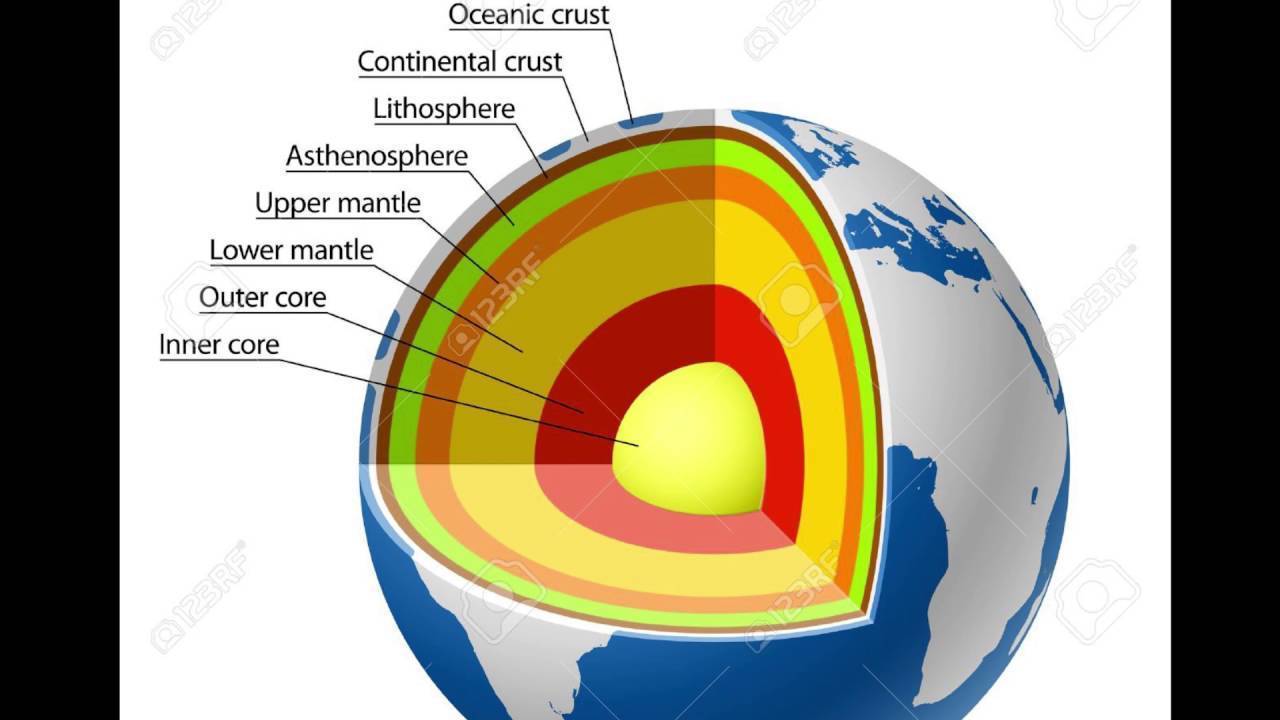
- 29What are the layers of the earth?
- 30What are the depths of each boundary of the earth's interiorCrust:
3 km (Mid-ocean ridge)
70 km (mountain ranges)
Mantle = 2,885km
Lithosphere = outermost 100/150 km of earth
Outer Core = 2,255 km
Inner Core = 1,220 km - 31What is the difference between oceanic and continental crustsContinental crust lies under the continents
Is 35-40 km thick
Composed of granitic rocks
1 km above sea level
Oceanic Crust underlies the ocean basins
Is 7-10 km thick
Composed of basaltic rocks
4km below sea level - 32What is moho and the depths to MohoMohorovičić discontinuity
The boundary between the Earth's crust & mantle.
Lies at 35 km below continents
About 7 km beneath the oceanic crust. - 33What is the upper zone in the earth's interior and what's the composition of itMantle is divided up into upper and lower zones and are divided by transition zone
Between a depth of 410 and 660 km
the mantle and transition zone consist of peridotite, an ultramafic igneous rock - 34What is the difference between rigid and elastic crustLithosphere bends elastically when loaded
Asthenosphere flows plastically when loaded - 35What is the outer core's composition in a liquid stateLiquid iron-nickel-sulphur
- 36Where does the magnetic field originate fromFlow in the outer core generates the magnetic field
- 37What is the composition of the inner coreSolid iron-nickel alloy
- 38What evidence do we have of continental drift"Fit" of the continents
Locations of glaciations
Fossil evidence
Rock type and structural similarities
Paleo-climatic evidence. - 39How do magnetic anomalies provide evidence of seafloor spreadingTowed magnetometers measure ocean crust
Magnetism oscillates perpendicular to the Mid Ocean Ridge - 40What are plate tectonicsEarth's outer shell is broken into rigid plates that move
Moving plates change the face of planet Earth - 41How do we describe the distribution of earthquakes, volcanoes, fossils etcContinental Drift
- 42How many plates are there in the world and how fast do they move20 tectonic plates
move at a rate of 1 to 15 cm/year - 43How do divergent boundaries occur and how are they represented by volcanoes, earthquakes etcSea-floor spreading causes plates to move apart
Magma wells up to fill the gap = volcano
Magma cools, adding material to each plate - 44how do convergent boundaries occur and how are they represented by earthquakes, volcanoesLithospheric plates move toward one another
One plate dives back into the mantle (subduction)
Subduction recycles oceanic lithosphere - 45What are the differences between ocean-ocean, continent-continent and ocean-continent boundariesThe first two are convergent zones,
when an oceanic plate converges with a continental plate, the oceanic plate is forced underneath the continental plate because oceanic crust is thinner and denser than continental crust - 46How do transform boundaries occur and how are they represented by earthquakes, volcanoes etcLithosphere slides past; not created or destroyed
Offset spreading ridge segments
Some cut through continental crust
Characterized by:
Earthquakes
Absence of volcanism - 47What are some examples of convergent, divergent and transform plate movementTransform Boundaries
e.g. San Andreas Fault
Convergent boundaries
e.g. Andes Mountain Range
Divergent boundaries
Mid-Atlantic Range - 48What is a hot spotVolcanic plumes independent of tectonic plates
- 49How do hot spots show a path representing plate motionMafic magmas derived from the lower mantle
Tattoo overriding plates with volcanoes - 50How do earthquakes occurAlong faults
- 51What is hypocentreThe spot within the earth where earthquake waves originate
- 52What is epicentreLand surface above the hypocentre (focus)
- 53What is a reverse faultAlong a reverse fault one rocky block is pushed up relative to rock on the other side.

- 54What is a normal faultA normal fault drops the rock on one side of the fault down relative to the other side.

- 55What is a thrust faultHanging wall goes up relative to footwall
due to crust shortening
Slope (dip) of fault is not sleep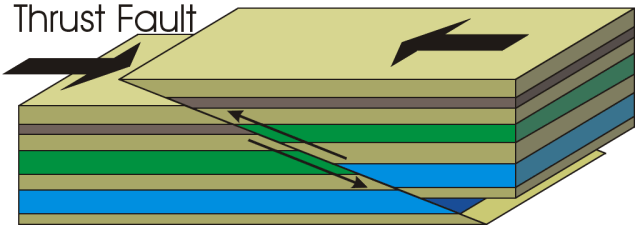
- 56What is a strike-slip faultScrape along side-by-side.
Movement is horizontal
Rock layers haven't been moved up or down on either side of the fault.
- 57What are foreshocksA mild tremor preceding the violent shaking movement of an earthquake
- 58What are aftershocksA smaller earthquake following the main shock of a large earthquake
- 59What are the two types of earthquake scalesMagnitude: The Richter Scale
Intensity: The Mercalli Scale - 60What is a Mercalli scaleThe Mercalli scale measures the intensity of an earthquake by quantifying the effects of an earthquake on the Earth's surface
- 61What are the main plate boundary types at which earthquakes occurConvergent
Divergent
Transform - 62Where do 5% of earthquakes occur5% of earthquakes occur in the intra-plate setting
Volcanic activity that occurs within tectonic plates - 63What types of damage can earthquakes causeFire
Liquefaction
Landslides
Mudslides
Avalanches
Ground Displacement
Flooding - 64How can we predict earthquakesOn probability scales but not an absolute time scale
- 65How does a tsunami occurCaused by sudden movement of the ocean due to:
Earthquakes
Landslides on the sea floor
Land slumping into the ocean
Major volcanic eruptions
Large meteorite impacts - 66How does a tsunami propogate from the sourcegtbnr
- 67Explainhow and why
- 68DescribeWhat, what is happening, what do you see
Informações
- Descrição
- Earth Systems FlashCards sobre Dynamic Earth and Earthquakes, criado por Olivia Gniadek em 19-04-2018.
- Criado por
- Olivia Gniadek
- Visualizações
- 10
- Tags
- Avaliação