
Flashcards
GCSE 9-1 Biology Topic 1: Key Concepts in Biology

Flashcards do conjunto (50)
- 1What substrate does Protease act on and what is its product?Protease acts on Protein and its product is Amino Acids.
- 2What substrate does Lipase act on and what is its product?Lipase acts on Lipids and its products are Fatty Acids and Glycerol.
- 3What substrate does Amylase act on and what are its products?Amylase acts on starch and its product is simple sugars (e.g Glucose).
- 4What substrate does Carbohydrase act on and what is its product?Carbohydrase acts on carbohydrates and its product is simple sugars (e.g Glucose)
- 5What are the components of this diagram? 1. 2. 3.1. Enzyme, Substrate, Active site
2. ESC, Lock-and-Key mechanism
3. Product - 6What is a catalyst?A catalyst is a substance which increases the rate of a chemical reaction. It remains unchanged throughout the reaction; it cannot be used up and can be used repeatedly.
- 7What are enzymes?Enzymes are chains of Amino Acids which are folded(?) in a specific way. They are biological catalysts. They can break down large molecules or make bigger ones.
- 8Why do we need enzymes?Enzymes are needed in the human body as, without enzymes, the chemical reactions essential for life would take place too slowly to be sufficient for the needs of the body.
- 9What is a substrate?A substrate is a molecules which joins onto the enzyme and is changed, joined to another substrate or split (e.g starch, protein, lipids, etc.)
- 10What is the active site of an enzyme?The active site of the enzyme is the area at which the enzyme joins with the substrate to perform chemical reactions.
- 11What is meant by enzymes being substrate-specific?Enzymes are substrate-specific as they will only join to one specific substrate.
- 12Describe the effect of increasing temperature on enzymes.- enzyme activity increases gradually
- 37°C -> Optimum temperature ->peak activity
- after 40°C -> Enzymes denature -.> substrate will not fit - 13Describe the effects of pH on enzyme activity.- as pH increases, enzyme activity increases.
- optimum pH (varies per enzyme) -> fastest rate of reaction
- beyond optimum -> Enzymes denature -> no longer complementary to substrate - 14Which parts of the body would have enzymes with an optimum pH of: i) 1-2? ii) 7.5-8?i) stomach
ii) duodenum - 15What happens to the rate of reaction when the surface area of the substrate is increased?When the surface area increases, the rate of reaction also increases as there is more space for the enzymes to attach to.
- 16What happens to the rate of reaction when the concentration of enzymes is increased?As concentration of enzymes increases, the rate of reaction increases there is more opportunity for reaction. however, this rate plateaus because excess enzymes make the reaction space crowded
- 17What happens to the rate of reaction when the concentration of substrate is increased?As concentration of substrate increases, the rate of reaction increases as there is more opportunity for reaction. however, this rate plateaus because there will eventually be to many substrates for the enzymes.
- 18Describe the test for the presence of starch.- iodine solution
- room temperature (no heating required)
- positive result: amber -> blue/black
- negative result: stays amber - 19Describe the test for the presence of protein.- Biuret solution
- Room temperature (no heating required)
- Positive result: blue -> purple
- Negative result: stays blue - 20Describe the test for the presence of reducing sugars (e.g Glucose).- Benedict's solution
- Heat to 80°C
- Positive result: blue -> green -> yellow/orange -> brick red precipitate (scale)
- Negative result: stays blue - 21Describe the test for the presence of lipids.- Ethanol + water
- shake with ethanol for 30s then add water and lightly shake
- Positive result: colourless -> milky white emulsion/ sparkling white suspension
- Negative result: stays colourless - 22What needs to be considered when comparing concentration of lipid/reducing sugar/protein between samples?When comparing between samples of lipids/proteins/reducing sugars:
- same volume/mass of test substance
- same volume of indicator
- same conditions (temperature, etc.)
- same length of time before observation - 23Recall the 7 food groups.- Carbohydrates
- Protein
- Lipids
- Fibre
- Minerals
- Vitamins
- Water - 24Ranked in order of energy content, recall the three most energy rich food groups.1) Lipids (fat)
2) Protein (not respired unless in starvation)
3) Carbohydrates - 25How can we compare energy content of different foods?- same volume of H2O
- same height of calorimeter above food
- same mass of food
- minimise heat loss
- repeat 3x (form mean)
- digital thermometer
- ensure food is completely burnt - 26What is the formula to calculate the energy content in Joules of food samples?energy released from food = 100 * 4.2 * temperature rise
- 27What could be the reasons that the results from the experiment are different values from the packaging of the food?- the food could have not been burnt properly
- energy from splint affecting results
- energy escaping into the surroundings - 28How do you convert down the size range (e.g mm to µm) ?To convert down the size range, multiply the larger size by 1000/1x10^3
- 29How do you convert up the size range (e.g µm to mm) ?To convert down the size range, divide the larger size by 1000/1x10^3
- 30what is the formula for magnification?Magnification = image size / object size
- 31What are some of the differences between electron and light microscopes?while light microscopes can be used to view both living and dead samples, electron microscopes can only be used to view dead objects (in a vacuum). electron microscopes can create both 2D and 3D images whereas light microscopes can only create 2D images.
- 32Define: (i) anomaly (ii) repeatability(i) a result that does not fit the trend of other results.
(ii) agreement of results when experiments are produced over a short period of time by the same person in the same conditions. - 33Define: (iii) reproducibility (iv) validity(iii) agreement of results when the experiment is reproduced by various people over a wide timescale in similar/equivalent equipment.
(iv) investigation measures what is supposed to be measured, so variables are minimised. - 34What are the units for rate?if rate is calculated by 1/time, unit is s^-1.
if rate is calculated by 100/time, unit is s^-100. - 35Label this Animal cell1) Cytoplasm
2) Nucleus
3) Cell Membrane
4) Mitochondria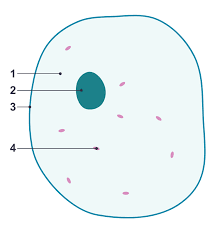
- 36Label this plant cell1) Cytoplasm
2) Nucleus
3) Cell Membrane
4) Mitochondria
5) Cell Wall
6) Vacuole
7) Chloroplast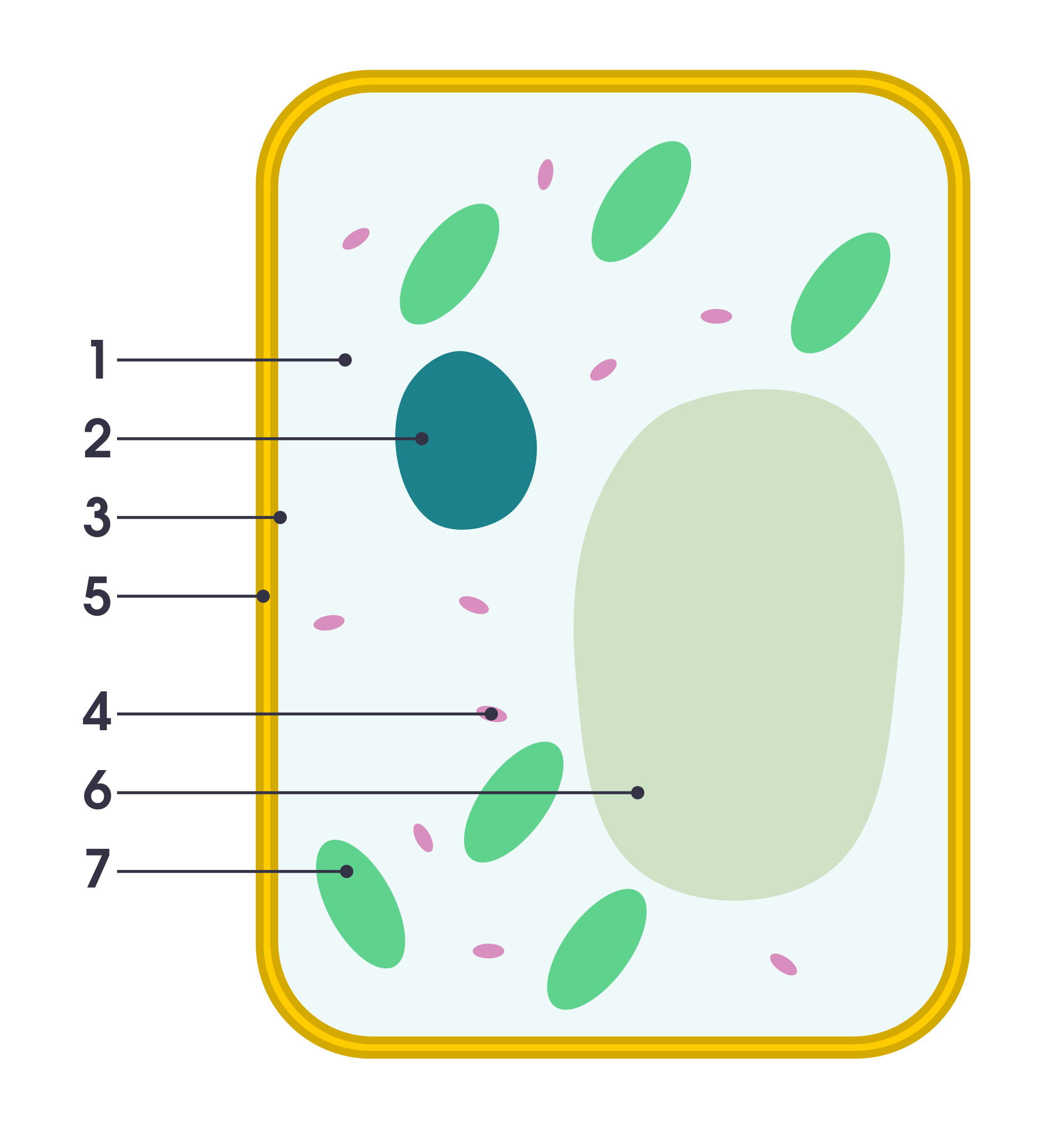
- 37Label this bacterial cell1) Cytoplasm
2) Cell membrane
3) Cell Wall
4) Slime Capsule
5) Mitochondria/Ribosomes
6) Nucleoid DNA
7) Plasmids
8) Flagellum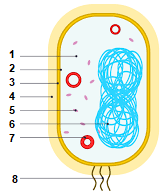
- 38Describe the function of: i) Flagellum ii) DNA iii) Plasmids iv) Ribosomesi) Long, thread-like structure for movement
ii) Information, make-up, 'brain' of the cell
iii) Transfers DNA from one cell to another
iv) The site of protein synthesis - 39Describe the function of: v) Cell Wall vi) Slime capsule vii) Cell Membrane viii) Nucleusv) made of cellulose; it supports the cell and allows it to keep its shape
vi) Sticky outer layer to attach to object
vii) Separates cell contents from the surroundings, controls entry and exit to the cell
viii) Contains DNA, controls activity - 40Describe the function of: ix) Vacuole x) Chloroplasts xi) Cytoplasm xii) Nuclear Membraneix) space in the cytoplasm, filled with cell sap (water & ions), membrane-bound, keep cell shape
x) contains chlorophyll, essential for photosynthesis
xi) Where chemical reactions occur
xii) allow molecules (e.g. mRNA) to enter/exit - 41How is a sperm cell adapted to its function? (4 points)- Flagellum: can 'swim' to ova
- Haploid: fertilisation can occur
- Acrosome: penetrate ova walls
- Mitochondria: provide energy to travel?penetrate ova for fertilisation - 42How is an ova adapted to its function? (2 points)- nutrients in cytoplasm: for embryo if fertilisation is successful
- Haploid: fertilisation can occur - 43How are ciliated epithelial cells adapted to their function? (1 point)- Cilia: small hairs to 'waft' ova/mucus along the fallopian tube/trachea respectively
- 44What is diffusion?Diffusion is the movement of molecules from a region of high concentration to a region of low concentration until equilibrium is reached.
- 45Recall 2 features of Diffusion1) Diffusion is a passive process - no start-up energy is required
2) Diffusion rate depends on distance, temperature and concentration gradient - 46What is Osmosis?Osmosis is the diffusion of water molecules from a high concentration to a low concentration across a partially permeable membrane
- 47How do plant cells react to concentrations of water in terms of osmosis?- When external water concentration is lower than the cell's, water will diffuse out and the cell will sink
- When external water concentration is higher than the cell's, water diffuses in and the cell expands - 48How do animal cells react to concentrations of water in terms of osmosis? (Considering the absence of a cell wall)- When external water concentration is lower than the cell's, the cell will crenate (shrivel up) and lose its shape
- When external water concentration is higher than the cell's the cell will undergo lysis (burst) - 49What is active transport?Active transport is the movement of molecules from a low concentration to a high concentration across a membrane. As it is an active process, energy from respiration is required for it to occur.
- 50How to carrier proteins work? (in terms of active transport)Carrier proteins act like enzymes and recognise substances that need to be transported against the usual direction of diffusion. It is then inverted by energy to deposit the substance.
Informações
- Descrição
- Enzymes, Biomolecule testing, Energy content in food, Magnification & Microscopy, AMYLASE CORE PRACTICAL
- Criado por
- Madison Ellis
- Visualizações
- 36
- Avaliação