
Flashcards
Biology B2
Flashcards do conjunto (40)
- 1What does a nucleus do?Controls the activities of the cell
Contains genes
Carry out instructions for making new cells - 2What does Cytoplasm do?most chemical reactions needed for life take place here
- 3What does the cell membrane do?controls the passage of substances into and out of the cell
- 4What do the mitochondria do?oxygen is used here and the energy from respiration is released
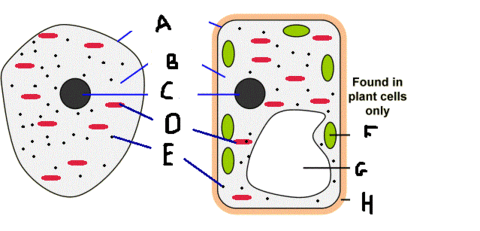
- 5—A-Cell Membrane
B-Cytoplasm
C-Nucleus
D-Mitochondria
E-Ribosome
F-Chloroplast
G-Vacuole
H-Cell Wall - 6What is found only in a plant cell and not an animal cell?Cell Wall
Vacuole
Chloroplast - 7What are some types of specialised cells?Fat cells
Cone Cells
Root hair cells
Sperm Cells - 8What is diffusion?The movement of molecules from an area of higher concentration to an area of lower concentration
- 9What affects the rate of diffusion?Difference in concentration
- 10What is a tissue?a group of cells with a similar structure and function.
- 11What is an organ?Organs are made of tissues
- 12What organs form the digestive system?Mouth, stomach, liver, gall bladder, bile duct, small intestine, large intestine, pancreas
- 13What are the plant organs?stems roots and leaves
- 14What is the equation for photosynthesis?carbon dioxide + Water > glucose + oxygen (+Light Energy)
- 15What are the limiting factors of photosynthesis?CO2 Concentation
Light intensity
Temperature - 16What do plants do with the glucose they make?use it for respiration
convert insoluble starch for storage
to produce fats and oils for storage
to produce cellulose for use in the cells and cell walls. - 17How do plants store food?Glucose is converted to starch
- 18How can we control the environment in which plants are grown?it can be artificially control so that the optimum temp. CO2 concentration and light intensity is met.
- 19What factors affect the distribution of organisms in their natural environment?-temperature
-nutrients
-light intensity
-water availability
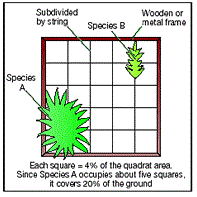
-CO2 & O2 avaliability - 20What is a quadrat?is the simplest way to sample an area
- 21What is a protein?molecules made up of long chains of amino acids
- 22What do proteins do?act as:
structural components of tissues
hormones
antibodies
catalysts - 23What is an enzyme?A biological catalyst
- 24How does temperature affect enzymes?As the temperature increases so does the rate of reaction, until the optimum temperature were it works best and then if the temperature continues to increase can denature the active site.
- 25Were are digestive enzymes made?In special cells in the glands and in the lining of the gut.
- 26How are enzymes involved in the digestion of your food?Different enzymes catalyse the breakdown of carbs fats proteins into smaller soluble molecules.
- 27Why does the stomach contain HCl?Enzymes in the stomach work pest in acidic conditions
- 28Why is bile important in digestion?bile neutralises acid and emulsifier fats.
- 29What do biological detergents contain?Protease and lipase
- 30What is aerobic respiration?glucose+oxygen->carbon dioxide+water(+energy)
- 31Were in the cells does respiration take place?In the mitochondria
- 32Why do mitochondria have folded inner membranes?to create a large surface area for maximum respiration
- 33How does the body respond to the increased demands for oxygen during exercise?increased heart rate
glycogen is converted to glucose
blood flow to muscles increases. - 34What is anaerobic respiration?glucose->lactic acid
- 35What is mitosis?the cell division in normal body cells-producing two identical cells
- 36What is meiosis?cell division where the chromosome number is reduced by half
- 37How do new species rise?When two populations become isolated
- 38How do populations become isolated?When they are separated geographically
- 39What alleles are selected in a new environment?alleles are selected that increase successful breeding in the new enviroment
- 40How does speciation take place in an isolated population?when an isolated population becomes so different from the original population that interbreeding can no longer take place.
Informações
- Descrição
- A-Level Biology (Biology) FlashCards sobre Biology B2, criado por Holly Bamford em 22-03-2015.
- Criado por
- Holly Bamford
- Visualizações
- 47
- Tags
- Avaliação