
Flashcards
Data Mining part 2
Flashcards do conjunto (16)
- 1Overfitting and Tree PruningOverfitting an induced tree may overfit the training data. Too many branches, some may reflect anomalies due to noise or outliers. Poor accuracy for unseen samples.
- 2Two approaches to avoid overfittingPREPRUNING: Halt tree construction early—do not split a node if this would result in the goodness measure falling below a threshold. Difficult to choose an appropriate threshold.
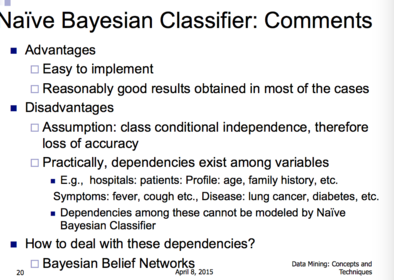
PPOSTPRUNING: Remove branches from "fully grown" tree—get a sequence of progressively pruned trees. Use a set of data different from the training data to decide which is the "best pruned tree" - 3Naive Bayesian Classifer: Comments
- 4Associative ClassificationAssociation rules are generated and analyzed for use in classification
Search for strong associations between frequent patterns (conjuring of attribute-value pairs) and class labels - 5Associative Classification: Why effective?It explores highly confident associations among multiple attributes and may overcome some constraints introduced by decision-tree induction, which considers only one attribute at a time
In many studies, associative classification has been found to be more accurate than some traditional classification methods, such as C4.5 - 6Classifier Accuracy Measures
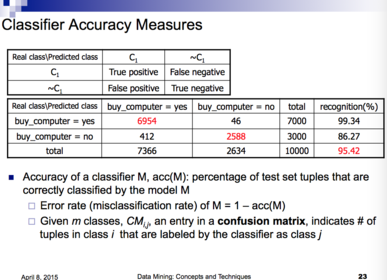
- 7Evaluating the Accuracy of a Classifier or Predictor: HOLDOUT METHODGiven data is randomly partitioned into two independent sets:
TRAINING SET (e.g., 2/3) for model construction
TEST SET (e.g., 1/3) for accuracy estimation
RANDOM SAMPLING: a variation of holdout — repeat holdout k times, accuracy = avg. of the accuracies obtained - 8Evaluating the Accuracy of a Classifier or PredictorCROSS-VALIDATION (k-fold, where k = 10 is most popular)
Randomly partition the data in k mutually exclusive subsets, each approximately equal size.
At i-th iteration, use Di as test set and others as training set.
LEAVE-ONE-OUT: k folds where k = # of tuples, for small size data
STRATIFIED CROSS-VALIDATION: folds are stratified so that class list. in each fold is approx. the same as that in the initial data - 9Ensemble Methods: Increasing the AccuracyEnsemble Methods: use a combination of models to increase accuracy, combine series of k learned models, M1, M2, ..., Mk, with the aim of creating improved model M*
POPULAR ENSEMBLE METHODS:
Bagging: average the prediction over a collection of classifiers
Boosting: weighted vote with collection of classifiers - 10An example of K-Means Clustering
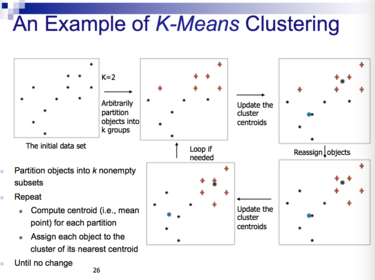
- 11Hierarchical Clustering
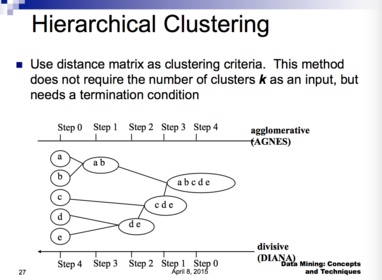
- 12Density-Based Clustering: Basic Concepts
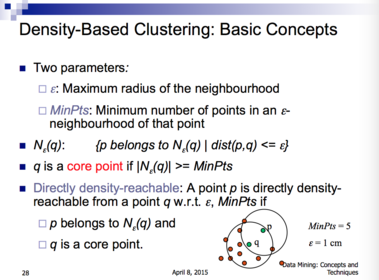
- 13Density reachable
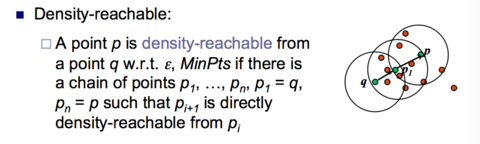
- 14Density-connected
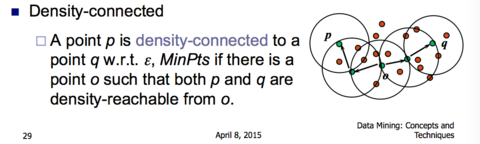
- 15Density Based Spatial Clustering of Applications with noise
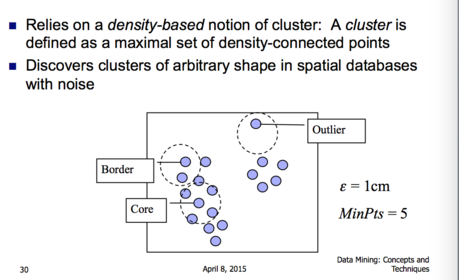
- 16The Curse of DimensionalityData in only one dimension is relatively packed
adding a dimension stretch the points across that dimension, making them further apart
adding more dimensions will make the points further apart-high dimensional data is extremely spares
distance measure becomes meaningless due to equi-distance
Informações
- Descrição
- Data Mining final review part 2
- Criado por
- Kim Graff
- Visualizações
- 57
- Tags
- Avaliação