
Data Mining
134 resources created by 102 users
This Data Mining page on GoConqr gathers community-made mind maps, quizzes, flashcards and notes, from data preprocessing and association rules to decision trees, clustering and text analytics. It's built for university students practising the core techniques, and for teachers after ready-made material. There are over 130 resources here, including more than 80 mind maps, more than 20 flashcards and over 10 quizzes, almost all at university level. Pick a topic, test yourself with a quiz, then make your own maps.
Top Data Mining resources
-
Mind map Data Preprocessing Data Preprocessing Technique in Data Mining
-
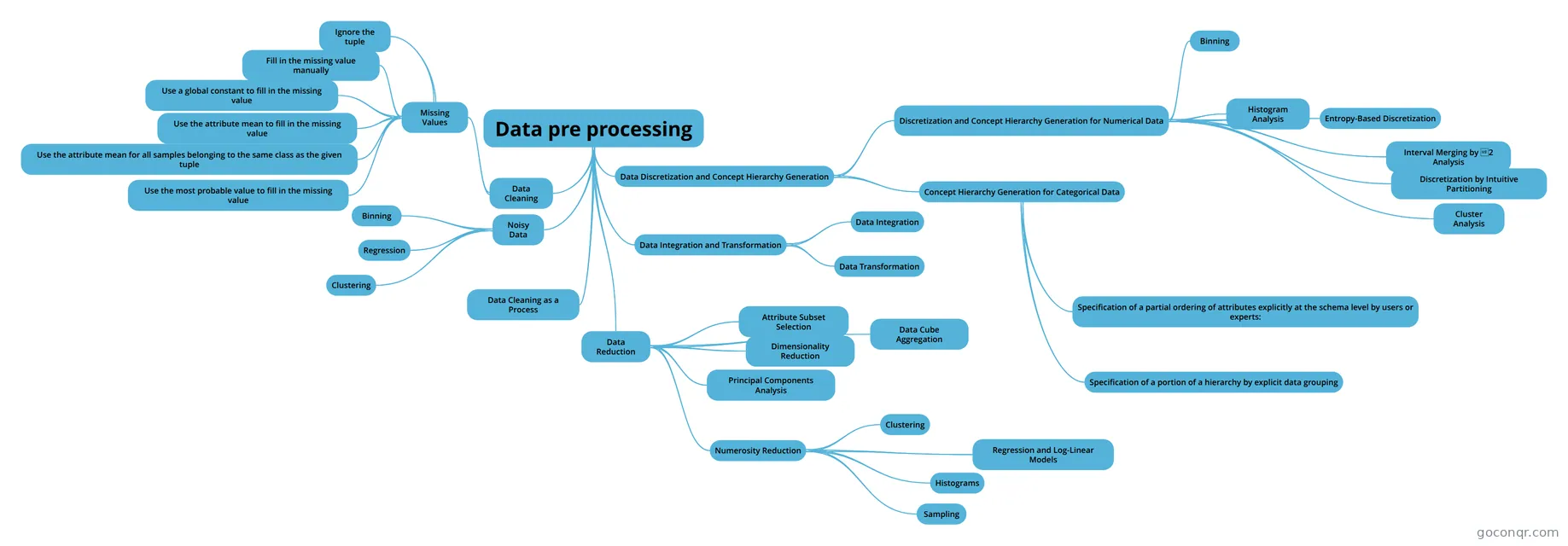 Mind map Data pre processing
-
Mind map Data Pre-processing
-
16 cardsData Mining part 2 Overfitting and Tree Pruning
-
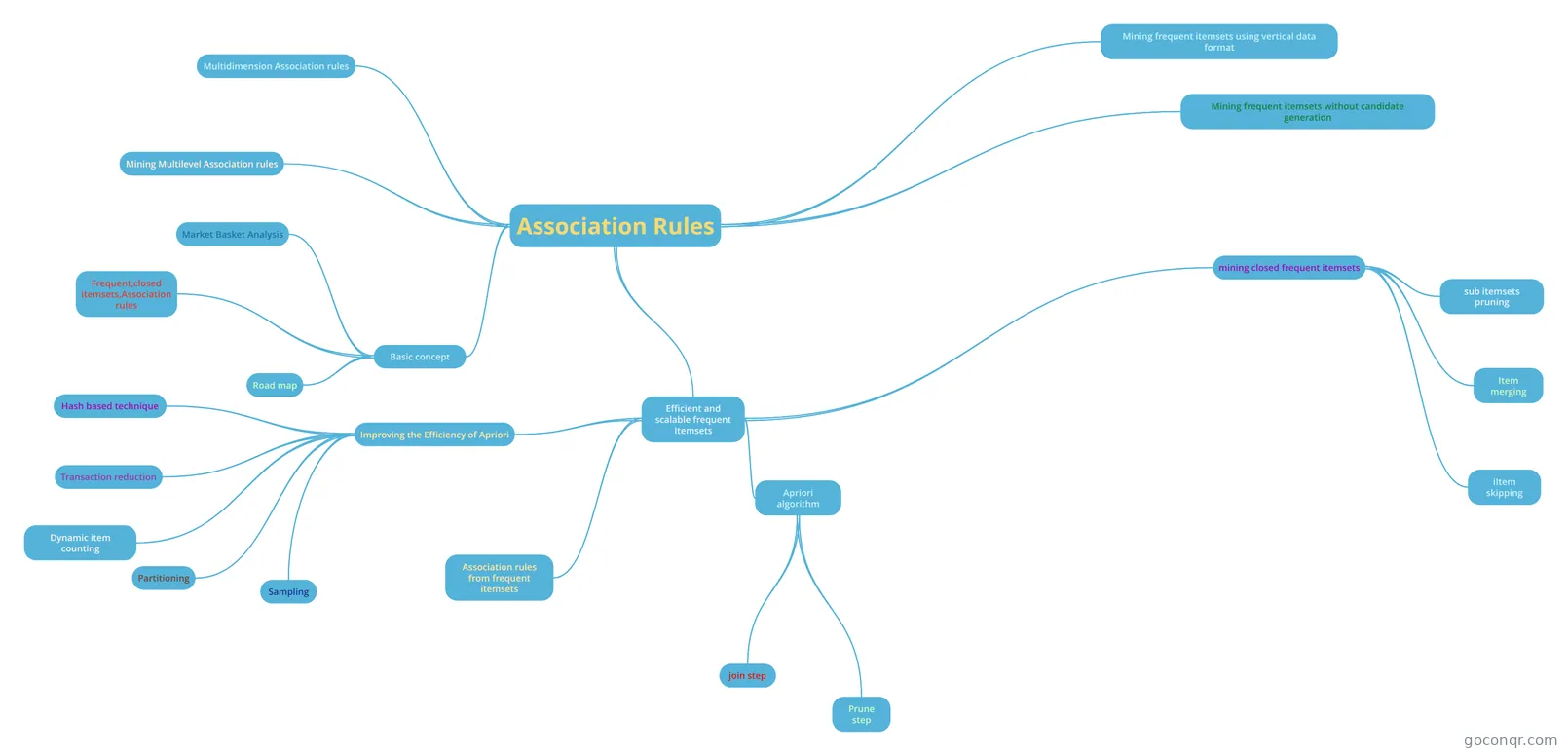 Mind map Association Rules Data mining Association rules
-
21 cardsData Mining Part 1 Data Mining is..
-
10 cardsGraph mining - To become a champion Degree of a vertex
-
9 cardsA2 IT Data mining
Mind maps
See all 88 mind maps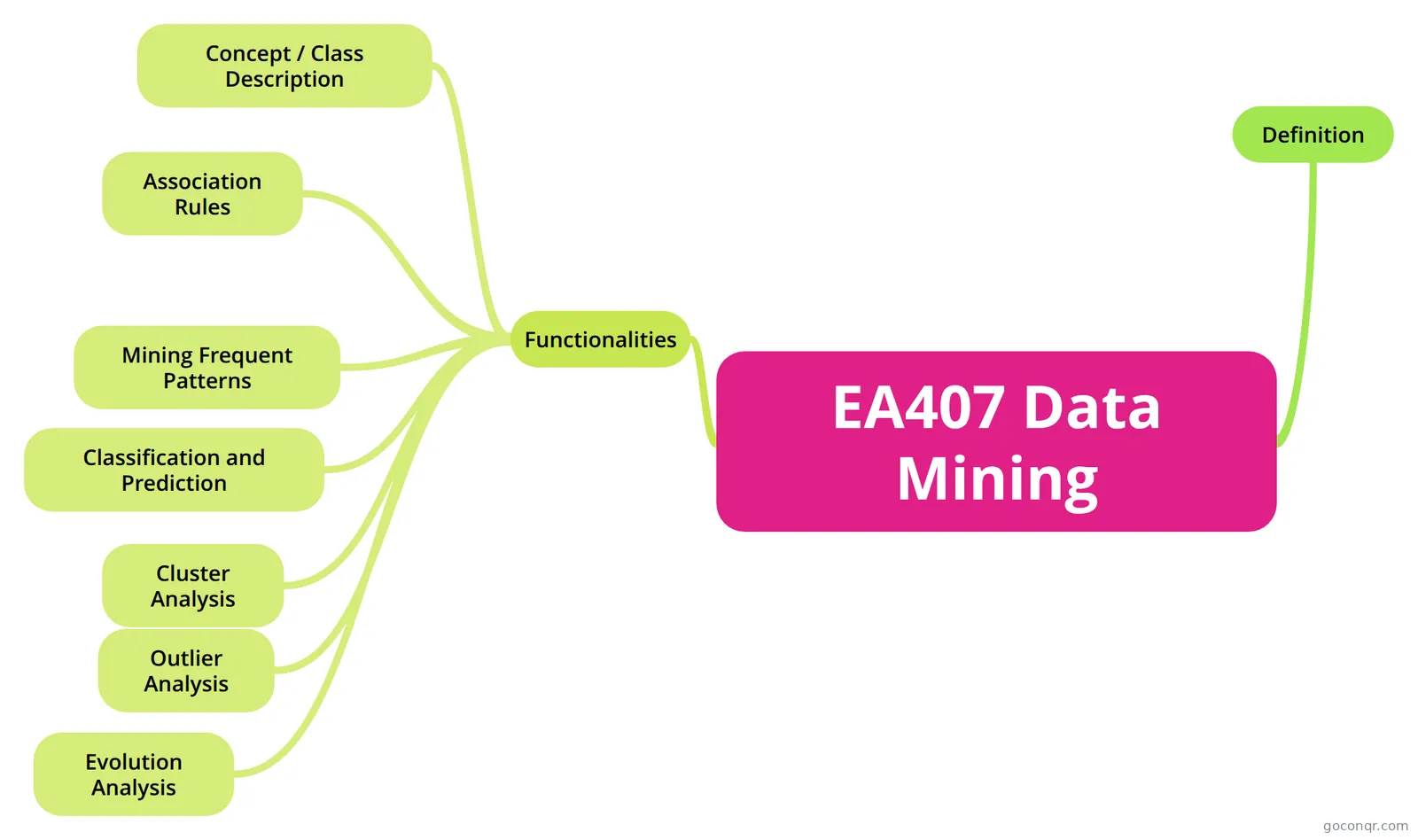
Flashcards
See all 23 flashcardsMore Databases and data science topics
About Data Mining
GoConqr OriginalWhat this unit covers
The page sits in the Machine Learning and Artificial Intelligence strand of Databases and data science. Most of what it lists is mind maps, and a large share of them deal with data preprocessing: cleaning, integration, transformation, reduction and discretisation. One map also looks at why we preprocess at all, using ideas such as accuracy, completeness, consistency and believability.
Core techniques
Several maps take in the whole field. The Data Mining maps branch into association rule mining, classification, clustering and prediction. Under those you will find the Apriori algorithm, FP Tree, Bayesian classification, decision trees, K Means and density based clustering. Separate maps and flashcard decks go deeper on association analysis, market basket analysis and decision tree induction.
Applications and wider topics
The page also reaches beyond the basics. There is a Personal Credit Scoring map that covers behavioural scoring and the history of the field. The event detection map looks at Twitter, blogs and time series of tweet volume. Others cover Text and Web Analytics, Link Prediction and Latent Semantics Analysis (LSA) Algorithm.
Where to start
- Open the Data Mining Process map to see the five stages and the task types.
- Move to the Data Mining Tasks flashcards to fix the difference between supervised and unsupervised learning.
- Work through a preprocessing map, then an association rules map.
- Try the Data Mining - Chapter 1 quiz, which asks you to pick out predictive modelling tasks.
Using maps and quizzes together
Read a map first, then close it and take a quiz on the same topic. Where you slip, go back to the branch that covers it. The association quizzes, including the Apriori execution test, pair well with the association analysis maps. Descriptive Data Mining is a useful quiz once you have met clustering.
When you are ready, choose one technique from the list and try its quiz, then sketch your own version of the map from memory.
Frequently asked questions
Where should I start with Data Mining?
Begin with the Data Mining Process mind map, which sets out the five stages and the main task types. Then try the Data Mining Tasks flashcards to separate supervised from unsupervised learning. After that, pick preprocessing or association rules and move on to a quiz.
What do the mind maps cover?
There are more than 80 of them. Many cover data preprocessing, including cleaning, integration, transformation and reduction. Others cover association rules, Apriori, FP Tree, classification, decision trees, clustering and prediction. Some look at applications such as credit scoring, event detection, text analytics and link prediction.
Are there quizzes on association rules?
Yes. Association - Machine Learning and Association and Apriori Execution Test - Machine Learning are both listed. They work well after you have read an association analysis or association rules mind map, because you can check whether you can apply the steps.
Who are these resources for?
Nearly all of them are at university level, so they suit university students studying data mining. Teachers can also use them as ready-made material for classes. The resources were made by GoConqr users, not by GoConqr itself.
Are the resources free?
Yes. Every resource listed here is free to open, study and take, with no account needed. If you make a free account, your quiz scores are saved and you can create your own quizzes, mind maps, flashcards and notes.
What if I can't find my topic?
Check nearby titles first, as preprocessing appears under several spellings, such as Data Pre-processing and Data Preprocessing. If a topic is still missing, you can build your own map, flashcards or quiz on it and keep it for revision.