
Flashcards
F211- Module 1 Cells, exchange and transport
Flashcards do conjunto (90)
- 1Define: MagnificationMagnification is the number of times greater an image is than the object.
- 2Define: ResolutionThe ability to distinguish two separate points as distinct from each other.
- 3What is the maximum magnification of a Light Microscope?x1500
- 4What is the maximum resolution of a Light Microscope?200nm
- 5What are the two ways of preparing specimens for the Light Microscope?Staining: Which allows the specimen to be seen.
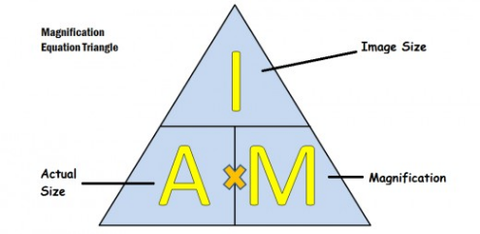
Sectioning - 6How do you work out either actual size, image size or magnification of a specimen?
- 7What is the maximum magnification of a Transmission Electron Microscope?x500 000
- 8What is the maximum resolution of Transition Electron Microscope and Scanning Electron Microscope?Both 0.2nm
- 9What is the maximum magnification of a Scanning Electron Microscope?x100 000
- 10How does the Transmission Electron Microscope get its image?An electron beam passes through a thinly prepared sample and the electrons bounce off the sample. A 2D image is produced.
- 11How does a Scanning Electron Microscope produce an image?An electron beam is directed onto a sample, the electrons do not pass through.
- 12What is the structure of the cytoskeleton?The cytoskeleton is made of a network of protein fibres. Some fibres (actin filaments) are found in the muscles, whereas the other fibres are called microtubules, which are 25nm in diameter.
- 13What is the role of the cytoskeleton?The role of the cytoskeleton is to provide shape and stability in cells. The Actin Filaments cause some organelles to move around inside cells, whereas the microtubules can be used to move a microorganism through liquid.
- 14What is a vesicle?Vesicles are membrane bound sacs found in cells. They are used to carry substances around the cell.
- 15What is the role of the nucleus?The nucleus houses most of the cells genetic material and has the instructions for making proteins.
- 16What is the role of the Rough Endoplasmic Recticulum?It transports proteins attached to ribosomes.
- 17What is the role of the Smooth Endoplasmic Recticulum?It is involved in making lipids.
- 18What is the role of the Golgi Apparatus?The Golgi recieves proteins from the RER and modifies and packages them, putting them into vesicles to be transported elsewhere.
- 19What is the role of a mitochondria?Mitochondria are the powerhouse of the cell, that produce ATP during respiration.
- 20What is the role of chloroplasts?Chloroplasts are the site of photosynthesis.
- 21What is the role of a lysosome?Lysosomes contain digestive enzymes that break down molecules.
- 22What is the role of ribosomes?Ribosomes are the site of protein synthesis. They act as an assembly line where coded information is used to assemble proteins.
- 23What is the role of a centriole?Centrioles take part in cell division. They form fibres known as the spindle.
- 24What is division of labour?Any system where different parts perform specialised functions, each contributing to the function of the whole.
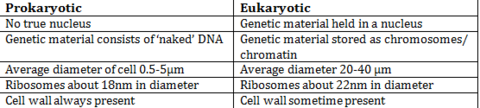
- 25What is a prokaryote?An organism with cells that do not contain a true nucleus.
- 26What is the difference between a prokaryote and a eukaryote?
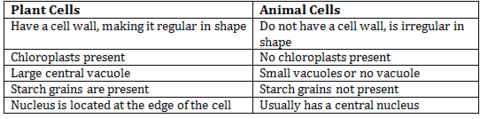
- 27What are the differences between plant cells and animal cells?
- 28What are the roles of membranes?They separate cell content from both the cytoplasm, and the outside of the cell. They are important in cell recognition and signalling. They also hold the components for some metabolic pathways in place, as well as regulating transport of materials in and out of the cell.
- 29What two components make up the phospholipid bilayer?Hydrophobic, fatty acid tails
Hydrophillic, phosphate heads - 30Define: Fluid Mosaic ModelThe model of cell membrane structure proposed by Singer and Nicholson-a phospholipid bilayer with proteins 'floating' in it
- 31What is the role of cholesterol?Cholesterol gives the membrane mechanical stability by sitting between fatty acid tails, therefore making the barrier more complete, preventing molecules like water and ions from passing through the membrane
- 32What is the role of phospholipids?Phospholipids have a hydrophobic head and a fatty acid tail. They form a bilayer separating cells from the outside. They are fluid so components can move around freely.
- 33What is the role of glycolipids?Glycolipids are phospholipid molecules that have a carbohydrate part attached. They are used for cell signalling, cell surface antigens and cell adhesion.
- 34What is the role of glycoproteins?Glycoproteins are phospholipid molecules that have a protein attached. They have the same function as glycolipids.
- 35What is the role of proteins?Channel proteins allow the movement of some substances, such as large molecule sugar, into and out of the cell as they can't travel directly through the cell surface membrane
- 36What is the role of channel proteins?Channel proteins allow movement of some substances across a membrane. The molecules they allow to cross are too large and too hydrophilic and can also be ions. Channel proteins allow polar substances to cross the membrane
- 37What is the role of a carrier protein?Carrier proteins actively move substances across a membrane. They transport large substances by endocytosis using ATP as energy
- 38What is the role of a receptor cell?Some receptor cells allow hormones to bind with the cell, as they have complementary shapes, therefore the cell response can be carried out.
- 39What happens to the membrane when temperature is changed?As temperature increases the molecules have more kinetic energy. The increased movement makes the membrane leak, which allows molecules that cannot usually pass through the membrane move in and out of the cell
- 40What is cell signalling?Cell signalling is a process that leads to communication and coordination between cells, e.g. a hormone binding to its receptor on the cell surface membrane
- 41What is the role of membrane-bound receptors as sites where hormones can bind?Hormones are used in cell signalling. The target cells have a receptor which is complimentary to the hormone, meaning it can bind to the receptor cells, triggering the desired internal response.
- 42What is the role of membrane-bound receptors as sites where drugs can bind?Drugs have been developed which bind to the receptors on cells. Beta-blockers prevent a muscle from increasing the heart rate to a dangerous level, and some drugs used to treat schizophrenia mimic a natural neurotransmitter which some people cannot mimic.
- 43Define: Cell SignallingCells communicate with one another by signals. Many molecules act as signals-some signal during processes taking place inside cells; others signal from one cell to others. Cytokines are an example of cell signals
- 44Define: DiffusionDiffusion is the net movement of molecules from a region of high concentration to a region of lower concentration, thus moving down a concentration gradient
- 45What is passive transport?Passive transport is the transport of a molecule without using energy. Large, charged molecules need to be transported across, they can't just diffuse across, but instead use either channel proteins or carrier proteins
- 46What is active transport?Active transport is the movement of molecules or ions across membranes, using ATP to drive 'protein pumps' within the membrane
- 47What is endocytosis?Endocytosis is when large quantities of material are brought into a cell using ATP
- 48What is exocytosis?Exocytosis is when large quantities of a material are brought out of a cell using ATP
- 49What is osmosis?Osmosis is the movement of water molecules from a region of high water potential to a region of low water potential across a partially permeable membrane
- 50What happens to a plant cell if it is placed in a high water potential?Water moves, by osmosis, into the cell causing the cell to burst. This is known as the cell being haemolysed
- 51What happens if a plant cell is placed in a solution with a negative water potential?Water moves out of the cell by osmosis causing the cell to be crenated
- 52What happens if a plant cell is solution with a high water potential?Water moves into the cell by osmosis causing the cell to become turgid
- 53What happens to a plant cell if it is placed in a solution with a negative water potential?Water moves out of the cell by osmosis causing the cell to become plasmolysed
- 54What factors affect the rate of diffusion?Temperature, Concentration gradient, stirring/moving, surface area, distance/thickness of membrane, size of molecule
- 55What is facilitated diffusion?Facilitated diffusion is the passive movement of molecules across membranes down their concentration gradient, which is aided by transport (Channel or carrier) proteins. No metabolic energy is required
- 56Define: MitosisMitosis is nuclear division that results in the formation of cells that are genetically identical to the parent
- 57When does mitosis occur?Mitosis occurs in a-sexual reproduction, growth, repair of cells and replacement of cells
- 58Define: MeiosisMeiosis is nuclear division that results in the formation of cells that contain half the number of chromosomes of the adult cell
- 59When does meiosis occur?Sexual reproduction only
- 60As mitosis only occupies a small percentage of the cell cycle, what occupies the other percent?Cytokinesis and Interphase
- 61What are the stages of mitosis?Interphase, Prophase, Metaphase, Anaphase and Telophase
(IPMAT) - 62What occurs in Interphase?In Interphase the DNA replicates. This occurs in three stages: Growth phase 1 (biosynthesis: proteins made, organelles replicate), S (Synthesis of new DNA: replication of chromosomes) and Growth phase 2 (Growth)
- 63What occurs in Prophase?In Prophase the chromosomes supercoil, becoming visible under a light microscope. The nuclear envelop breaks down and the centriole divides into two and move to opposite ends of the cell to form a spindle
- 64What occurs in Metaphase?In Metaphase the chromosomes line up along the middle of the cell and attach to the spindle thread by their centromere
- 65What occurs in Anaphase?In Anaphase the replicated sister chromatides are separated when the centromere splits. The spindle fibres shorten, pulling the chromatids apart
- 66What occurs in Telophase?In Telophase as the separate sister chromatids reach the poles of the cells a new nuclear envelop forms around each set. The spindle then breaks down and the chromosomes uncoil so they are no longer visible under a light microscope
- 67Define: CytokinesisCytokinesis is the division of the cell, following nuclear division to form two new cells
- 68As the chromosomes are being replicated why are the checked by enzymes?If the chromosomes are not checked by enzymes, mistakes may occur and get replicated. This would cause mutations meaning the new cell fails to function
- 69What cells can mitosis occur in?In animal cells mitosis can occur in most cells, whereas in plants only meristem cells can divide this way
- 70Define: Homologous pair of chromosomesChromosomes that have the same genes at the same loci. Members of a homologous pair pair up during meiosis. Diploid organisms produced by sexual reproduction have homologous pairs- one member of each pair from the mother and one from the father
- 71What is budding?Budding is when yeast cells undergo cytokinesis by producing a small 'bud' that nips off the cell
- 72Define: Stem CellStem cells are undifferentiated cells that are capable of becoming differentiated to a number of possible cell types
- 73How are erythrocytes specialised for their function?They have a biconcave disc shape to maximize their surface area. They also do not have any nucleus which allows them to carry more haemoglobin
- 74How are neutrophils specialised to suit their function?Neutrophils have a flexible shape which allows them to engulf foreign particles and pathogens. They also have many lysosomes which contain digestive enzymes that break down the engulfed particles
- 75How are epithelial cells specialised to suit their function?Epithelial cells have cilia to move particles, and also have many microvilli to increase surface area
- 76How does the organelle content of sperms help their function?Sperm cells have many mitochondria to generate energy for undulipodium movement, they also have specialised lysosomes in the head which contain a special enzyme to break down the egg wall.
- 77How does the shape of sperm cells herlp their function?Sperm cells are very long, thin, and small which help them ease their movement. They also have an undulipodium to move
- 78How does the content of sperm cells help specialise their function?Sperm cells contain half the number of chromosomes of an adult cell in order to fulfill its role as a gamete
- 79How are palisade cells specialised for their function?Palisade cells contain chloroplast which help them absorb light. They also have thin walls so carbon dioxide can diffuse in
- 80How are root hair cells specialised to suit their function?Root hair cells have hair like projections to increase surface area to absorb water and minerals from the soil
- 81How are guard cells specialised to suit their function?Guard cells contain thin outer walls and thick outer walls. In light they absorb water to become turgid and allow exchange of gases
- 82What is tissue?Tissue is a group of similar cells that perform a particular function
- 83What are organs?Organs are a collection of tissues that work together to form a specific overall function or set of functions within a multicellular organ
- 84What are organ systems?Organ systems are a number of organs working together to form a life function
- 85What are the four main types of animal tissue, and what are they used for?Epithelial tissue is layers and linings
Connective tissue holds structures together and provide support
Muscle tissue are cells that contract and move parts of the body
Nervous tissue: cells that convert and conduct stimuli into electrical impulses - 86How is squamous epithelial tissue specialised?Are flattened cells that form a thin, smooth, flat surface. Line the inside of tubes such as blood vessels
Form thin walls, e.g. the alveoli
They are held in place by basement membrane which is made of collagen and glycoproteins - 87How is ciliated epithelial tissue specialised to suit their function?Ciliated epithelial tissue is column shape with exposed surface covered cilia. They move in synchronised waves and are found on the surface of tubes such as bronchi and the oviduct. They help waft mucus in the lungs and eggs in the oviduct
- 88How is the xylem specialised to suit suit their function?The xylem is composed of xylem vessel cells and parenchyma cells. The parenchyma cells fills the gaps between xylem vessels to provide support
- 89How is the phloem specialised to suit their function?The phloem is comprised of sieve tubes and companion cells. The companion cells are highly metabolically active, moving products of photosynthesis up and down the phloem
- 90Why is cooperation between cells, tissues, organs and organ systems important?Movement: the muscular and skeletal system work together for movement to take place, this can only happen if the nervous system 'instructs' muscles to coordinate their actions. Muscles and nerves use energy, so they require a supply of nutrients and oxygen from the circulatory system, which receives the chemicals from the digestive and ventilation system.
Informações
- Descrição
- Here are my que cards for OCR Biology F211
- Criado por
- eilish.waite
- Visualizações
- 654
- Tags
- Avaliação