
Flashcards
enviro midterm 2 study guide
Flashcards do conjunto (66)
- 1most populated countries1. india 2. china (together they make 36%)
- 2what set off the population boom?industrial revolution
- 3haber-bosch process- they found the chemical bond in diatomic nitrogen (strongest chem bond) can be broken at high temp and pressure using a catalyst
- today all inorganic nitrogen fertilizer comes from this process
- doubled world population (would've been 4bill w/o it) - 4population doubling time (PDT) formula70 years / growth percent = PDT in years
- 5crude fertility/death ratenumber of births/death per thousand persons in a given year (using midyear population)
- 6total fertility ratenumber of children born to an average woman in a population during her entire reproductive life
- 7replacement ratenumber of children per couple needed to maintain a stable population (~2.1 children)
- 8ecological footprintestimate of our individual and collective environmental impacts
- 9relationship between ecological footprint and human development indexas human development index increases, ecological footprint increases (direct relationship)
- 10carrying capacitymaximum quantity of beings that can be held in an area
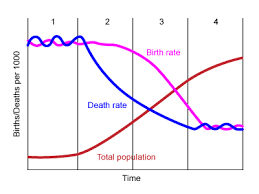
- 11demographic transition
- 12marx's view on populationbelieved population growth resulted from poverty, resource depletion, and pollution
- 13malthus's view on populationbelieved human populations would outstrip their food supply and starve
- 14sustainable development goalsaim to improve people's quality of life without driving other species extinct
- 15challenges future of agriculture facesdouble global food/fuel production on existing farmland within 21st century
enabling food security, while using resources more efficiently, enhancing soil, water, air quality, biodiversity, and ecosystem health, and being economically viable and socially responsible - 16global hunger index (GHI)index that measures hunger in countries
- 17issues with pesticideshealth concerns (humans and animals), compromises water quality, use builds resistance (like antibiotics in human use)
- 18issues with GMOsmore research is needed to address uncertainties, transparency needed, CRISPR (GMO technology enabling less nontarget effects)
- 19global water issuesinorganic fertilizers leaches quicker --> water pollution
- 20crop yield in past 150 yearsUS grain yield small in 1866, then increased sharply in 1937
(bc of genetics, nitrogen fertilizer, and pesticides) - 21how collective diet has changed over last 50 yearsless sugar but more corn-derived sweeteners
- 22approz. area of cropland per person1.5 acres
- 23ranked land use (grazing/farmland)of 4.9 billion hectares, 75% of ag land used for grazing (mainly beef)
- 24biofuels and food availability/costmore biofuels = doubling cost of corn, higher availability
- 25main features of soilunconsolidated, porous geological material, composed of inorganic and organic chemicals,
- 26soil components- organic matter
- minerals
- particle size (sand particles are larger)
- pore space and sizes
- biota - 27how soil workslayers (formed top --> down) of different color and/or texture (which tells us info)
- 28soil carbon/importance in carbon cyclemore carbon in soil than plant biomass + atmosphere
soil is dominant source of carbon emission to the atmosphere - 29how long does it take for 1 cm of soil to form?400 years
- 30what happens when major soil loss occurs (dust bowl)?crops were damaged (deficient rainfall), dust storms
- 31what is sorption?soil's ability to hold onto nutrients/chemicals
- 32how is sorption measured?Kd = concentration in soil (Cs) / concentration in water (Cw)
- 33charge on soil particlessoil is negative (attracts positive charges, or cations)
- 34how do cations and anions move around in soil?anions (-) can't be sorbed, so they move around
cations are sorbed, so they can't move - 35for non-polar compounds, interaction is controlled by what soil constituents?water solubility (high of this = low sorption)
- 36main type of degradation in soilschemical degradation:
- 37causes of soil erosionwater/wind movement, deforestation, construction
- 38effects of soil erosiondestroys soil profile, decreases water-holding capacity of the soil
- 39what is soil healthcontinued capacity of soil to function as a vital, living ecosystem that sustains life
- 40principles/common practices for soil health improvementsustainable agriculture (best approach: mimic natural ecosystem function)
- 41methods of waste managementminimizing generation of waste, recovering/recycling discarded materials, disposing of waste safely
- 42differences between municipal/industrial/hazardous wastemunicipal: household, small business
industrial: liquid consumer goods, mining, agriculture, oil - 43% recycled, combusted and placed in landfillrecycled: 32%
combustion: 15%
landfill: 53% - 44source reductionminimizing waste at its source (best way)
- 45composition of global wastefood/green waste: 44%
- 46CERCLAestablished Superfund program to cleanup abandoned hazardous dump sites, gave power to EPA to seek out responsible parties, requires EPA to designate hazardous substances/sites
- 47responsible waste management hierarchysource reduction/reduce, recycling/composting, energy recovery, disposal
- 48TSCAauthorized EPA to secure info on new chem substances and regulate distribution
- 49RCRAmade national framework for solid waste, financial aid for waste management programs
- 50NPLnational priority list of hazardous waste sites eligible for investigation and remedial action financed under the Superfund program
- 51what materials aren't entirely recycledplastics and tires
- 52life cycle analysis (LCA)analyzing environmental impacts of item’s production, use, and
disposal/recycling - 53what makes an organic compound toxic?solubility, size/structure, density, and presence of Cl, F, and Br
- 54biosolidssolid organic matter, used as fertilizer
- 55pros/cons of biosolidspros: fertilizer
cons: odor, attracts pathogens/critters, antibiotic resistance - 56organic contaminants and sourcesindustrial organics, everything ended in -icide, emerging contaminants
- 57chemicals of emerging concern vs. legacy chemicalsnot previously monitored substances
vs.
known substances - 58examples of chemicals of emerging concernPPCPS, EDCs, PFAS, BFAs
- 59examples of legacy chemicalsPFAS, BPAs (bisphenol), PCBs,
- 60compound classessoluble in water/fat, how we interact with them (air, water, food, skin), and level of toxicity
- 61grasshopper effecthow persistent pollutants travel large distances reaching remote areas
- 62bioaccumulation (one animal) vs. biomagnification (large scale)increase in contaminant concentrations in one animal over time
vs.
increase in contaminant concentration at higher trophic levels - 63dose-response graphS curve
- 64dosedetermines whether a chemical with be beneficial or poisonous
- 65NOAEL vs. LOAELno/lowest observable adverse effect level
- 66remediating contaminant sitesusing activated carbon to make it safer (locks up contaminants w/o removing them)
Informações
- Descrição
- Environmental Studies FlashCards sobre enviro midterm 2 study guide, criado por Elen Ryson em 29-02-2024.
- Criado por
- Elen Ryson
- Visualizações
- 1
- Avaliação