
Flashcards
Lecture 9- Nucleic Acids
Flashcards do conjunto (44)
- 1What is the structure of a nucleotide?Sugar (ribose or deoxy ribose), nitrogenous base and a phosphate group
- 2What is a nucleobase?Nitrogenous base
- 3What is a nucleoside?Nucleobase + sugar
- 4What is a nucleotide?Nucleoside +phosphate
- 5What is a nucleotide called if 2 or 3 phosphates are present?Nucleotide diphosphate and nucleotide triphosphate
- 6How is the sugar attached to the nucleobase?Beta-N-glycosidic link
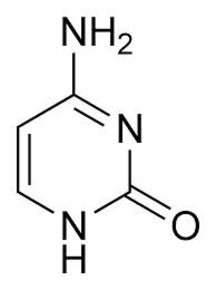
- 7What is a pyrimidine nucleobase?Heterocyclic organic compound consisting of a pyrimidine ring. (Long name small structure)
- 8Which nucleobases are pyrimidine nucleobases?Cytosine, thymine and uracil
- 9—Cytosine
- 10—Thymine
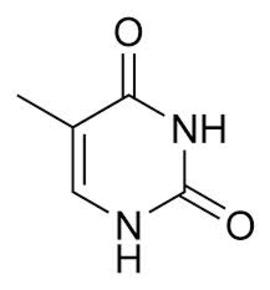
- 11—Uracil
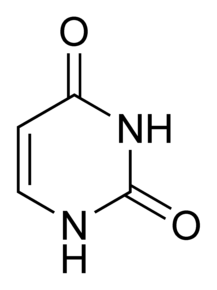
- 12Why is thymine more stable than uracil?Methylation make thymine more stable which means RNA degrades quickly
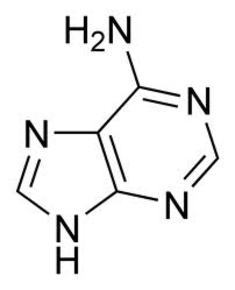
- 13What are purine nucleobases?Heterocyclic organic compounds consisting of a pyrimidine ring fused to an imidazole ring (shorter name more complex structure)
- 14Which bases are purine bases?Adenine and guanine
- 15—Adenine
- 16—Guanine
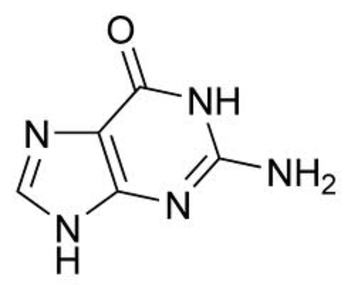
- 17Where can the aldopentose sugar ribose be found?ATP, GTP, NAD+, DNA (in deoxy form) and RNA
- 18Write equations to show the dephosphorylation and releases energy from ATPATP <-> ADP + P
ADP <-> AMP + P
ATP <-> AMP +PP - 19What is the role of cAMP?Cell signalling molecule
- 20What is the role GTP?Important in cell signalling and protein synthesis
- 21—ATP
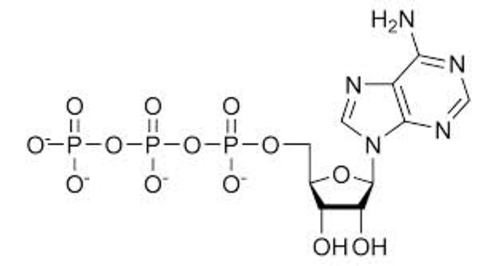
- 22—GTP
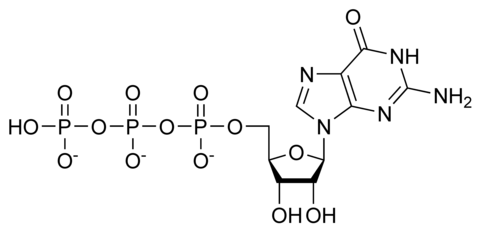
- 23—cAMP
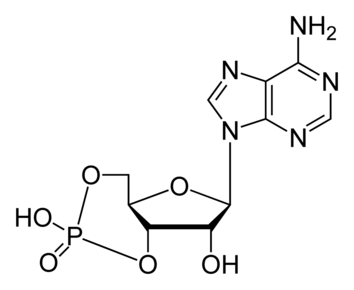
- 24What is NAD+?Co-enzyme in cellular reactions
- 25What is the role of NAD+?Acts as an electron acceptor in cellular respration
- 26In DNA what bond forms between the phosphate on one nucleotide and the deoxyribose sugar on the next?Phosphodiester bond (this forms a sugar phosphate backbone) which is a covalent bond
- 27What bonds form between the bases on each strand of DNA?Hydrogen
- 28Are the strands in DNA parallel or anti parallel?Anti parallel
- 29What direction are the strands read in?5' end to 3' end
- 30How many hydrogen bonds form between the complementary base pairs A and T?Two (T for 2)
- 31How many hydrogen bonds form between the complementary base pairs G and C?Three (C rhymes with 3)
- 32What are genes?They are portions of DNA that code for proteins
- 33What is the genetic code?Non overlapping- each base is only part of one codon
Universal- a single codon can only code for one amino acid
Degenerate- for most amino acids there is more than one codon - 34How can DNA be used in molecular biology?Forensic DNA 'fingerprint' analysis, DNA sequencing, somatic gene cell therapy, genetic engineering to make or change proteins
- 35How is RNA different to DNA?Uracil replaces thymine, ribose sugar replaces deoxyribose and it is a single strand not a double strand
- 36What is the role of mRNA?It converts the genetic information in DNA into a template that can be used to construct a protein molecule
- 37What is the role of tRNA?It helps transport the amino acids that build the polypeptide chain of a protein
- 38What is the central dogma?
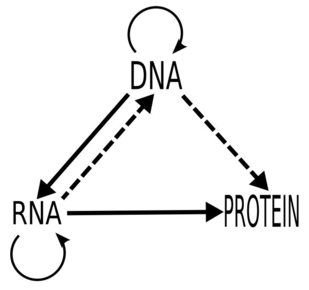
- 39What type of replication does DNA undergo to produce two identical daughter cells?Semi-conservative
- 40What is meant by the "3' end?Free OH group on carbon 3
- 41What is meant by the "5' end?Phosphate group attached to carbon 5
- 42What type of bond links amino acids to tRNA molecules?Ester bond
- 43What doesn't obey the central dogma?Prion proteins and retroviruses
- 44Why don't prion proteins and retroviruses obey the central dogma?They propagate themselves by making conformational changes in other molecules of the same type of protein. This is could be considered the formation of a protein from a protein.
Informações
- Descrição
- Biology- Semester 1 (Lecture 9- Nucleic Acids ) FlashCards sobre Lecture 9- Nucleic Acids , criado por emma_moran em 01-01-2014.
- Criado por
- emma_moran
- Visualizações
- 64
- Tags
- Avaliação