
Flashcards
Waves
Flashcards do conjunto (28)
- 1Define a progressive waveThe movement of a disturbance from a source, which transfers energy and momentum without transferring matter
- 2What is a mechanical wave?Where particles oscillate about their equilibrium position i.e. a medium is required for propagation
- 3What is an electromagnetic wave?Oscillating electric and magnetic fields that progress through space and time without the need of a medium
- 4Max and Min Amplitude of a Transverse wave?Peak and Trough
- 5Max and Min Amplitude of a Longitudinal WaveRarefaction and Compression
- 6Define displacementThe distance and direction from the equilibrium position
- 7Definition of Amplitude (Units)The maximum displacement of a vibrating particle from its equilibrium position
(m) - 8Define Wavelength (units)The least distance between two adjacent vibrating particles with the same displacement and velocity at the same time (i.e. between two peaks)
(m) - 9Define Cycleone complete vibration of a particle i.e. from max displacement to the next max displacement
- 10Define the period of a wave (units)The time taken to complete one cycle
(s) - 11Define Frequency (and units)The no of cycles of vibration of a particle per second (or the number of complete waves passing a point per second)
Measured in Hz - 12Equation for frequencyFrequency = 1/T
- 13Wave Equationv = f/\
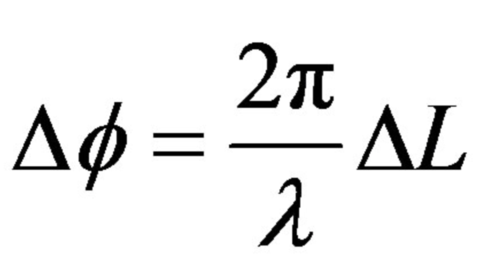
- 14Define Phase differenceFor two objects oscillating with the same frequency = fraction of a cycle between vibrations of the two particles
- 15Equation for phase differenceWhere L= distance apart along the wave
/\= wavelength - 16Law of reflectionAngle of Incidence = Angle of Reflection
- 17What is Refraction and why does it happen?The changing direction of waves when passing from one medium to another at an angle. Different mediums= change in speed of wave therefore change in direction if it hits at an angle.
- 18What maximises diffraction?Wavelength = gap
Narrower the gap= more diffraction
Larger wavelength = more diffraction - 19Principle of superpositionwhen 2 waves meet, the total displacement at a point is equal to the sum of the individual displacements at that point
- 20What does coherent mean?Waves that have a constant phase difference and same frequency
- 21What is monochromatic lightLight that has the same frequency and wavelength
- 22When does a stationary wave formWhen two progressive waves of the same frequency and amplitude travelling in opposite directions pass through each other
- 23What is a node?Node: point of 0 displacement in a stationary wave
- 24What is an antinode?Fixed Point on a stationary wave with maximum amplitude
- 25What are the conditions for a stationary wave to form?The time it takes for the wave to travel along the string and back much equal the time take for the source to produce a whole number of waves.j
- 26Phase difference for a stationary wavemPi where m is the number of nodes between the two particles
- 27Define 1st harmonicThe pattern of stationary waves on a string when it vibrates at its lowest possible frequency
- 28Equation for factors affecting 2st harmonicT= Tension in string
m/L = mass per unit length
L= Length of string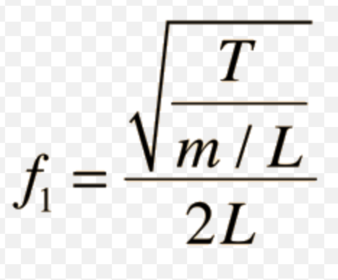
Informações
- Descrição
- A level physics: AQA Topic 5 Waves
- Criado por
- Francesca Wittmann
- Visualizações
- 6
- Avaliação