
Flashcards
Aromatic Compounds
Flashcards do conjunto (45)
- 1What is an Aliphatic compound?Straight or branched chain organic substances.
- 2What is an Aromatic compound (arena)?Includes one or more ring of six carbon atoms with delocalised bonding.
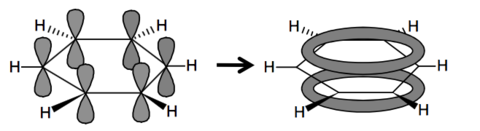
- 3Describe Benzene's Structure:C6H6, covalently bonds, so one unused e- on each C in a orbital, perpendicular to the plane of the ring. 6p electrons; delocalised into a ring structure above&below plane.
- 4Define delocalisedNot attached to a particular atom. Six electron in pi bonds of Benzene are delocalised and spread over the whole ring.
- 5Why is Benzene a planar molecule?Evidence suggests that all C-C bonds are the same and have a length and bond energy between a C-C single and C=C double bond.
- 6What is the H-C-C bond angle in Benzene?120*
- 7Enthalpies of Hydrogenation
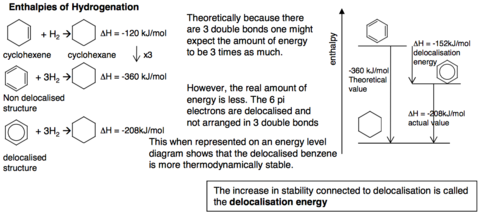
- 8What are the pieces of evidence for Benzene having a delocalised structure?>Bond length intermediate between short C=C and long C-C
>ΔH hydrogenation less exothermic the expected when compared to ΔH hydrogenation for Kekulé structure
> only reacts with Br2 at high temperatures or in presence of a halogen carrier - 9What is the molecular formula for the Phenyl group?C6H5 -
- 10Why does Benzene not undergo addition reactions?Because these would involve breaking up the delocalised system. Most of Benzene's reactions involve substituting 1H for another atom or a group of atoms.
- 11What reaction does Benzene usually undergo?Electrophilic substitution
- 12Describe the reaction of Benzene with Bromine?Benzene doesn't react with bromine without additional halogen carrier chemicals. In benzene, e- in pi-bonds are delocalised. In alkanes, pi-e- are localised between two C's. Benzene therefore has a lower e- density than C=C, so polarises Br less and induces a weaker dipole in Br than an alkene would.
- 13why is Benzene toxic?It is a carcinogen (cancers causing molecule).
Methylbenzene is less toxic. - 14Why does methylbenzene react more readily than benzene?It reacts more readily than benzene as the methyl side group releases electrons into the delocalised system making it more attractive to electrophiles.
- 15What are the reagents for the Nitration of Benzene?Concentrated Nitric acid (HNO3) in the presence of concentrated Sulphuric acid (H2SO4 - catalyst)
- 16What is the mechanism for the Nitration of benzene?Electrophilic Substitution
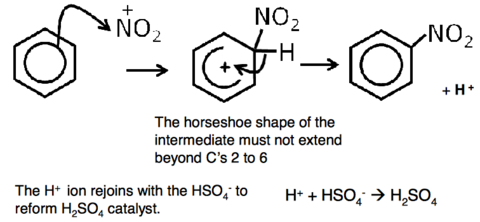
- 17Which Electrophile is used in the Nitration of Benzene?NO2 +
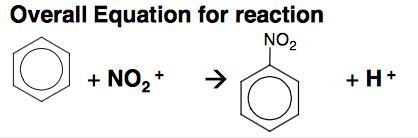
- 18What is the overall equation for the reaction of Nitrobenzene?
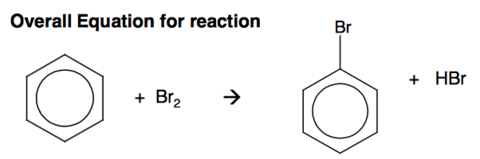
- 19What is the overall equation for the formation of the NO2 + electrophile (used in formation of nitrobenzene)?

- 20What are the required conditions for the nitration of Benzene?60*C. On using higher temperatures a second nitro group can be substituted onto different positions of the ring.
- 21Overall reaction for Halogenation of Benzene:
- 22What reagent is used for the halogenation of Benzene?Bromine
- 23What conditions are required for the halogenation of Benzene?Iron (III) Bromide catalyst (FeBr3)
- 24What mechanism is required for the halogenation of Benzene?Electrophilic Substitution
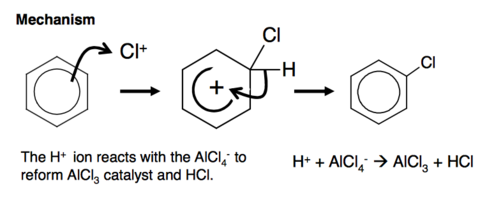
- 25What are the equations for the formation of Electrophiles Cl+ and Br+?

- 26Why is the Nitration of Benzene an important reaction?It is an important step in synthesising useful compounds, for example; explosive manufacture (TNT - trinitrotoluene, 2,4,6-Trinitromethylbenzene) and formation of amines from which dyestuffs are manufactured.
- 27What is the overall reaction for Freidel Crafts Alkylation?Turns Benzene into Alkylbenzene:
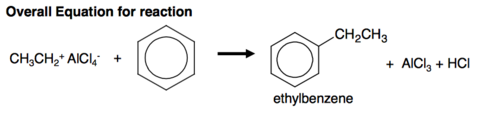
- 28What are the reagents for Freidel Crafts Alkylation?Chloroalkane in the presence of anhydrous AlCl catalyst
- 29What are the required conditions for Freidel Crafts Alkylation?Heat under reflux
- 30What mechanism is used for the Freidel Crafts Reaction?Electrophilic Substitution
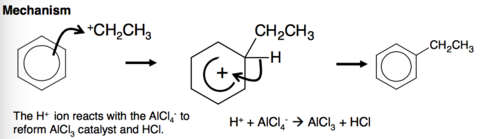
- 31What is the equation for the formation of an electrophile?

- 32What is the overall equation for Freidel Crafts Acylation?Benzene becomes Phenyl Ketone
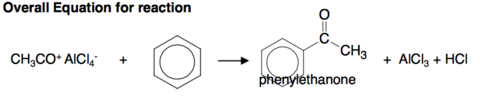
- 33What reagents are required for Freidel Crafts Acylation?Acyl Chloride in the presence of anhydrous aluminium chloride catalyst.
- 34What conditions are required for Freidel Crafts Acylation?Heat under reflux (50*C)
- 35What mechanism is required for Freidel Crafts Acylation?Electrophilic substitution
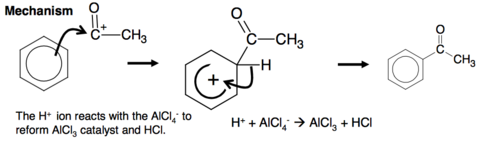
- 36Why is Acylation an important reaction in organic synthesis?Because it introduces a reactive functional group onto benzene ring.
- 37Describe the structure of a PhenolOH group directly attached to Benzene ring. The lone pair of electrons on Oxygen is delocalised with the electron charge cloud of arena ring. The delocalised bonding changes reactivity of OH group and arena ring.
- 38What type of acids are Phenols?Weak acids. They are weaker acids than carboxylic acids. Both Phenols and C.Acids will react with sodium metal and NaOH. Only C.Acids will react with Na2CO3 as a Phenol is not strong enough an acid to react.
- 39Reaction with BrominePhenol doesn't need FeBr3 cat. like Benzene & undergoes multiple subs. whereas Benzene will only add 1Br. Product: white solid
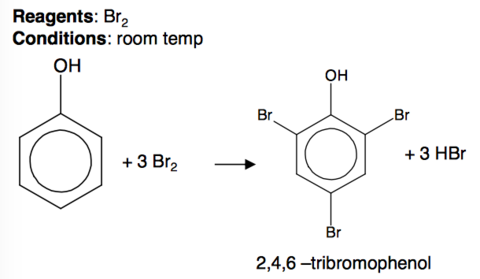
- 40Why does Phenol have a greater electron density and more polarised Br2?Because in phenol the lone pair of electrons on the oxygen (p-orbital) is partially delocalised int the ring
- 41What are phenols commercially used for?Production of plastics, antiseptics, disinfectants, and resins or paints.
- 42Reaction of Phenol with Nitric AcidOH
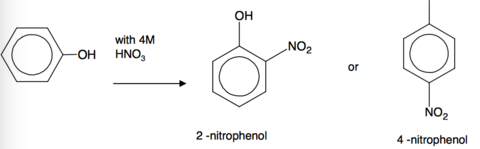
- 43What conditions and reagents are required for the reaction of Phenol with nitric acid?room temperature, 4M HNO3
- 44Effect of (nucleophilic) groups on substitution:Nucleophilic groups: OH, NH2
Will force further substitutions to occur on the 2- and 4- positions of the ring. - 45Effect of (electrophilic) groups on substitution:Electrophilic groups: NO2
Will have a 3-directing effect of in Electrophilic substitution of aromatic compounds
Informações
- Descrição
- A level Chemistry FlashCards sobre Aromatic Compounds, criado por Sara R em 31-01-2017.
- Criado por
- Sara R
- Visualizações
- 9
- Avaliação