
Flashcards
Human Biology Year 1 Semester 1 Midterm 1 - Cells
Flashcards do conjunto (53)
- 1What are the two kinds of cells?Procaryotes and eucaryotes.
- 2What are the two domains of Procaryotes (bacteria)?Archaebacteria & Eubacteria
- 3Do Procaryotes have a nucleus? Do they have membrane bound organelles?No
No - 4True or False: Procaryotes were the first cells and they are single-cell organisms.True
- 5What is Peptidoglycan ?Protein in plasma membrane of some prokaryotes, but no eukaryotes.
- 6What is the one domain of Eukaryotes?Eukaryia
- 7What is the endosymbiotic theory?The endosymbiotic theory states that several key organelles of eukaryotes originated as symbioses between separate single-celled organisms. (wikipedia)
- 8What are single, colonial and multicellular organisms?Single- one nucleated cell
Colonial- each cell isn't specialized and does all of the work, but they live in groups. Example: moss.
Multicellular- each cell is specialized and couldn't survive on its own. (ex:humans) - 9Where is the DNA located in eukaryotes? Procarkyotes?Eukaryotes: Nucleus
Prokaryotes: All throughout cytoplasm - 10True or False: eukaryotes have membrane bound organelles.True
- 11True or False: There a difference in the plasma membrane of pro and eukaryotesTrue
- 12What is haploid? Diploid?Haploid (n): Set of chromosomes from one donor, gametes, asexual reproduction, haploid organisms (reproduce by mitosis)
Diploid (2n): Set of chromosomes from 2 parents, each type of chromosome in pairs, somatic cell type of diploid organisms. - 13True or False- Do animals and plants both have mitochondria and chloroplasts?False. Plants have both; animals only have mitochondria.
- 14What is mitosis? Cytokinesis? Meiosis?Mitosis-DNA replication and division.
Cytokinesis- Division of cell components
Meiosis-Production of gametes (sex cells) [only diploid organisms can go through meiosis] - 153 points of Prokaryotic Division-Binary fission
-Circular DNA
-Fts2 molecule is the trigger for separation - 163 points of eukaryotic chromosomes-House the genes
-Made of DNA and proteins (chromatin)
-Tightly coiled - 17What is DNA coiled around?Histone molecule (nucleosome)
- 18What is a group of nucleosomes called?Solenoid
- 19What forms a chromatin loop?Long strips of solenoids
- 20What do many chromatin loops form?Many loops form a rosette anchored to the chromosome core by a scaffold protein
- 21Eukaryotic chromosomes have a centromere. Where is it located and what is it the attachment site for?IIts location is unique to that chromosome and it is the attachment for spindle fibres.
- 22What is the protein that spindle fibers attach to?Kinetochore
- 23What is a chromosome?Where DNA is housed. Structure consisting of DNA and histone of same gene.
- 24Define: centromereSite of DNA synthesis; where sister chromatids come together.
- 25Define: Chromatid2 identical strands of replicated DNA (sister chromatids)
- 26Define: Homologous2 chromosomes of same type from different parent
- 27Define: Haploid (n)Genetic info. came from a single donor
- 28Define: Diploid (2n)Genetic info. came from 2 donours.
- 29What is trisomy & monosomy ?Trisomy: 3 chromosomes of same type
Monosomy: 1 chromosome instead of 2 - 30Define: Cell cycleTime that is spent in each phase of the cells life
- 31What are the phases of interphase? Mitosis? And what follows mitosis?Interphase: G, S, G2
Mitosis: Prophase, Metaphase, Anaphase, Telophase. (PMAT)
Cytokinesis - 32What do the checkpoints determine? What are they? (regulating the cell cycle)Checkpoints determine if cell moves to the next phase of the cell cycle.
-G2, M checkpoint
-Spindle checkpoint
-G1,S checkpoint (start or restriction checkpoint) - 33Name 3 factors that influence the check at the checkpoints.Nutrition, size, health
- 34What stage do cells often get stuck in and stay for long periods of time?When they get stuck in G1 for an extended period of time, it is called G0(zero). Some cells never leave this stage.
- 35What happens at the G1 restriction point?The cell decides to divide or not. Arrest at this point results in G0(zero).
- 36What happens at the G2/M checkpoint?At the end of G2 phase. CDK (cyclin dependent kinase) active at this pointand allow movement into M-phase. DNA checked for proper replication.
- 37What happens at the spindle checkpoint?Check that all chromosomes are attached to spindles for anaphase.
- 38What does CDK stand for?Cyclin dependent kinase
- 39What are proteins activated by and what does this allow?Proteins are activated by phosphorylation on the enzyme thus allowing passage through the checkpoint.
- 40True or false- Each checkpoint has its own cyclinsTrue
- 41Define mitosis. State what it produces.For growth and repair. This occurs in both diploid and haploid cells. DNA replication and division of somatic (autosomal) cells.
One cell produces 2 identical cells (identical to parent and each other) - 42Does crossing over of alleles occur in mitosis? What is conserved?Crossing over of alleles (genetic info.) does not occur in mitosis. Genetic info. is conserved.
- 43What are the 4 phases of mitosis and what is it followed by?P- Prophase
M- Metaphase
A- Anaphase
T- Telophase
Followed by cytokinesis. - 44What is meiosis? What does it produce?Division of germ cells. The production of sex cells (n), called gametes (only half the chromosomes of parent) from germ cells 2n (diploid.
- 45What does meiosis start with and what does it end with?Start with 1 diploid and end with 4 haploid cells.
- 46Name the 6 major differences between Mitosis and Meiosis.In notes. (too much to type out)
- 47What happens and what is produced in: Meiosis I: _____ Meiosis II: _______ What are the final products?Meiosis I: tetrads separate into sister chromatids (resulting cells are haploid)
Meiosis II: separates sister chromatids so that each cell gets one chromosome (resulting in unpaired sister chromatids)
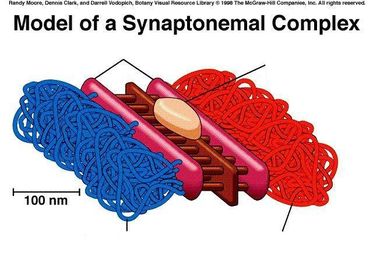
Products: 4 haploid gametes (sex cells) that are not identical to each other or the parent cell. - 48<- Label
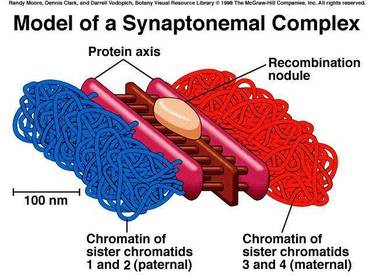
- 49What is the chiasma?Where nodules do crossing over
- 50Fill in the blanks
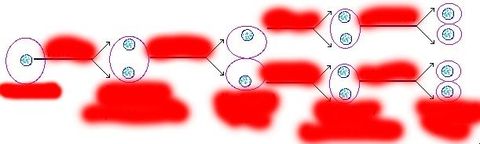
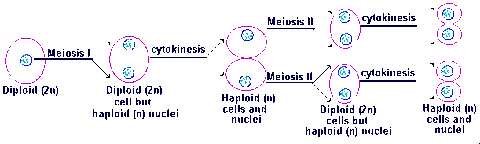
- 51Complete: Meiosis II resolves the ____________. 4 _______ cells.Meiosis II resolves the original DNA replication.
4 haploid cells. - 52How does recombining of genetic info. occur?Recombining of genetic information by segregation, random orientation of chromosomes, and crossing over
- 53Where does variation originally occur? What does it create?Variation originally comes from mutations in DNA synthesis in germ cells which create new phenotypes
Informações
- Descrição
- University Human Biology FlashCards sobre Human Biology Year 1 Semester 1 Midterm 1 - Cells, criado por michellelynnlebl em 29-09-2014.
- Criado por
- michellelynnlebl
- Visualizações
- 105
- Tags
- Avaliação