
Flashcards
10) Brand and Product Decisions in Global Marketing
Flashcards do conjunto (47)
- 1Product is a...good, service, or idea with both tangible and intangible attributes that collec-tively create value for a buyer or user.
A product’s tangible attributes can be assessed in physical terms, such as weight, dimensions, or materials used.
Intangible product attributes, including the status associated with product ownership, a manufacturer’s service commitment, and a brand’s overall reputation or mystique, are also important. - 2Product TypesA frequently used framework for classifying products distinguishes between consumer and industrial goods.
Example: Buyer orientation or life span - 3What is Buyer Orientation?Buyer orientation is a composite measure of the amount of effort a customer expends, the level of risk associated with a purchase, and buyer involvement in the purchase. The buyer orientation framework includes such categories as convenience, preference, shopping, and specialty goods.
- 4Which are the three tpes of a product's Life Span?Durable, nondurable, and disposable
- 5What is an "express warranty"?is a written guarantee that assures the buyer that he or she is getting what he or she has paid for or that provides recourse in case a product’s performance falls short of expectations.
- 6What is Packaging?is an integral element of product-related decisions.
is an especially important consideration for products that are shipped to markets in far-flung corners of the world. - 7What does the term "consumer packaged goods" means?it is the term that applies to a wide variety of products whose packaging is designed to protect or contain the product during shipping, at retail locations, and at the point of use or consumption.
- 8What is “Eco-packaging” ?is a key issue today, and package designers must address environmental issues such as recycling, biodegradability, and sustainable forestry.
- 9LabelingIn today’s self-service retail environments, product labels may be designed to attract attention, to support a product’s positioning, and to help persuade consum-ers to buy.
ingredient information
use and care instructions - 10Aestheticsperceptions of color in different parts of the world.
the importance of visual aesthetics embodied in the color or shape of a product, label, or package. Likewise, aesthetic styles, such as the degree of complexity found on a label, are perceived differently in different parts of the world. - 11A brand is a...a complex bundle of images and experiences in the customer’s mind.
- 12Brands perform two important functions:First, a brand represents a promise by a particular company regarding a particular product; it is a type of quality certification.
Second, brands enable customers to better organize their shopping experience by helping them seek out and find a particular product. - 13Brand image is...defined as perceptions about a brand as reflected by brand associations that consumers hold in their memories. Perceptions of service after the sale, price, and distribution are also taken into account for the brand image.
- 14Brand equity represents...Represents the total value that
accrues to a product as a result of a company’s cumulative investments in the marketing of the brand.
It can also be thought of as an asset repre-senting the value created by the relationship between the brand and its customers over time. The stronger the relationship, the greater the equity. - 15The benefits of strong brand equity include:-Greater loyalty
-Less vulnerability to marketing actions
-Less vulnerability to marketing crises
-Larger margins
-More inelastic consumer response to price increases
-More elastic consumer response to price decreases
-Increased marketing communication effectiveness - 16T/F Companies develop logos, distinctive packaging, and other communication devices to provide visual representations of their brands.TRUE
- 17A local product or local brand isis one that has achieved success in a single national market.
Example: Coca-Cola has developed several branded drink products for sale only in Japan;
they also represent the lifeblood of domestic companies.
Example: In China, for example, a sporting goods company started by Olympic gold medalist Li Ning sells more sneakers than global powerhouse Nike. - 18International products and international brands areare offered in several markets in a particular region.
Example: a number of “Euro products” and “Euro brands” - 19Global Products and BrandA global product meets the wants and needs of a global market. A true global product is offered in all world regions, including the Triad and in countries at every stage of development.
Example: Gillet
A global brand has the same name and, in some instances, a similar image and positioning throughout the world.
Example: BMW or GE - 20Mention the global brands three characteristics:1) Quality signal.
2) Global myth.
3) Social responsibility. - 21What is "Co-branding" ?is a variation on combination branding in which two or more different
company or product brands are featured prominently on product packaging or in advertising.
can engender customer loyalty and allow companies to achieve synergy.
Example: Intel-Inside campaign - 22What are "brand extensions"?This
strategy entails using an established brand name as an umbrella when entering new businesses or developing new product lines that represent new categories to the company.
Example: Virgin company - 23Global brand leadership means...using organizational structures, processes, and cultures to allocate brand-building resources globally, to create global synergies, and to develop a global brand strategy that coordinates and leverages country brand strategies.
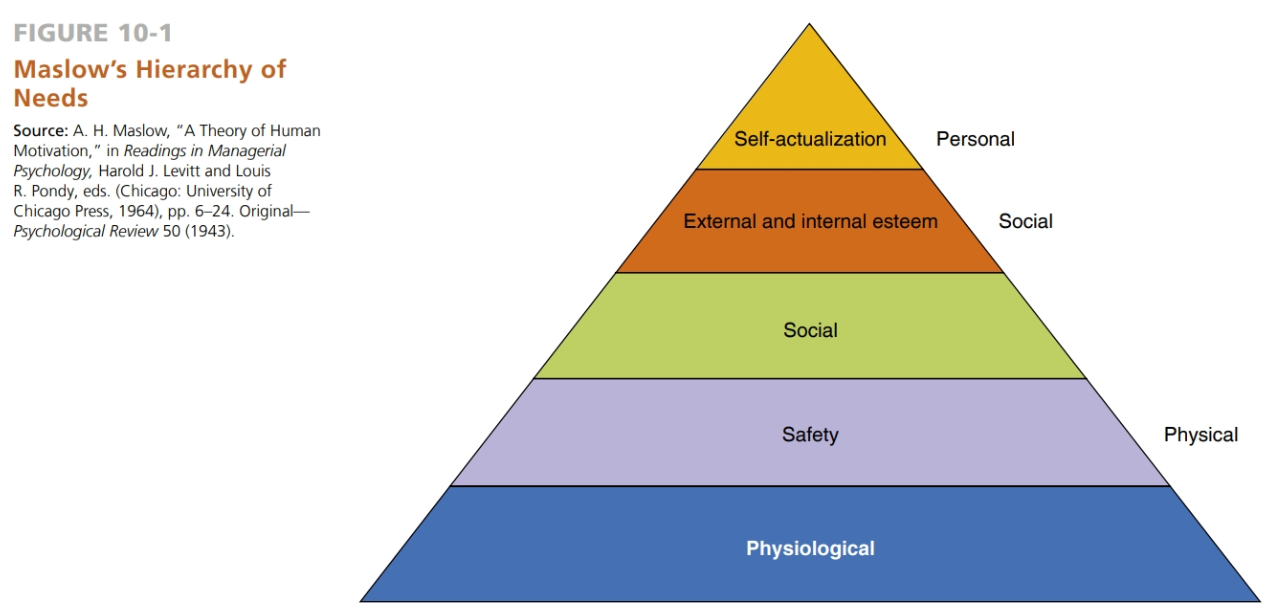
- 24The essence of marketing is ...finding needs and filling them.
(Maslow's needs hierarchy) - 25Mention Maslow's Hierarchy of Needs levels:5) Self - actualization
4) External and internal esteem
3) social
2) safety
1) physiological - 26T/F Products can fulfill different needs in different countries.True
- 27What is the "country-of-origin-effect"?The perceptions about and attitudes toward a particular countrie that often extend to the products and brands known to originate in that countrie. They become part of a brand’s image and contribute to brand equity.
- 28Extend, Adapt, Create: Strategic AlternativesDepending on organizational objectives and market needs, a particular program may consist of extension strategies, adaptation strategies, or a combination of the two.
- 29extension strategyA company that has developed a successful local product or brand can imple-ment an extension strategy that calls for offering a product virtually unchanged (i.e., “extending” it) in markets outside the home country.
- 30adaptation strategythis involves changing elements of design, function, or packaging in response to needs or conditions in par-ticular country markets. These product strategies can be used in conjunction with extension or adaptation communication strategies. This is the type of strategic decision facing executives at a company such as Starbucks who build a brand and a product/service offering in the home-country market before expanding into global markets.
- 31product inventionentails developing new products “from the ground up” with the world market in mind.
- 32Four strategic alternatives available to any company seeking to expand from its domestic base into new geographic markets.The key, is to avoid being either “hopelessly local” or “mindlessly global.”
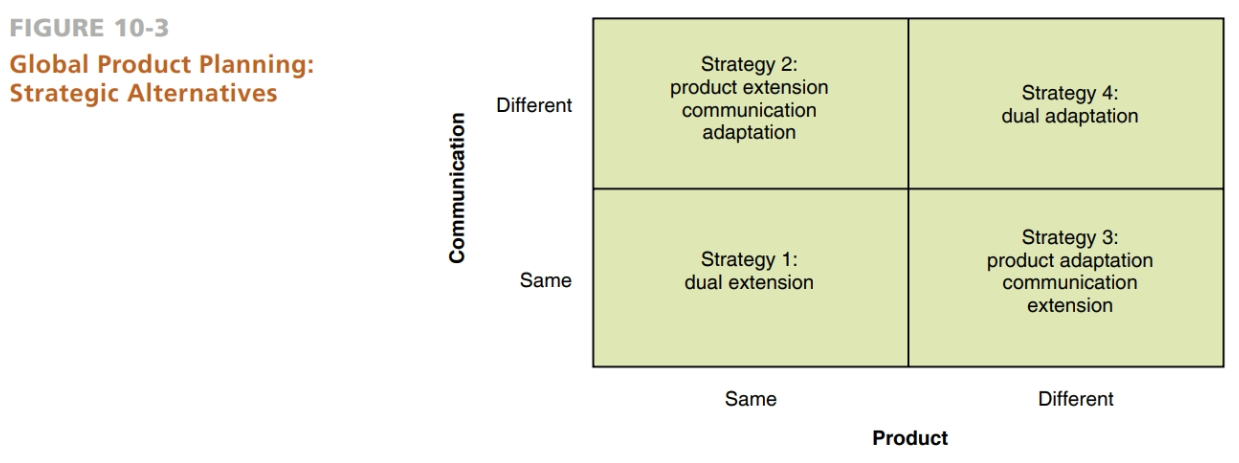
- 33Strategy 1: Product-Communication Extension (Dual Extension)Companies pursuing this strategy sell the same product with virtually no adaptation, using the same advertising and promotional appeals used domestically, in two or more country markets or segments. For this strategy to be effective, the advertiser’s message must be understood across different cultures, including those in emerg-ing markets.
- 34Strategy 2: Product Extension–Communication AdaptationIn some instances, a product or brand can be successfully extended to multiple country markets with some modification of the communication strategy.
Its relatively low cost of implementation. - 35product transformation:The same physical product ends
up serving a different function or use than that for which it was originally designed or created. - 36Strategy 3: Product Adaptation–Communication Extensionis to adapt the product to local use or preference conditions while extending, with minimal change, the basic home-market communications strat-egy or brand name.
- 37Strategy 4: Product-Communication Adaptation (Dual Adaptation)both the product and one or more promotional elements are adapted for a particular country or region. Sometimes marketers discover that environmental conditions or consumer preferences differ from country to country; the same may be true of the function a product serves or consumer receptivity to advertising appeals. In cases where country managers who have been granted considerable autonomy order adaptations, they may be simply exercising their power to act independently.
- 38Strategy 5: Innovationthe process of endowing resources with a new capacity to create value, is a demanding but potentially rewarding product strategy for reaching mass markets in less-developed countries as well as important market segments in industrialized countries.
( Extension and adaptation strategies are effective approaches to many but not all global mar-ket opportunities. For example, they do not respond to markets where there is a need but not the purchasing power to buy either the existing or the adapted product. ) - 39To sum up, the choice of product-communication strategy in global marketing is a function of three key factors:(1) the product itself, defined in terms of the function or need it serves
(2) the market, defined in terms of the conditions under which the product is used, the preferences of potential customers, and customers’ ability and willingness to buy; and
(3) the adaptation and manufacturing costs to the company considering these product-communication approaches. - 40Which are the three categories related to identifying new-product ideas?1) discontinuous innovations
2) dynamically continuous innovations
3) continuous innovation
- 41What are " discontinuous innovations"?products that belong to the category of “new and different” and that literally represent a break with the past.
In short, they are game-changers. - 42What are "dynamically continuous innovations"?Products that cause relatively smaller disruptions in previously existing consumption patterns.
- 43What are "continuous innovation"?Products that are
typically “new and improved” versions of existing ones and require less R&D expenditure to develop than dynamically continuous innovations.
Continuous innovations cause minimal disruption in existing consumption patterns and require the least amount of learning on the part of buyers. - 44What are "line extensions" within continuous innovation?when a product has a minor improvement or change such as new size, flavor, ro low-fat version.
- 45Which is the major driver for the development of global products?the cost of product R&D.
- 46Which is often the goal during the developing of a new-product?Often the goal is to create a single platform, or core product design element or component, that can be quickly and cheaply adapted to various country markets.
- 47A successful product launch requires an understanding of how markets develop:sequentially, over time, or simultaneously. Today, many new products are launched in multiple national markets as product development cycles shorten and product development costs soar.