
Flashcards
Biology 2
Flashcards do conjunto (62)
- 1What is three main parts of an animal cell?Mitochondria; Nucleus; Cell Membrane
- 2What is in the Nucleus?DNA
- 3What do Mitochondria do?Power the cell
- 4What does the cell membrane do?Lets things in and out the cell
- 5What two extra things do plant cells have?Cell Wall and Chloroplasts
- 6What is the purpose of the cell wall?To provide support for the cell
- 7What do chloroplasts do?Absorb energy from sunlight for use in photosynthesis
- 8Where is protein made in both plant and animal cells?Ribosomes
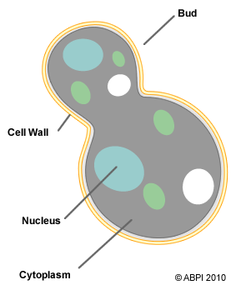
- 9What are the four parts of a yeast cell?
- 10How do yeast reproduce?They reproduce by budding, asexual reproduction
- 11Are yeast microorganisms or fungus?BOTH!
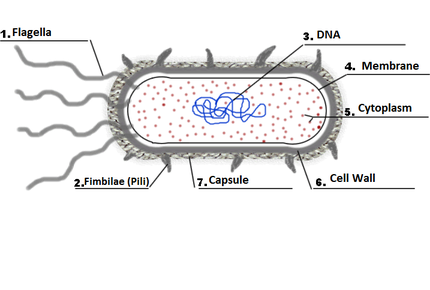
- 12What is the seven parts of the bacteria cell?
- 13Where do yeast live?Skin, Marine Water, Leaves & Flowers
- 14What is yeast used for?To produce beer, bread and in wine production
- 15What can yeast cause?Thrush in mouth and throat
Viganal infections
Diaper Rash - 16True or false: Yeast and bacteria are single celled?True
- 17What shape can bacteria be?Sphere, Rod or Spiral
- 18What is bacteria used for?Some help plants absorb nitrogen
Cause diseases like botulism
Live in cows stomach to break down cellulase - 19What is flagella and what does it do?The tail structure on bacteria that allows it to swim
- 20What does the capsule do?Stops white blood cells entering and killing the bacteria
- 21What is the DNA different in bacteria?As there is no nucleus, the DNA is spread out but is still controlling the cell
- 22What is the fimbliae?Allows bacteria to stick to each other or other things
- 23What is a tissue?A group of cells that have similar structures but carry out the same functions
- 24What is an organ?Organs are a group of tissue working together to carry out a particular function
- 25What is the function of the small intestines?To break down food, absorb the good parts and send them to the blood stream
- 26The gas exchange system's function?Is to oxygenise the red blood cells through diffusion and remove the carbon dioxide form the capilleries
- 27What is an organ system?A group of organs working together to carry out a function
- 28What is an organ system?A group of organs working together to carry out a function
- 29What is diffusion?The spreading out of particles from an area of high concentration to an area of low concentration
- 30What is the purpose of a cell membrane during diffusion?The membrane only lets small molecules like oxygen, glucose, amino acids and water through not large molecules like protein and starch.
- 31What are five specialised cells?Sperm, Red blood, fat, neurone, root hair
- 32Functions of the specialised cells?Sperm: Travel through female system to pass genetics on Red blood: To carry oxygen Fat cell: To store excess food Neurone: Carry messages quickly Root Hair: Enable plants to take in water
- 33Equation of photosynthesisCO2+water->glucose+oxygen
- 34What is photosynthesis?The process where glucose is produced using sunlight for food
- 35What uses photosynthesisPlants and algaes
- 36How does water reach the cell?via the Xylem
- 37What affects the rate of photosynthesis?Temperature, Light & CO2
- 38What causes the light to be a limiting factor?Night time
- 39What causes temperature to be a limiting factor?Winter
- 40What causes CO2 to be a limiting factor?Warm and brightness
- 41Where can these limiting factors be controlled?A Greenhouse
- 42How do plants use Glucose?Respiration, making cell walls, making protein, it is stored in seeds and stored as starch
- 43What might affect the distribution of organisms?Temperature, water, oxygen and CO2, nutrients and light
- 44What can speed the processes up inside living things?Catalysts
- 45What are catalysts?A catalyst is something that increases the speed of a reaction, without be changed or used up in the reaction
- 46What need to be controlled with a catalystTemperature and pH
- 47Amylase breaks starch into what?Sugars
- 48Protease breaks proteins into what?Amino acids
- 49Lipase breaks Lipids into what?Glycerol and fatty acids
- 50What does bile do?Neutralises stomach acids and emulsifies fats
- 51Where is bile producedLiver
- 52Where is bile stored?gall bladder and then released into the small intestine
- 53What do salivary glands produce?Amylase
- 54What does the pancreas produce?Protease, amylase and lipase. it releases these to the small intestines.
- 55What does the small intestine produce?Amylase, protease and lipase to complete digestion.
- 56What is respiration?The process of releasing energy from glucose, which happens in every cell
- 57What is aerobic respiration?Respiration using oxygen, it is the most efficient way to release energy
- 58where does aerobic respiration occur?Mitochondria
- 59Equation for aerobic respirationGlucose+oxygen-> CO2+water+energy
- 60what is energy released used for?build up large molecules from small ones, allow muscles to contract, keep body temp steady
- 61when is anaerobic respiration used?when there is not enough oxygen
- 62equation for anaerobic respirationglucose->energy+lactic acid
Informações
- Descrição
- For use with aqa biology 2 (may be useful with other exam boards)
- Criado por
- leahon
- Visualizações
- 266
- Tags
- Avaliação