
Flashcards
IB Biology Topic 7.2 DNA Replication (HL)
Flashcards do conjunto (7)
- 17.2.1 State that DNA replication occurs in a 5' - 3' directionDNA replication is semi-conservative, meaning that a new strand is synthesised from an original template strand
DNA replication occurs in a 5' - 3' direction, in that new nucleotides are added to the C3 hydroxyl group such that the strand grows from the 3' end
This means that the DNA polymerase enzyme responsible for adding new nucleotides moves along the original template strand in a 3' - 5' direction - 27.2.2 Name the 5 enzymes involved in DNA ReplicationHelicase, RNA primase, DNA polymerase III, DNA plymerase I, DNA ligase
- 37.2.2 When and how does DNA replication occur?DNA replication is semi-conservative and occurs during the S phase of interphase
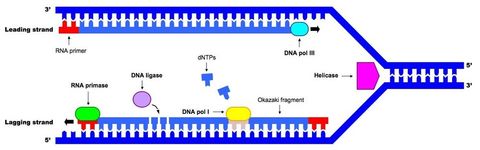
- 47.2.2 Explain the role of Helicase, RNA primase and DNA polymerase III in DNA replication.Helicase unwinds and separates the double stranded DNA by breaking the hydrogen bonds between base pairs
This occurs at specific regions (replication origins), creating a replication fork of two polynucleotide strands in antiparallel directions
RNA primase synthesises a short RNA primer on each template strand to provide an attachment and initiation point for DNA polymerase III
DNA polymerase III adds deoxynucleoside triphosphates (dNTPs) to the 3' end of the polynucleotide chain, synthesising in a 5' - 3' direction
The dNTPs pair up opposite their complementary base partner (adenine pairs with thymine ; guanine pairs with cytosine)
As the dNTPs join with the DNA chain, two phosphates are broken off, releasing the energy needed to form a phosphodiester bond
Synthesis is continuous on the strand moving towards the replication fork (leading strand)
Synthesis is discontinuous on the strand moving away from the replication fork (lagging strand) leading to the formation of Okazaki fragments - 57.2.2 Explain the role of DNA polymerase I and DNA ligaseDNA polymerase I removes the RNA primers and replaces them with DNA
DNA ligase joins the Okazaki fragments together to create a continuous strand - 67.2.2 Draw a diagram that overviews DNA Replication
- 77.2.3 State that DNA replication is initiated at many points in eukaryotic chromosomesBecause eukaryotic genomes are (typically) much larger than prokaryotic genomes, DNA replication is initiated at many points simultaneously in order to limit the time required for DNA replication to occur
The specific sites at which DNA unwinding and initiation of replication occurs are called origins of replication and form replication bubbles
As replication bubbles expand in both directions, they eventually fuse together, two generate two separate semi-conservative double strands of DNA
Informações
- Descrição
- Biology (Topic 7 Nucleic Acid & Protein (HL)) FlashCards sobre IB Biology Topic 7.2 DNA Replication (HL), criado por robertospacey em 23-03-2015.
- Criado por
- robertospacey
- Visualizações
- 329
- Tags
- Avaliação