
Flashcards
Clinical supervision

Flashcards do conjunto (35)
- 1How did Kavanagh et al., 2002 describe clinical supervision?A working alliance between practitioners in which they aim to enhance clinical practice, fulfil the goals of the employing organization and meet the ethical, professional and best practice standards of the organization and the profession, while providing personal support and encouragement in relation to the professional practice.
- 2According to Kavanagh et al (2002), who has the highest stakes in supervision?
- 3why is clinical supervision necessary?A ‘working alliance’ – a positive relationship
Support
Encouragement
Enhance therapeutic competence
Assessment and therapy skills
Link between theory & practice (esp. for trainees)
Professional identity and obligations
Ethics and conduct
Professional standards
Best practice
Demands of the service
Service standards
Service demands
Quality control
To ‘oversee’
To meet minimum standards
Reflective Practice, Case Discussion, Consultation, Support Groups (same or different profession) - 4give some examples of issues taken to supervision?Advice on formulation & therapy
Reflecting on feelings experienced in sessions
Discussing interactions with colleagues
Ethical dilemmas
Dual relationships - 5What makes the ideal supervisor according to Kavanagh et al (2002)?Empathy
Respect
Genuineness
Easily understood
Uses self disclosure
Sense of humour - 6What practical elements should be in place for effective supervision?Regular times
Clear and explicit goals
Safe environment
Uninterrupted - 7Outline the different modes of supervision?Individual, Group, Peer
Observation
Live
Video
Audio
Reporting case material
Role-play - 8Describe CBT style supervision?Congruent with structured, collaborative approach to therapy:
Agenda setting
Prioritisation
Homework review & setting
Summarising
Supervisee feedback
Encourage awareness of values and beliefs of supervisee and client
Teaching specific techniques & specific behavioural tasks
Direct instruction, guided discovery, Socratic questioning
Discovering meaning and evidence for NATS & assumptions
Supervisee as own agent of change
Emphasis on empirical evaluation - 9Describe the psychodynamic style of supervision?Focus on the process of therapeutic sessions
Detail of what happened and when
Interest in how the work makes the supervisee feel (counter-transference)
Focus on the supervisee-client relationship (transference)
Focus on the supervisor-supervisee relationship
Recognising Parallel Process – when the supervision relationship mirrors aspects of the therapeutic relationship
Using the supervision relationship to model an analytic attitude
Psychodynamic theories
Defence mechanisms
Internal conflicts
The relationship – transference and counter-transference
Resistance
Can be useful even if not working within a psychodynamic framework
In addition to personal therapy
Different supervisor & therapist - 10Describe Kolb’s experiential learning cycle (specific supervision model)

- 11Outline issues with the CBT and psychodynamic models of supervision?whilst there are some similarities between supervision and therapy, it can be argued that therapeutic models are too narrow to explain the complexity of supervision.
As Supervision is essentially an educational process which facilitates the learning of a professional role – models of adult learning may be more useful.
We learn by our experience and by being able to reflect on that experience; then linking experiences to theories to create new hypotheses on which to act. the absence of any one of these processes can hamper learning - 12What did Feltham (2000) find regarding the effectiveness of supervision?curiously little evidence, but much emotional rhetoric, supporting the value or clarifying the purposes of supervision
- 13who said that 'Effective supervision demands a causal link between supervisor interventions and client outcomes. This is a tall order'?Scaife (2009)
- 14Give an overview of methodological criticisms of research on the effectiveness of supervision?(paucity of) RCTs, Satisfaction Surveys, Systematic Reviews, Qualitative studies
Small sample sizes
Inadequate statistical power
Lack of comparison groups
Use of analogue situations & students
Measures with poor reliability & validity
Reliance on single sources of outcome information
Difficult to compare therapist behaviours across clients
Studies not testing theories of supervision - 15What is defined as effectiveness?Patient/client outcomes
Supervisee outcomes (skills/behaviour/self-efficacy)
Satisfaction ratings
Service/organisational outcomes (e.g. governance)
Difficult to measure and attribute to supervision (experience and additional learning outside supervision) - 16what kind of supervision do inexperienced supervisees prefer?more directive, structured supervision giving clear answers
- 17----- or ----- experience have not been shown to be important factors (evidence is mixed)Gender
Supervisor - 18More experienced practitioners also prefer more directive supervision approach if...?learning new skills or dealing with new situations
- 19Direct instructional methods are associated with?greater supervisee competence
- 20What did Beck, 1986 find regarding supervisee effects?Ongoing supervision prevented deterioration of CBT skills following an intensive 3-month training programme
- 21High quality supervision may enhance?therapist self-efficacy
- 22--- of supervision (not ---) may enhance job satisfaction and prevent burnoutquality
quantity - 23What did Spence et al (2001) find about supervision?Overall limited evidence, providing tentative support for positive effects of supervision.
- 24Intensive, directive ---- can be effective in teaching new clinical skills and enhancing client outcomes. Evidence for --- is less robust, and in some cases what is found?Training
Supervision
no relationship between amount of supervision and client outcomes was found. However clients attended more often when more supervision was available (Steinhelber et al., 1984). - 25What did Bambling et al., 2006 find regarding client outcomes?Supervision aided the therapeutic alliance and reduced depression scores
- 26WHat did Beinhart & Clohessy (2009) find?Client attendance related to amount of supervision
Client improvement related to congruence of supervisor/supervisee theoretical model
Direct feedback related to trainee effectiveness & client outcome (rated by supervisor) - 27What did Kavanagh et al (2002) find in their review of supervision for drug and alcohol services?Sessions can degenerate into unstructured socialization: aims and objectives are important
The potential complexities of roles and objectives in supervision means that a structured agreement is an important part of a successful supervision relationship - 28who said that the literature on the effectiveness of supervision is heavy on opinion, theory and reccomendations, and light on good evidence?Kavanagh et al (2002)
- 29what do surveys of practitioners typically find regarding access to supervision?problems with access are posed by competing high priority work demands and by a lack of appropriate and available supervisors
Kavanagh et al (2002) - 30what review found that supervisors typically receive little in supervision methods?Spence et al (2001)
- 31Outline the study of Milne and James (2002)The present study analysed the impact and relative effectiveness of routine training (consultancy) versus routine training plus feedback on clinical supervision.
Design. The behaviours of one supervisor and six supervisees were observed longitudinally, and comparisons made between a baseline condition and two subsequent experimental training conditions (with and without feedback) and a maintenance period.
Method. An observational instrument was used to code N = 1387 interactions between the supervisor and the supervisees. Supervisees' satisfaction with supervision was also recorded longitudinally.
Results. The inter-observer reliability was very good initially (K ≥ 0.81) and did not ‘drift’. Supervision improved during the experimental phase, but most markedly during the maintenance phase. The results appear to reflect a lag effect for the interventions, which can be most readily explained in terms of a socialization period during which both supervisor and supervisee adapted their styles of interaction.
Conclusion. Competence in supervision appears to require training. - 32Outline the method of Bambling et al (2006)This study evaluated the impact of clinical supervision on client working alliance and symptom reduction in the brief treatment of major depression. The authors randomly assigned 127 clients with a diagnosis of major depression to 127 supervised or unsupervised therapists to receive eight sessions of problems-solving treatment. Supervised therapists were randomly assigned to either alliance skill– or alliance process–focused supervision and received eight supervision sessions. Before beginning treatment, therapists received one supervision session for brief training in the working alliance supervision approach and in specific characteristics of each case. Standard measures of therapeutic alliance and symptom change were used as dependent variables.
- 33What did Bambling et al (2006) find?Client-rated Working Alliance scores were significantly superior for participants in supervised groups compared with those in the unsupervised group, providing qualified support for Hypothesis 1.
Hypothesis 2 was supported because clients receiving supervised therapy achieved a significantly greater reduction in BDI scores than those receiving unsupervised therapy.
Hypothesis 3 was supported because supervision had a significant effect on client treatment satisfaction. Clients treated by supervised therapists were more satisfied than those treated by unsupervised therapists. Client satisfaction might be regarded not only as an indication of treatment success but also as an independent measure of treatment effect - 34Outline the 7 eyed process model by Hawkins & Shohet, 2006 (part two)
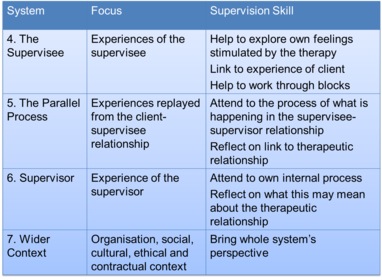
- 35Outline the 7 eyed process model by Hawkins & Shohet, 2006 (part two)

Informações
- Descrição
- FlashCards sobre Clinical supervision, criado por Jo Gledhill em 07-05-2015.
- Criado por
- Jo Gledhill
- Visualizações
- 23
- Tags
- Avaliação