
Flashcards
CELLS AND THE MOVEMENT IN AND OUT OF THEM
Flashcards do conjunto (114)
- 1What instruments do we use to magnify images of objects?Microscopes
- 2What are the two types of microscope?Light microscope and electron microscope
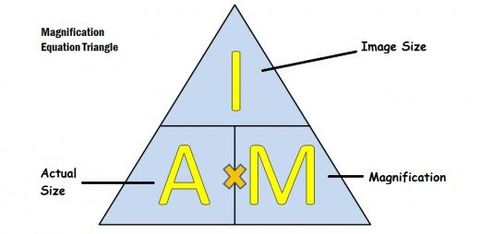
- 3What is the equation used to calculate magnification?
- 4What is it important to ensure when calculating the magnification?The units are the same for the object size and image size
- 5How many nanometers are there in a millimeter?1,000,000
- 6So if an image was 10mm long and you knew the size of the object was 100nm, what calculation would you do to work out the magnification?10,000,000nm ÷ 100nm
- 7What is the definition of magnification?The degree to which something is enlarged under a microscope
- 8What is the definition of resolution?The minimum distance apart that two objects can be in order for them to appear as two separate objects
- 9What does resolution depends on?The wavelength or form of radiation used
- 10What is the process called in which cells are broken up and the different organelles they contain are separated out?Cell fractionation
- 11Before cell fractionation can begin, the tissue is placed in a cold, isotonic, buffer solution. Explain why each of these is necessary.Cold - to reduce enzyme activity that could break down the cells
Isotonic - to prevent organelles bursting or shrinking as a result of osmosis
Buffer - to maintain a constant pH - 12What are the two stages of ultra centrifugation?Homogenation and ultracentrifugation
- 13What happens in homogenation?Cells are broken up by a homogeniser - this releases the organelles - the homogenate is filtered to remove any complete cells or large pieces of debris
- 14After this the homogenate is spun in an ultracentrifuge. First the tube of filtrate is spun at a low speed. What happens?The heaviest organelles - NUCLEI - are forced to the bottom and form a sediment
- 15The fluid at the top (supernatent) is filtered off and it is spun on a faster speed. What happens?The next heaviest organelles - MITOCHONDRIA - are forced to the bottom of the tube
- 16When the supernatent is removed and spun again, what organelles form the next sediment?Lysosomes
- 17Which are the smallest organelles that will from the last sediment?Ribosomes
- 18Why do light microscopes have a poor resolution?Due to the relatively long wavelength of light
- 19What does this mean the electron microscope has and why?A higher resolution due to the shorter wavelength of electrons
- 20Why can the beam of electrons be focused using electromagnets?Electrons are negatively charged
- 21Why does a vacuum have to be used in electron microscopes?Because electrons are absorbed by molecules in air
- 22What are the two types of electron microscope?Transmission electron microscope & scanning electron microscope
- 23Which out of the two produces a 3D image?Scanning electron microscope
- 24Which one out of the two has the higher resolution?Transmission electron microscope
- 25What are limitations of electron microscopes in general?- Vacuum needed and beam of electrons used so living specimens cannot be observed
- Specimen must be extremely thin
- Complex staining process required
- Expensive to buy and to maintain
- Lots of training required - 26Name six organellesNucleus, ribsomes, ER, golgi, lysosomes, mitochondria
- 27What are the functions of the nucleus?- Act as a control center (production of mRNA and hence protein synthesis)
- Retain the genetic information of the cell in the form of DNA and chromosomes
- Make ribosomal RNA and ribosomes - 28Which organelle is the site of respiration?Mitochondria
- 29What do mitochondria release?ATP
- 30The cristae inside the mitochondria are folded. This increases the surface area for what?The attachment of enzymes involved in respiration
- 31What are the two types of ER?Smooth ER and rough ER
- 32Which one has ribosomes on its surface?Rough ER
- 33What are the functions of rough ER?Provide a large surface area for the synthesis of proteins and glycoproteins & provide a pathway for the transport or materials throughout the cell
- 34How does the smooth ER differ in appearance to rough ER?No ribosomes on its surface, more tubular
- 35What are the functions of smooth ER?Synthesise, store and transport lipids and carbohydrates
- 36What are the three functions of the golgi apparatus?Produces lysosomes
Processes, packages and secretes lipids, proteins and carbohydrates
Vesicles to transport to the cell surface membrane - 37Which organelle is the site of protein synthesis?Ribosomes
- 38How many subunits make up ribosomes?2
- 39What are the functions of lysosomes?1. Contain enzymes that digest worn out parts of cell
2. Autolysis - 40What are lipids soluble and insoluble in?Insoluble in water, soluble in organic solvents (alcohols, acetone)
- 41What elements do lipids contain?Carbon, hydrogen and oxygen
- 42What are the three main groups of lipids?Triglycerides, phospholipids and waxes
- 43What are the 5 main roles of lipids?Plasma membranes
Energy source
Waterproofing
Insulation
Protection - 44What parts make up a triglyceride?Three fatty acid tails and glycerol
- 45In what reaction do the fatty acid tails make a bond with the glycerol?Condensation reaction
- 46Where does the different properties of the fats and oils come from?The variation of the fatty acids
- 47How many fatty acids are there?70
- 48If the hydrocarbon chain of the fatty acid has no double bonds it is __________Saturated
- 49What is the difference between triglycerides and phospholipids?Phospholipids have 2 fatty acids and a phosphate group
- 50What properties of phospholipids makes them suitable in the cell surface membrane?Hyrdrophilic head (phosphate) and hydrophobic tails (fatty acids)
- 51What is the test called that we use to test for lipids?The emulsion test
- 52What are the steps of the emulsion test?1. Add ethanol to sample
2. Shake to dissolve sample
3. Add water and shake - 53What is the result of the test if a lipid is present?Any cloudy white colour
- 54What is the cloudy white colour due to?Due to any lipid in the sample being finely dispersed to form and emulsion - light passing through refracts across oil and water droplets
- 55In the plasma membrane, what are the functions of the phospholipid bilayer? (3)- Allow lipid soluble substances to enter and leave the cell
- Keep water soluble substances from entering and leaving the cell
- Make the membrane flexible - 56What two types of proteins are there in cell surface membranes?Intrinsic and extrinsic
- 57There are six functions of the intrinsic and extrinsic proteins in cell surface membranes. What are these functions?Structural support - act as carries for water soluble substances - allow active transport by forming ion channels - form recognition sites - help cells stick together - act as receptors
- 58Why is the cell surface membrane described as 'fluid mosaic'?Fluid - because the individual phospholipid molecules can move relative to one another, making the membrane flexible
Mosaic - because the proteins vary in size and it looks like a mosaic - 59What is the definition of diffusion?THE NET MOVEMENT OF MOLECULES (OR IONS) FROM A REGION OF HIGH CONCENTRATION TO A REGION OF LOW CONCENTRATION
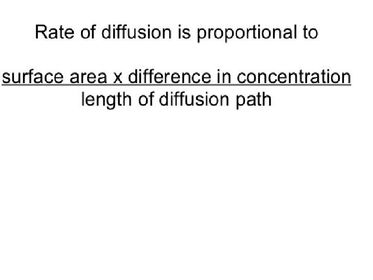
- 60What equation do we use to calculate diffusion?
- 61What is diffusion also affected by?The nature of plasma membrane (composition/number of pores) and the size and nature of the diffusing molecule (small molecules diffuse faster than large ones)
- 62Is facilitated diffusion passive or active?Passive
- 63Diffusion and facilitated diffusion occur ______ a concentration gradientDown
- 64However what does facilitated diffusion involve that normal diffusion doesn't?Carrier proteins
- 65What type of molecules do the carrier proteins allow to diffuse?Water soluble
- 66What is the definition of osmosis?THE PASSAGE OF WATER FROM A REGION OF HIGH WATER POTENTIAL TO A REGION OF LOW WATER POTENTIAL THROUGH A PARTIALLY PERMEABLE MEMBRANE
- 67What is a solute?Any substance that is dissolved in the solute
- 68What is a solution?The solute and the solvent together
- 69What is water potential measured in?kPa
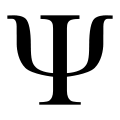
- 70What is the sign for water potential?
- 71What is the water potential of pure water?0
- 72What is an isotonic solution?A solution with the same water potential to the cell inside it
- 73When animal and plant cells are placed in an isotonic solution, what is the net movement of water?Neither enters or leaves the cell - there is no change
- 74What is a hypertonic solution?A solution with a lower water potential to that of the cell (high strength)
- 75What name is given to a solution with a higher water potential (low strength) to that of the cell?Hypotonic
- 76When a plant cell is placed in a hypertonic solution, what happens to it?Net movement of water out of the cell, cytoplasm shrinks from cell wall and cell plasmolyses
- 77What happens if a plant cell is placed in a hypotonic solution?Water enters the cell by osmosis and the cell swells and becomes turgid
- 78If an animal cell bursts when it is put into a solution, what must that solution be?Hypotonic
- 79Why is this?Water enters the cell so it swells and bursts
- 80What will happen to an animal cell if it is placed in a hypertonic solution?Water will leave the cell by osmosis and it will shrink
- 81What is the definition of active transport?THE MOVEMENT OF MOLECULES OR IONS INTO OR OUT OF A CELL FORM A REGION OF LOW CONCENTRATION TO A REGION OF HIGH CONCENTRATION, USING ENERGY AND CARRIER MOLECULES
- 82Does active transport differ from passive forms of transport such as facilitated diffusion?- Metabolic energy in the form of ATP is needed
- Materials move against a concentration gradient
- Process is v. selective
- Involves protein 'pumps' - 83In which two ways is ATP used in active transport?- Using it to directly move molecules
- By using a concentration gradient that has already been set up by direct active transport (co-transport) - 84In active transport, when molecules bind to carrier proteins on the outside of the cell, what attaches to the same protein on the inside of the cell?ATP
- 85What does this cause ATP to split into?ADP and a phosphate molecule
- 86What happens to the protein as a result of the phosphate molecule binding to the inside of the protein?It changes shape - opens to the opposite side of the membrane
- 87After the molecules or ions are released into the inside of the membrane, what happens to the phosphate molecule?It is released from the protein and combines with ADP to form ATP during respiration
- 88What does the protein then do?Revert to its original shape
- 89Give an example of an active transport system in which a molecule is being removed from a cell at the same time as one being moved in to the cellThe sodium-potassium pump
- 90Which molecules are actively moved where in the sodium-potassium pump?Sodium ions out, potassium ions in
- 91Glucose is absorbed in the wall of the small intestine. The walls of the small intestine are folded into finger like projections called _____Villi
- 92Give 4 reasons why the villi are well adapted for to absorption of molecules, such as glucose, by diffusion- They increase the s.a for diffusion
- They are thin to reduce the diffusion pathway
- Able to move and therefore maintain a conc. gradient
- Supplied with a rich network of blood capillaries to help maintain a diffusion gradient - 93What is situated on the epithelial lining of the villi?Microvilli
- 94What does this mean is increased further?The surface area
- 95In the sodium-potassium pump, which molecules are actively transported out of the epithelial cells (through a carrier molecule)?Sodium
- 96What does this mean about the concentration of sodium ions in the lumen of the intestine?It is high
- 97This means there is a ___________ _______ of the sodium ions between the lumen and the epithelial cells.Concentration gradient
- 98What does this mean sodium ions are able to do?Diffuse back in to epithelial cells
- 99What do the sodium ions bind with as they diffuse back into the cells, and through which molecules do they do so?They bind with glucose ions, and go through a co-transport protein
- 100What does the glucose then do?Move down its concentration gradient - it diffuses through the cell membrane and capillary walls and into the blood
- 101Why is the absorption of glucose molecules an indirect form of active transport?The sodium ion concentration gradient powers to movement of glucose molecules
- 102What is the name of the pathogen that causes cholera?Vibrio cholerae
- 103If vibro cholerae enters the digestive system, what are most of the bacteriums killed by?The HCl in the stomach
- 104However some may survive. When they reach the small intestine, what structure do they use to propel themselves through the mucus lining of the intestinal wall?Their flagella
- 105What does the bacterium release at this stage?A toxin
- 106What does this toxin cause to open?Ion channels
- 107What floods out of the epithelial cells as a result?Chloride ions
- 108What happens to the water potential of the lumen as a result?It is lowered (more negative)
- 109What does this make happen and by what process?Water floods out of the epithelial cells and into the lumen by osmosis
- 110This causes _________ and ___________Diarrhoea and dehydration
- 111How is cholera transmitted?Through the ingestion of water contaminated with the faecal material of infected individuals
- 112What is the name given to treatment for diarrhoea?Oral rehydration therapy
- 113What the the two reasons why just drinking water is ineffective in treating diarrhoea (/dehydration)?1. Water is not being absorbed by the intestine
2. Electrolytes (ions) are not being replaced - 114What 5 things are included in oral rehydration powder?Water - potassium - sodium - glucose - other electrolytes such as chloride and citrate ions
Informações
- Descrição
- A-Level AS AQA BIOLOGY FlashCards sobre CELLS AND THE MOVEMENT IN AND OUT OF THEM, criado por ashiana121 em 14-05-2015.
- Criado por
- ashiana121 · mai 2015
- Atualizado
- 19 fev 2016
- Visualizações
- 9
- Tags
- Avaliação