
Flashcards
The Firm: Objectives, Costs and Revenues
Flashcards do conjunto (35)
- 1Short Run Long RunThe period of time in which at least one factor of production is fixed
The period of time in which all factors of production are variable - 2Marginal ProductThe addition to total output by the extra unit of labour
- 3Variable factor of productionA factor of production that can be altered. E.g. Land/Labour
- 4Why may a firm experience diminishing returns in the short run?In the short run we assume one factor of production is fixed. (Capital)
If more workers are employed the marginal product results in an increase in output but at a less than proportional rate - 5Why may a firm experience increasing returns in the short run and returns to scale in the long runBecause in the long run the firm can temporarily overcome the problem of diminishing returns as it can vary its fixed costs. E.g. moving to a larger factory
- 6Increasing returns to scaleWhen an increase in factor inputs leads to a higher than proportionate increase in output
- 7Diminishing returnsWhere an increase of a variable factor leads to a less than proportionate increase in total output as each unit is added.
- 8Increasing marginal returnsWhere the addition of an extra variable factor adds more output than the previous variable factor.
- 9What is the difference between Increasing marginal returns and Increasing returns to scale?Increasing marginal returns is where the addition of one variable factor adds to more output compared to the previous added factor whereas increasing returns to scale is the addition factor inputs which leads to a greater than proportionate increase in output
- 10Why may a firm decide to choose to employ more capital rather than labour?Because Capital (Machinery) is a fixed cost, therefore it doesn't vary with changes in output as it can't be adjusted in the short term. However, labour is a variable cost because with short term changes in output more labour will be demanded.
- 11Fixed costs Variable costs Total costsCosts of production that do not vary as output changes. E.g. Rent
Costs of production that vary with output. E.g. Wages
Fixed costs + Variable costs = TC - 12—Where MC=AC is the optimal output. This is the point where the firm has achieved the lowest cost combination between FC and VC.
At this point the firm is productive efficient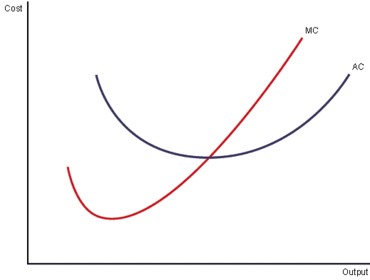
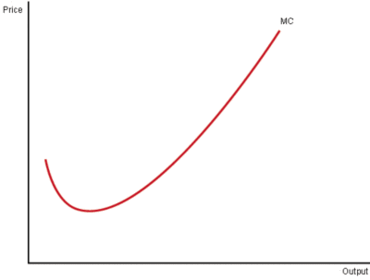
- 13Marginal CostsThe cost of the extra unit of output
- 14Why does the MC has the shape it does?At first MC decreases as production increases due to specialisation of labour. However, after a certain point diminishing returns starts to settle as output rises so it will cost more for every extra unit of output
- 15Why does the ATC shape the way it does?Because of the law of diminishing returns.
Economies of scales occurs when an increase in output leads to a fall in the ATC.
Diseconomies of scale occurs when an increase in output leads to a rise in the ATC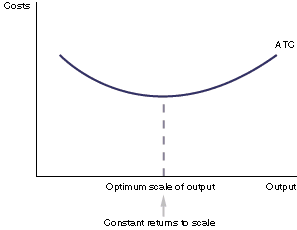
- 16Minimum Efficient ScaleThis is the lowest point on the LRATC. This is the output of long-run productive efficiency
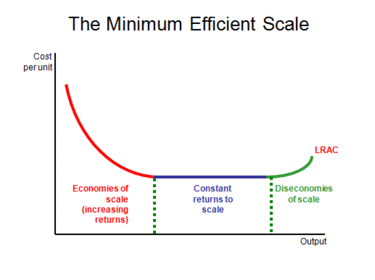
- 17What is the possible structure of an industry with a MES of production that occurs at low levels of output?The possible structure could be a monopolistic structure because it is more likely to exploit economies of scale.
A domestic firm with a small home market may need to export its goods to operate at the MES. - 18Economies of Scale Diseconomies of ScaleWhen unit cost falls as output increases
When a firm expands and leads to a rising unit cost - 19Internal Economies of scale Technical Economies of scaleFirms that can afford to invest in expensive and specialist capital machinery. E.g. A supermarket buying automated stock control technology
- 20Internal Economies of scale Specialisation of LabourLarger firms can split their jobs to different employees to boost productivity as they specialise in an specific job
- 21Internal Economies of scale Financial Economies of scaleLarge firms have greater access to financial resources. For example, a firm listed in the stock market can access fresh capital or loans/overdrafts at a lower interest rate in comparison to a smaller firm.
- 22External Economies of scale InfrastructureLocal authorities improving the transport links for the town/city where the firm is located.
- 23Diseconomies of scale CoordinationMonitoring employees can be difficult if the firm expands too quickly
- 24Diseconomies of scale CooperationIn large firms employees may feel like they are not part of the firm which therefore leads to a fall in productivity
- 25Invention InnovationComing up with a completely new idea or concept that can be patented
The putting of an invention into commercial use - 26How can the adoption of new technologies affect the industry to make it more competitive?The adoption of new technologies can help a firm/industry become more competitive because undertaking R&D often leads to more innovative goods which therefore could mean the firm can lower their unit costs. E.g. New machinery increasing supply
- 27Total Revenue Marginal Revenue Average RevenueSelling price x Units sold
The addition to total revenue from the production of one extra unit of output
Total revenue / Units sold - 28—
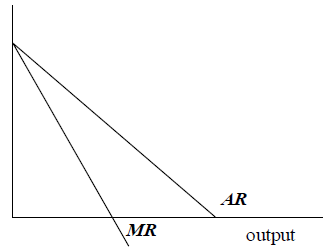
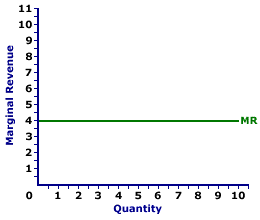
- 29Why does the MR curve slope more steeply than the AR curve?MR slopes more steeply than AR because both are constant with the difference that AR > MR with every extra unit of ouput produced.
- 30Sales Revenue Maximisation MR=0At price PQ revenue is maximised. This enables the firm to keep its position in the market by keeping competition away and gain market share as a result of the firms main interest NOT being profits.
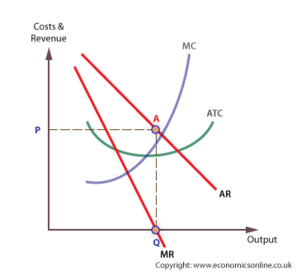
- 31Average Cost PricingAverage cost pricing acts as a disincentive for other firms to enter the market. At this point the firm does not make SNP
If government regulates the market the effect is the same
The aim is to be productive efficient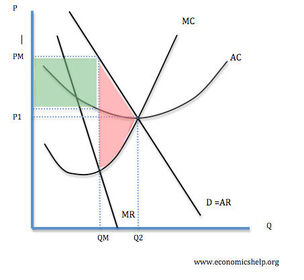
- 32Marginal Cost Pricing MC=ARThis is the point where the firm is allocative efficient. This is the optimum allocation of scarce resources that best accord with the consumers' pattern of demand.
Marginal cost pricing is setting the price at the level of MC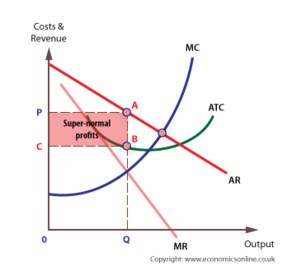
- 33Why is profit maximising where MC=MR?Because after MC and MR the marginal costs from producing an extra unit of output will be greater than the proportion of marginal revenue gained from it
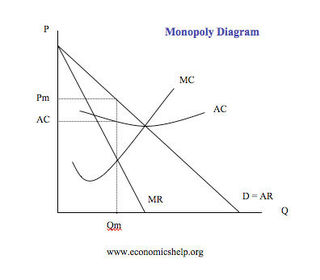
- 34Divorce of ownership and controlShareholders appoint directors to run the firm. Interest from stakeholders will always vary. Directors need to ensure that the firm is increasing in size but also make sure its profitable so that shareholders keep quiet (satisficing) and the firm removes the likelihood of a hostile bid.
- 35Satisficing Hostile BidThe firm is producing satisfactory but not maximum profit
A bid to buy shares in an attempt to gain control of the firm which is opposed by the firm's directors who fear job losses