
Flashcards
FLASHCARDS - Heterogeneous Catalysis

Flashcards do conjunto (36)
- 1Benefits of Heterogeneous Catalysts (3 P)- Easier recovery (filtration)
-- Easier to use in continuous (flow) reactors
- Easier to handle (eg. strong acids)
- Nearly all are porous: v. important property - 2Surface area formular = radius
n = no. of pores
l = length of cube - 3IUPAC definition... size for: 1) Micropores 2) Mesopores 3) Macropores1) <2.0 nm
2) 2 - 50 nm
3) >50 nm - 4Variable surface chemistry
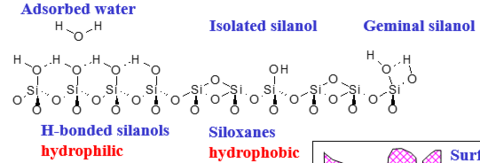
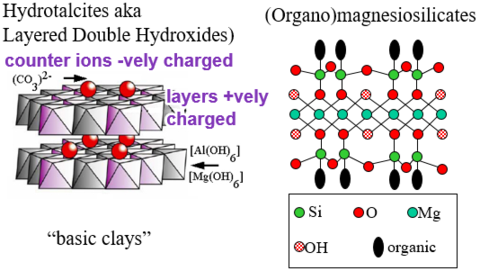
- 52D Materials: - Clays
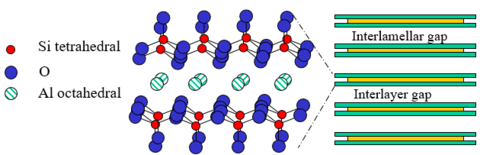
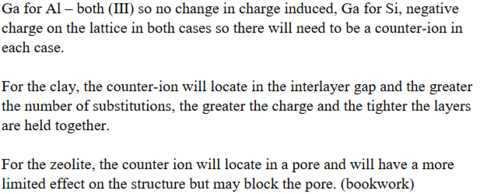
- 6Clays - neutral, no catalyst activity --> Isomorphous substitution: inserts charge into system: more active catalyst
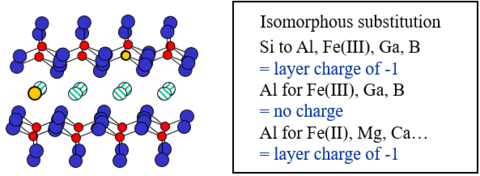
- 7Clays: - Effect of isomorphous substituion- Bronsted acid: Charge polarises OH
- No direct \(H^{+}\) exchange as it will dissolve the material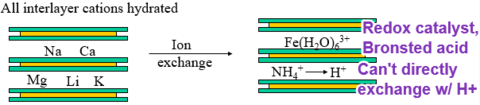
- 8Clays: - Effect of isomorphous substituion 2- Hydrated interlayer gaps reduce catalyst activity --> DRY
- BUT, drying makes interlayers come closer together, so slower catalysis --> COMPROMISE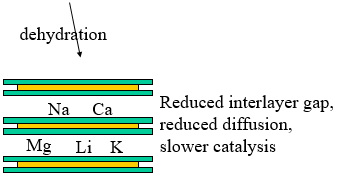
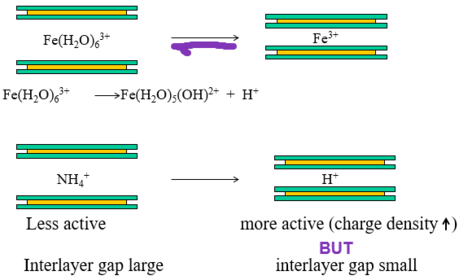
- 9Catalyst activation
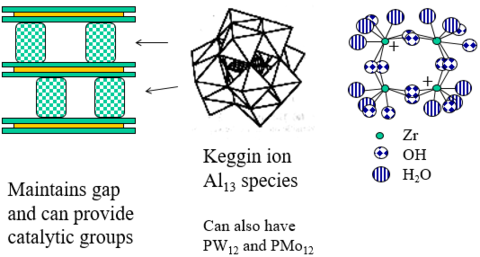
- 10Pillaring cations Layer collpase - problem especially w/ high charge density cationsReplace a (eg) \(Na^{+}\) w/ this: Gap maintained even when heated (dried)
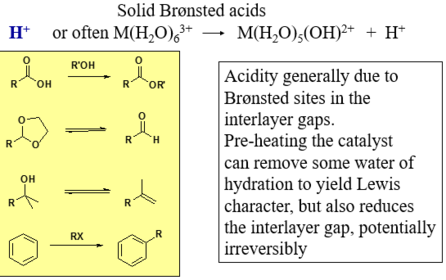
- 11Reactions of clays
- 12Other layered materials
- 133D Catalysts - Microporous systems
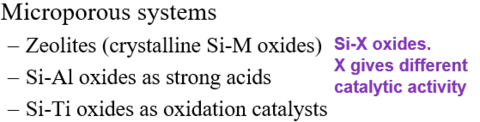
- 14Catalytic sites within zeolites

- 15Acidic Zeolites

- 16Pore size and diffusionAperture diameter used to define narrowest entry point
- Ring size defined by no. of O atoms present (= no. of Si + heteroatoms)
- Apreture dimensions between 0.4-0.75 nm - 17Pore size and diffusion 2: (3 P)- Molecular: pores >> molecule
- Knudsen: pores > molecule
- Configurational: pores \(\simeq\) molecule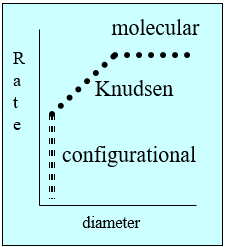
- 18Diffusion in porous materials depend on: (3 P)1) Pore diameter
2) Connectivity (move & connect between pores: more degrees of freedom --> better catalytic activity)
3) Tortuosity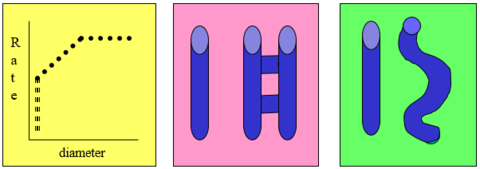
- 195 stages involved in a liquid phase reaction using a porous solid catalyst - NOTE: for gas phase reactions, thickness of hydrodynamic layer = 0, so 1) and 5) can be omitted1) Diffusion of reactants through hydrodynamic layer
2) Diffusion of reactants through pore system
3) Reaction
4) Diffusion of products through pore system
5) Diffusion of products through hydrodynamic layer
- For 1) & 2), parameters influencing the rate are: Thickness of hydrodynamic layer & pore size/geometry respectively - 205 stages involved in a liquid phase reaction using a porous solid catalyst 2 - Optimizing performance:- 1) & 5) --> Heating: viscosity drops, rate increases.
Stirring: hydrodynamic layer decreases, rate increases
- 3) If high \(E_a\) --> heating increases rate
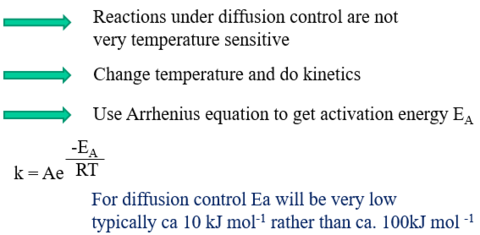
- Low \(E_a\) suggests process is diffusion controlled
- To distinguish between each: If RDS is 1), 5), 2) & 4), stirring will increase rate for 1) and 5), NOT for 2) and 4)
NOTE: Increasing temperature does NOT increase rate of 2) and 4) - 21Test for diffusion control- Diffusion dependent on pore size & pore size is not temperature dependent.
- 22How is pore size measured (2 P):- X-ray diffractions (work for crystalline systems)
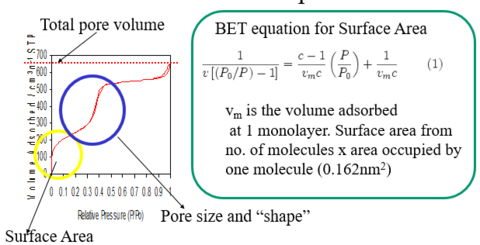
- Porosimetry: Gives pore size of porous solids. Adsrobtion of gas (eg N2) onto a solid over a range of partial pressures at the b.p of the gas
Stage 1: low partial pressure - monolayer of gas on surface (surface area calc.)
Stage 2: higher partial pressure - pores fill with liquid N2 to stabilise the meniscus (pore size calc.) - 23How is pore size measured - Porosimetry
- 24Measuring acidity of zeolites- Desorption of ammonia: Higher temp of desorp. higher the acidity
- Acidic strength \(\propto\) 1/Al content
- Concentration of sites \(\propto\) Al content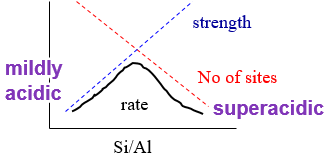
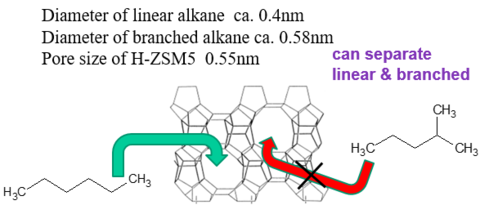
- 25Shape selectivity - Key property of zeolites (eg H-ZSM5)Selectivity based on shape/size rather than electronic properties

- 26Reactant selectivity
- 27Other uses of zeolitesAS a host for catalytic species (reactants can enter the supercage)
- 28Titanium silicates (TS-1): Oxidation catalyst
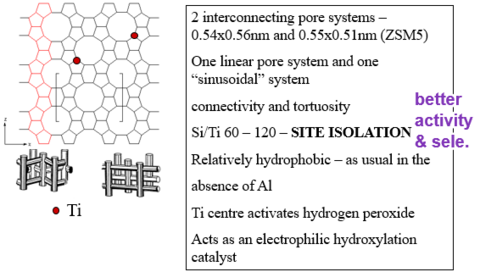
- 29Titanium silicates (TS-1): Oxidation catalyst 2
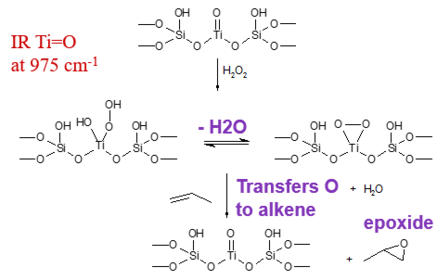
- 30Titanium silicates (TS-1) w/ 2 Ti: Oxidation catalyst
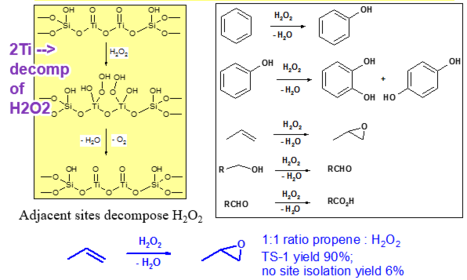
- 31Mesoporous systems - Larger templates give unstable materials. Solution...Micelle Templated Silicas (MTS)
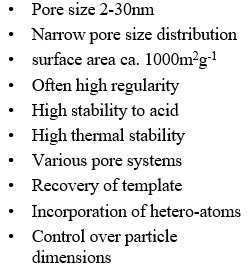
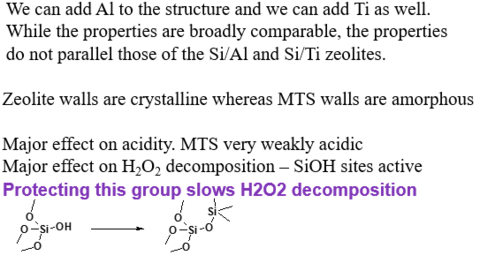
- 32Addition of Heteroatoms to MTS
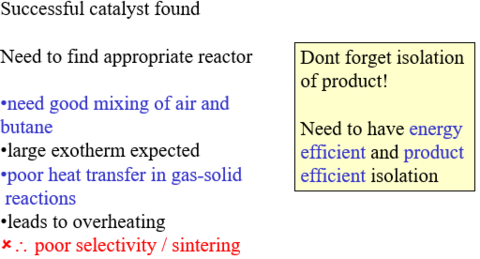
- 33ALMA industrial process Catalyst = \((VO)_2P_2O_7\)
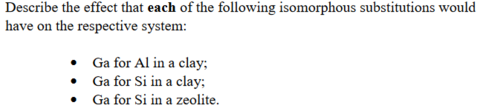
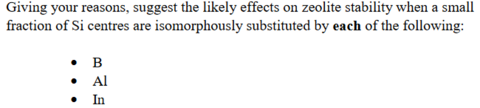
- 34What is meant by isomorphous substitution in context of porous solids

- 35—
- 36—

Informações
- Descrição
- FLASHCARDS - Heterogeneous Catalysis
- Criado por
- Sulivan González
- Visualizações
- 27
- Tags
- Avaliação