
Flashcards
Industrial relations: frameworks and practices w12
Flashcards do conjunto (24)
- 1Industrial relations system:An industrial relations (IR) system refers to the rules, regulations and institutions that govern the employment relationship and that set the terms and conditions of work and employment
- 2Industrial relations and SHRM• The relationship between industrial relations and HRM is often uneasy and contested.
• Differing perspectives.
• Responsiveness to a dynamic environment.
• Understanding of the regulatory environment. - 3The workplace relations framework in Australia• Describes ‘the arrangements by which the terms and conditions of work and the employment relationship are determined’ (from p. 98 of the textbook).
- 4The legislation – a brief history• Commonwealth Court of Conciliation and Arbitration established in 1904.
• Industrial tribunals established for each of the states.
• In 1996, the Workplace Relations Act 1996 was introduced.
• Between 1996 and 2006, the conservative federal government worked towards a unified, national IR system.
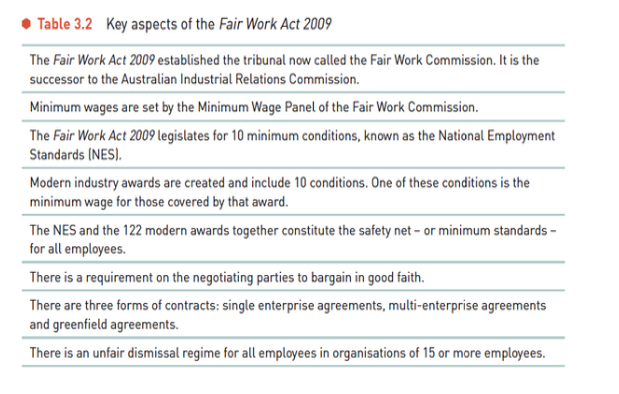
• In 2009, the Fair Work Act 2009 was introduced. - 5Key aspects of The Fair Work Act 2009
- 6The national employment standards (NES)• Maximum hours of work
• Requests for flexible working arrangements • Parental leave
• Annual leave
• Personal/carer’s leave
• Community service leave
• Long service leave
• Public holiday work
• Notice of termination and redundancy pay
• A Fair Work Information Statement - 7Union‘A union is an organisation, consisting predominantly of employees, the principal activities of which include the negotiation of rates of pay and conditions of employment for its members.’
- 8Union density contains the following patterns:– a higher proportion in the public sector than in the
private sector
– higher rates of unionisation among full-time than
among part-time workers
– an equalising of unionisation levels for men and
women. - 9Industrial association• The term ‘industrial association’ describes the organisations that may represent either employees or employers.
- 10Freedom of associationrefers to the rights of employees to:
–belong or not to belong to a union
–be represented or not be represented by a union
–participate or not participate in lawful industrial activities. - 11Employers and employer associations• In the past, employer associations represented employers in multi-employer bargaining and before industrial tribunals.
• The emphasis of enterprise bargaining is on single employer bargaining.
• Different approaches illustrate the variety of industrial relations and HRM models that currently exist within Australia. - 12collective bargaininginvolves the ‘agreement by employers and unions on the general terms under which employees would consent to work’ (see p. 109 of the textbook).
- 13Enterprise bargainingis a particular Australian variant of collective bargaining, and was formally introduced in 1991.
- 14Enterprise bargainingrefers to bargaining that occurs at the workplace level, and with the concerns of the enterprise in mind
- 15Good faith bargaining– does not require parties to make concessions or to
conclude or reach agreement
– does require the parties to enter and participate in the bargaining process in a meaningful way – that is,
in a way that suggests they are genuinely trying to reach agreement. - 16The low-paid bargaining stream• For employees in industries who have had little access to collective bargaining, and whose weak bargaining position precluded them from sharing in the benefits of increased productivity.
- 17Industrial action• Overall trends show that industrial conflict in the form of overt industrial action is declining and that lost time due to industrial conflict, including strikes, is reducing globally.
• During the year ended March 2015, there were 199 disputes, five fewer than the year ended March 2014. Over the same period, there were 82 200 working days lost, 7% fewer than in the year ended March 2014 (88 600) (see p. 112 of the textbook). - 18Modern awards• Modern awards reduced and simplified previous awards.
• The modern award conditions with the 10 NES form the safety net of working conditions for all employees in the national system.
• Enterprise agreements operate in addition to the above, but must not undercut the minimum conditions.
• Enterprise agreements must meet the Better Off Overall Test (BOOT). - 19Enterprise agreements• Enterprise agreements must have a nominal expiry date, and their maximum term is four years.
• Agreements cover matters relevant to the particular enterprise, such as:
–rates of pay
–employment conditions
–consultative mechanisms
–dispute resolution procedures
–deductions from wages for any purpose authorised by an employee. - 20Unfair dismissal• The fair dismissal system sets out the steps that an employer should go through before dismissing an employee.
• An unfair dismissal occurs ‘if the person has been dismissed; the dismissal is deemed to be harsh, unjust or unreasonable; the dismissal was not consistent with the small business code; the dismissal was not a case of genuine redundancy’ (s 385, Fair Work Act 2009). - 21The Fair Work Act 2009: Implications• Macro-regulatory context:
–10 minimum standards of employment
–Fair Work Commission is the main institution
–most private sector employees come under the one
national system.
• Micro-environment:
–the rights of employees as individuals
–shifting the balance of power in the employment
relationship. - 22Relations with unions• Where unions are already representing employees, or where there is a request for representation from employees, unions have rights of access
• ‘most Australian workplaces either involve well established management-union relationships, or (more commonly) a complete absence of any union presence. The new bargaining rules, while important, are unlikely to have a dramatic impact in those workplaces’ (Professor Andrew Stuart, quoted on p. 121 of the textbook). - 23Relations with employees• The Fair Work Act 2009 recognises employees as individuals and as members of collectives, or unions.
• Employees have the right to request changes.
• Reasons for refusal must be in writing and provided to the employee within 21 days of the request. - 24Bullying in the workplace• Bullying occurs where one or more people engage in repeated and unreasonable behaviour towards a worker (or a group of workers of which the worker is a member) which also creates a risk to health and safety.
• Someone who reasonably believes they have been bullied at work can apply to the FWC for an order to stop the bullying.
• The FWC can make a wide range of orders (except money orders) to stop the bullying continuing or reoccurring.