
Flashcards
AQA Chemistry Unit 3
Flashcards do conjunto (46)
- 1What is the periodic table?-An arrangement of elements according to proton number, electrons in outer shells (groups) and number of electron shells (periods)
-Called a periodic table because similar properties occurred at regular intervals - 2Newlands Periodic Table-Arranged elements according to their atomic weights
-Came up with his law of octaves that every 8th element was similar to the one before it
-However, it had issues as the pattern soon broke down
-If strict order of atomic was followed, some lements were put in the wrong group - 3Mendeleev's Periodic table-Overcame some of the problems that NEwlands faced by leaving gaps for what he thought were undiscovered elements
-Very accurate - 4Modern periodic tableWHen protons and neutrons were discovered in the early 20th century, elements were arranged according to atomic numbers and so placed in appropriate groups
- 5Properties of Group one-Alkali Metals
-Metals with low density (first 3 are less dense than water)
-React with non-metals to form ionic compounds where the metal ion has a 1+ charge. The compounds are white and dissolve to make a colourless solution
-React with water, releasing hydrogen
-Form hydroxides that dissolve in water to give alkaline solutions
-The further down the group you go the more reactive the element and the lower it's melting point
-React vigourusly with oxygen and water - 6Properties of transition metals-Have higher melting points than group one
-Higher densities
-Stronger and harder
-Much less reactive so don't react as vigorously with oxygen and water
-Have ions with different charges
-Form coloured compounds
-Are useful catalysts - 7Properties of group 7-Halogens
-React with metals to form ionic compounds where the halide ion has a -1 charge
-A more reactive halogen can displace a less reactive halogen from an aqueous solution of its salt
-The further down the group the less reactive it is and the higher it's melting and boiling point
-This is because there are more shielding electron shells between the positive nucleus and the lectron it's trying to attract - 8Interaction of water with soap-Soft water readily forms a lather
-Hard water reacts with soap to form scum, so more soap is needed for a lather
-Soapless detergents do not form scum - 9What are the two types of hard water?-Temporary hard water becomes soft when boiled
-Permanent hard water remains hard when boiled - 10How can you soften temporary hard water?-Temporary hard water contains Hydrocarbonate ions (HCO3-)
-These ions thermally decompose when heated to produce carbonate ions
-React with Calcium and Magnesium ions to form calcium carbonate and/or magnesium carbonate as a precipitate called scale - 11What are the negative aspects of using hard water?-Can increase costs because more soap is needed
-When temporary hard water is heated it produces scale which reduces the efficiency of heating systems or kettles - 12What are the benefits of hard water?-Good for your bones and teeth
-Helps reduce the risk of heart disease - 13How can hard water be softened?-Adding sodium carbonate, which reacts with Mg and Ca ions to form the precipitates calcium carbonate and/or magnesium carbonate
-Using commercial softeners like ion exchange columns containing hydrogen or sodium ions which replace the magnesium and/or calcium ions when the water passes through the column - 14Why is water quality important?-Water quality is essential for life
-For humans, drinking water should have sufficiently low levels of dissolved salts and microbes - 15How do we ensure water quality?-Choose an appropriate source
-Filter the water to remove any solids
-Steralise it with chlorine to remove microbes - 16What do water filters contain?-Carbon
-Silver
-Ion exchange resins
-Can remove some dissolved substances from tap water to improve taste and quality - 17What chemicals are added to drinking water? Why?-Chlorine may be added to reduce microbes
-Fluorine may be added to improve dental health, however some people object saying it causes tooth mottling and takes away personal choice - 18How can pure water be produced?-By distillation
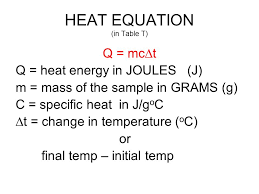
-However, this requires a lot of energy and is so expensive - 19What is calorimetry?-The relative amounts of energy released when substances burn can be measured by simple calorimetry
-E.g. heating water in a glass or metal container
-To improve method, insulate the container and add a lid
-Can be used to compare the amount of energy released by food and fuel - 20Equation for calculating amount of energy released from a fuel
- 21How can you measure the amount of energy released or absorbed in a chemical reaction?-Can be calculated from the measured temperature change of the solution where the reagents are mixed in an insulated container
-Can be used for reactions of solids with water or neutralistation reactions - 22What can simple energy level diagrams be used for?To show relative energies of reactants and products, the activation energy and the overall energy change of a reaction
- 23Labelled energy level diagram
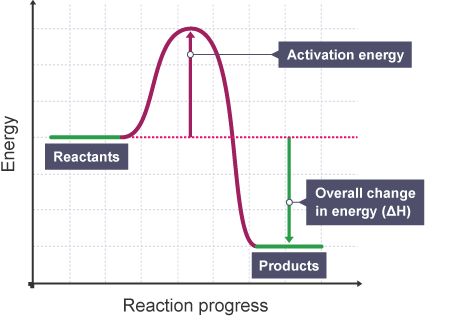
- 24Energy supply and release in chemical reactions-Energy needs to be supplied to break bonds
-Energy is released when bonds are formed
-In an exothermic reaction, energy released form new bonds is greater than energy needed to break bonds
-In an endothermic reaction, energy needed to break bonds is gretaer than energy released when bonds are formed - 25How do catalysts work?Provide an alternate pathway for a chemical reaction with a lower activation energy
- 26Using hydrogen in car engines-Hydrogen can be burned as a fuel in a combustion engine
-Hydrogen + Oxygen -> Water
-Hydrogen can also be used in fuel cells that provide electricity to power vehicles
-Hydrogen combustion is less expensive but still produces some nitrate oxideS (Air is only 20% oxygen)
-Fuel cells are much more efficient but also cost a lot more - 27Flame test coloursLithium - crimson
Sodium - yellow
Potassium - lilac
Calcium - red
Barium - green - 28Sodium hydroxide solution test-Aluminium, calcium and magnesium ions form white precipitates
-Only aluminium hydroxide precipitate dissolves in excess sodium hydroxide
-Copper(II) forms a blue precipitate
-Iron(II) forms a green precipitate
-Iron(III) forms a brown precipitate - 29Testing for carbonates-Carbonates react with any dilute acid to form carbon dioxide
-Carbon dioxide forms a white precipitate with limewater which turns limewater cloudy - 30Testing for Halide Ions-Halide ions in a solution react with silver nitrate and dilute nitric acid to form a precipitate
-Silver chloride is white
-Silver bromide is cream
-Silver iodide is yellow - 31Testing for Sulfate Ions-Sulfate ions in a solution produce a white precipitate with barium chloride and dilute hydrochloric acid
- 32Titrations of acids and alkalis-Volumes of acids and alkali that react with each other can be tested in a titration with a suitable indicator
-If the concentration of one reactant is known, the results of the titration can be used to find the concentration of the other reactant
-Concentrations are in moles per dm3
-Masses are in grams per dm3 - 33What are the raw materials for the Haber process and where are they obtained from?-Nitrogen from the air
-Hydrogen from natural gas or other sources - 34The Haber process-Purified gases passed over an iron catalyst
-Temperature of 450 C
-Pressure of 200 atmospheres
-Some of the hydrogen and nitrogen react to make ammonia
-Reaction is reversible so ammonia breaks down into hydrogen and nitrogen as well
-On cooling ammonia is liquefied and removed (lower boiling point)
-Hydrogen and nitrogen are recycled - 35Equilibrium in a reversible reaction-Equilibrium is reached in a reversible reaction when reactions occur at exactly the same rate in each direction
-The relative amounts of reacting substances at equilibrium depends on the conditions - 36Effect of temperature on equilibrium-If the temperature is raised, yield from the endothermic reaction increases as the equilibrium shifts
-Converse for exothermic reaction - 37Effect of pressure on EquilibriumIn Gaseous reactions, increase in pressure will favour the reaction that has the least number of molecules, so that yield decreases
- 38Deciding conditions of the Haber process-The point of equilibrium is important, but reaction rate and economics must also be taken into consideration, it's a compromise
-Low temperature good for ammonia, but rate of reaction too slow so 450 C compromise
-High pressure good for ammonia but over 200 atmosphere's becomes too expensive - 39Alcohols-Have a functional group of -OH
-Methanol, Ethanol and Propanol are the first 3 of a homologous series of alcohols - 40Structure of AlcoholsCH3CH2OH
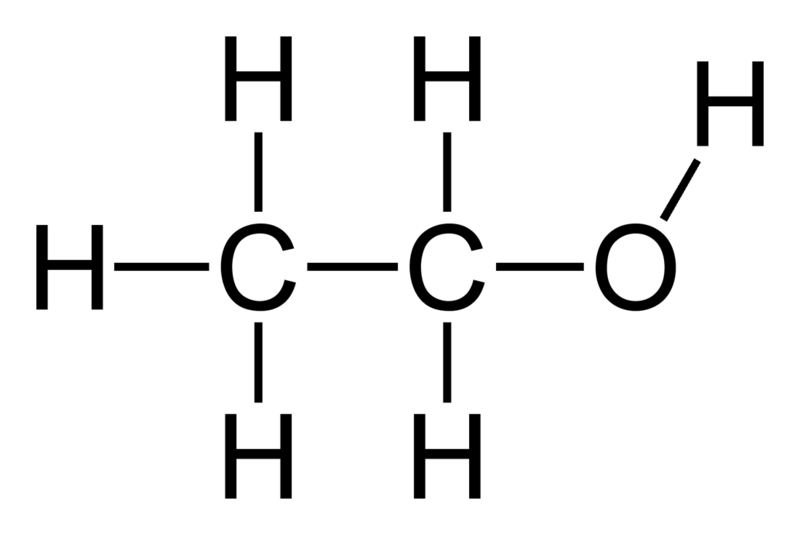
- 41Methanol, Ethanol and Propanol properties-Dissolve in water to form a neutral solution
-React with sodium to produce hydrogen
-Burn in air
-Are used as fuels and solvents
-Ethanol is the main alcohol in alcoholic drinks - 42How to make ethanoic acid-Ethanol can be oxidised to ethanoic acid, either through a chemical oxidising agent or microbial action
-Vinegar is an aqueous solution where the main acid is ethanoic acid - 43Carboxylic Acids-Have the functional group -COOH
-First 3 are methanoic acid, ethanoic acid and propanoic acid - 44Carboxylic acid structureCH3COOH
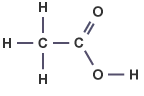
- 45Carboxylic Acids Properties-Dissolve in water to produce acidic solutions
-React with carbonates to produce carbon dioxide
-React with alcohols in the presence of an acid catalyst to produce esters
-Do not ionise completely when dissolved in water and so are weak acids
-Aqueous solutions of weak acids have a higher PH value than aqueous solutions of strong acids with the same concentration - 46Esters-Ethyl Ethanoate is the ester produced from ethanol and ethanoic acid
-Have the functional group -COO-
-Are volatile compounds with distinctive smells
-Are used as flavourings and perfumes
Informações
- Descrição
- Taken from the specification, so should be all you need o know for AQA Chemistry GCSE unit 3. Good luck =)
- Criado por
- Natalia Cliff
- Visualizações
- 45
- Tags
- Avaliação